Time in target holds until the diabetic line, then collapses, across 1,169 members
Across 1,169 members with both an HbA1c and CGM, time in the healthy glucose range barely moved from a normal to a prediabetic HbA1c, then collapsed at the diabetic line, from 65 to 27 percent.
Continuous glucose monitors and the HbA1c blood test mostly agree on average blood sugar, yet they part ways at the edges of the range in ways that matter clinically. A 985-window study in 315 adults found that the average glucose inferred from HbA1c carries a mean absolute error of 12 mg/dL against the value a continuous glucose monitor (CGM) measures directly, with gaps above 40 mg/dL persisting in roughly 5 percent of windows and tracking the same person across windows, which points to red-cell turnover rather than measurement noise (Tozzo et al., 2024). A 2025 panel of 18 CGM specialists reading 20 non-diabetic CGM reports reached a Fleiss kappa of 0.36, a statistic where 1 is perfect agreement and 0 is chance, so even experts barely concurred on glucose that looks elevated next to a normal HbA1c (Spartano et al., 2025). A 661-patient analysis showed the disagreement carries prognostic weight: each 0.20-unit rise in the ratio of CGM-derived to measured HbA1c came with 38 percent lower odds of retinopathy and 39 percent lower odds of diabetic kidney disease (Bovee et al., 2025). What none of this settles is the shape of the CGM picture across the HbA1c bands at consumer-wearable scale.
We took 1,169 Ultrahuman members who had both an HbA1c on a Blood Vision panel between August 2025 and April 2026 and at least seven valid days of glucose readings from the CGM within 90 days of that draw. Each member’s CGM metrics are the day-weighted average across that window, in the three standard HbA1c bands.
Time in target barely moves below the prediabetic line, then collapses above the diabetic one, while average glucose rises in a clean gradient. Average time in target fell from 74.7 percent at a normal HbA1c to 65.2 percent at a prediabetic HbA1c to 26.7 percent at a diabetic HbA1c: a 10 percentage-point step at the prediabetic boundary, a 38 percentage-point drop at the diabetic one. Average glucose rose 92.9, 101.6, 147.6 mg/dL across the bands; glucose variability rose modestly, 13.8, 15.6, 19.7 percent, below the 36 percent high-variability threshold even in the diabetic band.
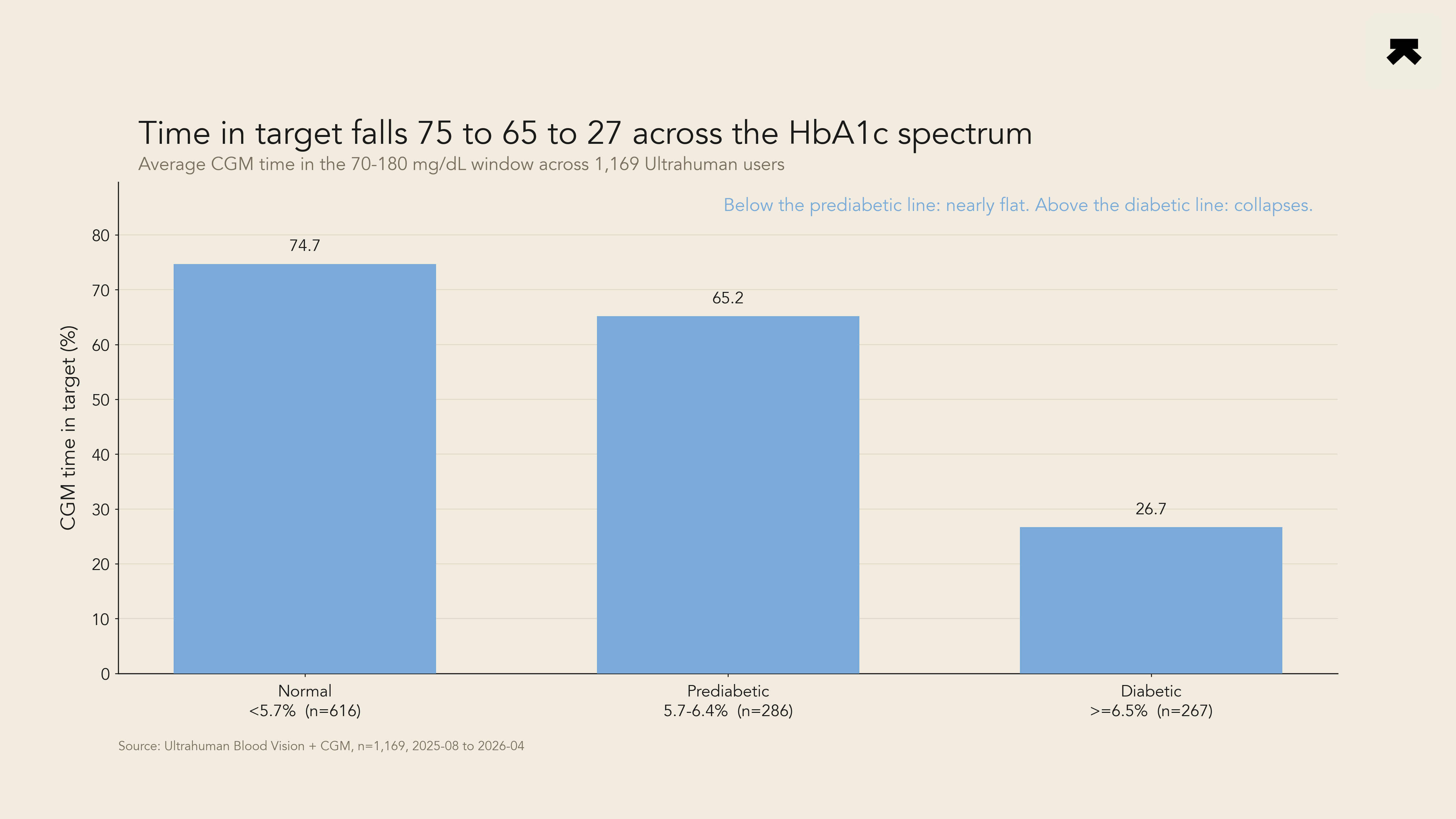
Figure 1. Mean per-member CGM time in target (share of readings between 70 and 180 mg/dL) by HbA1c band, across 1,169 Ultrahuman members with both an HbA1c on Blood Vision and at least seven valid CGM days within 90 days of the draw. Normal HbA1c below 5.7 percent (n = 616); prediabetic 5.7 to 6.4 percent (n = 286); diabetic at or above 6.5 percent (n = 267). The drop is about 10 percentage points across the prediabetic boundary and 38 across the diabetic one.
Of the three CGM numbers, time in target answers the diabetic boundary; average glucose tracks HbA1c most cleanly; variability moves least. The HbA1c-versus-CGM gap flips sign across the bands, agreeing most cleanly in the prediabetic middle and diverging at both ends, the same structured discordance the cited literature describes, in a cohort an order of magnitude larger. This cohort self-selects for metabolic concern, with 47 percent above the normal HbA1c threshold, so read the band averages as within-cohort signals, not general-population prevalence. The gradient is age-stable: the 35-to-49 band traces the same 74, 64, 27 percent steps.
A normal HbA1c is a useful number, not a complete one. The members losing the most healthy-range time are the ones the single blood test already flags as diabetic, where time in target collapses from 65 to 27 percent at the diabetic boundary while average glucose climbs in a smooth gradient.
More bytes
Keep exploring
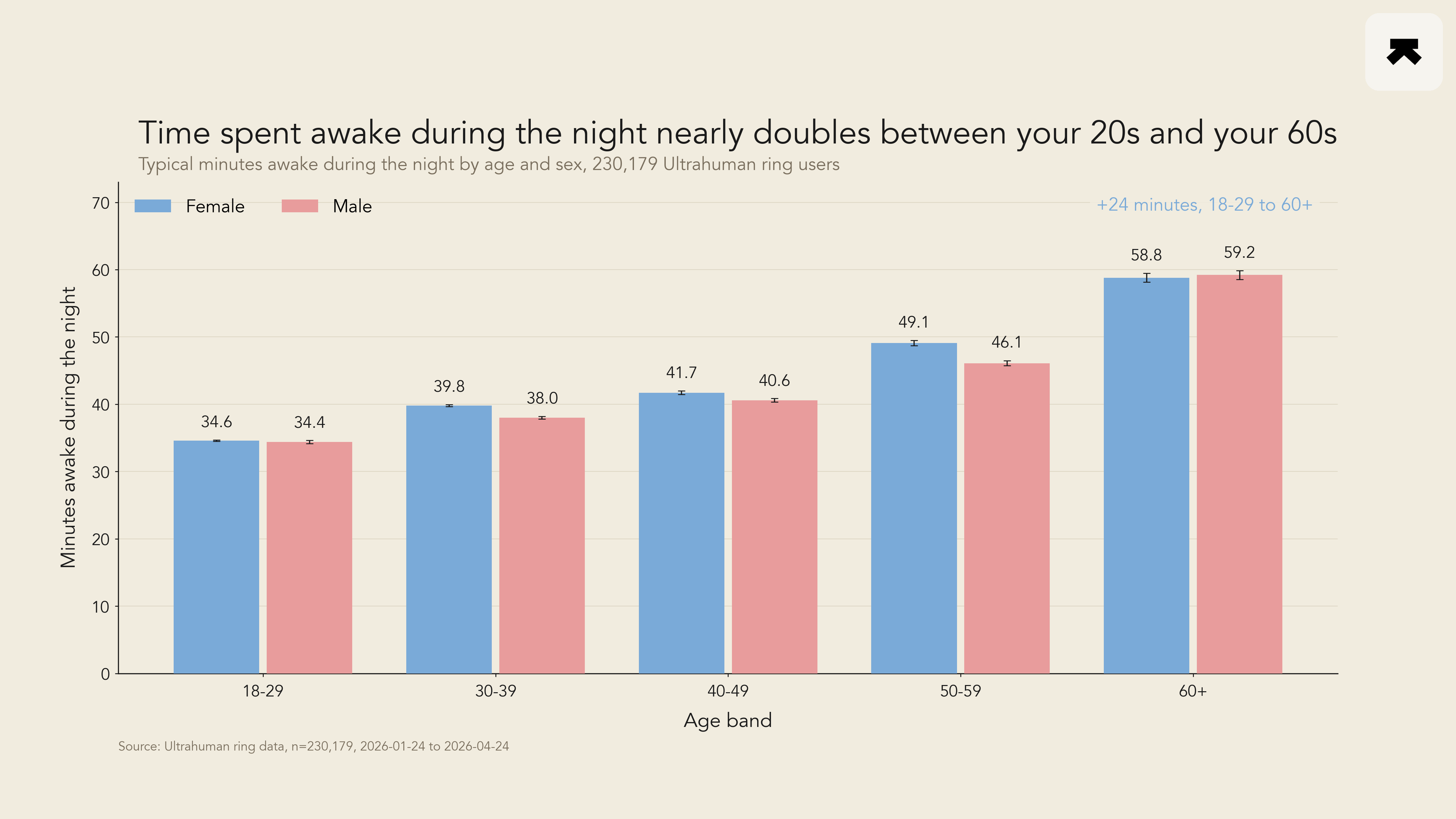
Across 230,179 Ring members, the dominant age change in sleep is more time awake at night, not less deep sleep
A faster resting pulse than age- and sex-matched peers carries a nightly recovery cost across 229,963 Ring members