A faster resting pulse than age- and sex-matched peers carries a nightly recovery cost across 229,963 Ring members
Across 229,963 Ring members, overnight resting heart rate forms clear age-and-sex peer groups, and within each one a higher pulse tracks lower heart-rate variability and recovery.
Resting heart rate carries one of the cleanest population-mortality signals in cardiology. A 16-year follow-up of 2,798 men in the Copenhagen Male Study, measured by resting electrocardiogram (ECG), found that every 10 bpm higher resting heart rate carried a 16 percent higher all-cause mortality risk (95 percent confidence interval, the plausible range for the true value, 10 to 22 percent), surviving adjustment for fitness, activity, and smoking (Jensen et al., 2013). A dose-response meta-analysis of 87 prospective cohort studies put the per-10-bpm relative risk at 1.15 for cardiovascular disease, 1.14 for total cancer, and 1.17 for all-cause mortality, rising linearly from roughly 60 bpm upward (Aune et al., 2017). What neither reaches is the within-person translation: what does that 10-bpm mortality ladder look like at the level of one member’s nightly state?
We took every Ultrahuman Ring member aged 18 to 90 with a recorded sex and at least 21 valid overnight resting-heart-rate nights across a 90-day window in early 2026, split them into ten decade-by-sex groups, and within each group ranked members into fifths by their median overnight rate, lowest to highest.
A higher rank within a peer group tracks worse recovery markers, in the same direction in every one of ten groups. The highest-rank fifth runs 16 to 28 ms lower in overnight heart-rate variability (HRV) and 5 to 9 points lower on the Ring’s Dynamic Recovery score than the lowest-rank fifth, across a peer-group spread of about 20 bpm.
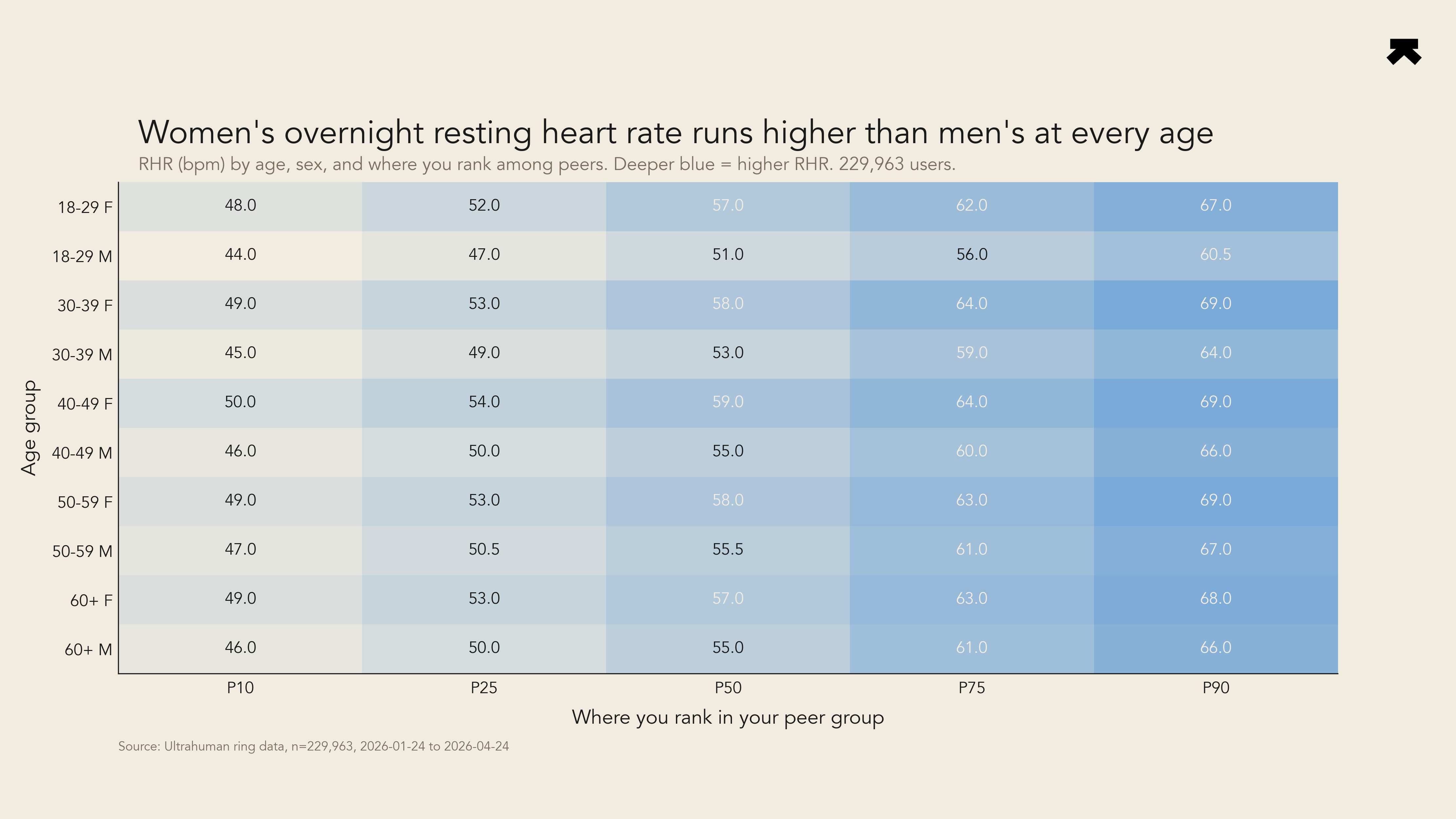
Figure 1. Overnight resting heart rate (bpm) by decade and sex across 229,963 Ultrahuman Ring members, with peer-group rank (P10 to P90) on the column axis.
The percentile bands are the first read. A typical 30-year-old woman runs 58 bpm overnight and a typical man 53, a 5 to 6 bpm sex gap that holds at every decade and reflects smaller chamber size and stroke volume, not a health difference. Median rate rises about 2 bpm into the forties and then plateaus, consistent with a healthier-than-average member base at older ages. Two healthy 30-year-old women can sit at 49 and 69 bpm and both fall inside the central 80 percent of their peers, so the useful question is where a reading lands within its band (Figure 1).
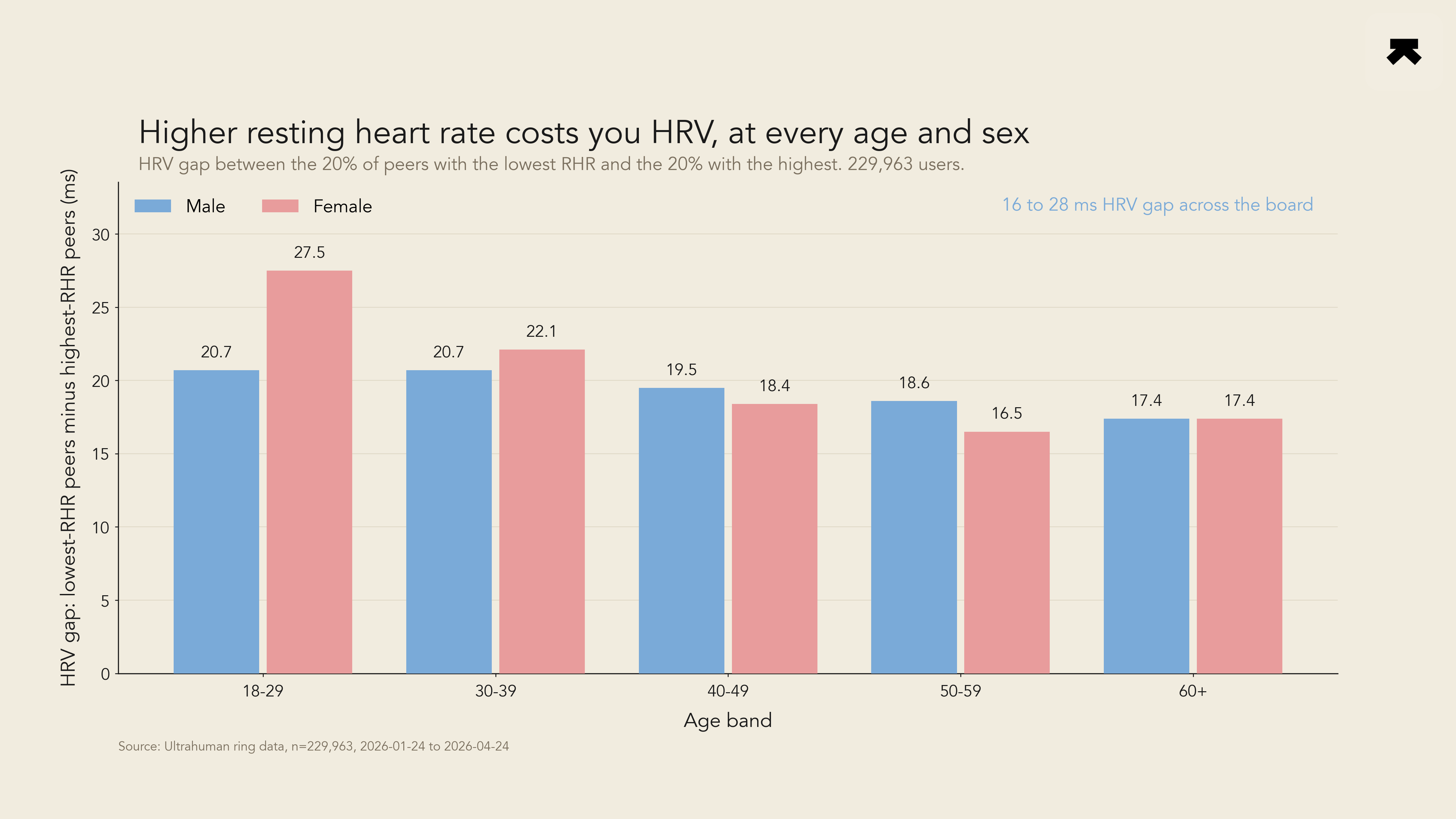
Figure 2. Within-peer-group HRV gap (lowest-rank fifth minus highest-rank fifth, ms) by age band and sex, same cohort as Figure 1. The gap holds in every decade-by-sex group, with magnitudes between 16 and 28 ms across an approximately 20 bpm resting-heart-rate difference.
Inside each band, overnight HRV ran 16 to 28 ms lower in the highest-rank fifth than the lowest. Scaled to the literature’s unit, that is roughly 8 to 14 ms of HRV and 3 to 4 recovery points per 10 bpm, with age and sex held constant (Figure 2). The cohort is observational and the framing associational; subclinical illness can raise the pulse and lower HRV without one driving the other, and aerobic fitness, the strongest known correlate of resting heart rate (Kodama et al., 2009), is not measured here.
Members whose resting pulse runs high for their age and sex tend to run lower in overnight heart-rate variability and recovery, in the same direction across every peer group. Part of that gap is mechanical, since heart rate and HRV move together, and the recovery reading is not independent because the Ring’s Dynamic Recovery score already factors in resting heart rate. Read it as a consistent peer-group gradient seen across a cohort two orders of magnitude larger than the prospective studies, not as a mortality cost charged to any one night.
More bytes
Keep exploring
Across 230,179 Ring members, the dominant age change in sleep is more time awake at night, not less deep sleep
Time in target holds until the diabetic line, then collapses, across 1,169 members