Across 230,179 Ring members, the dominant age change in sleep is more time awake at night, not less deep sleep
Across 230,179 Ring members, the dominant age change in sleep is more time awake at night, about 70 percent more by the 60s, not less deep sleep, which slips only a few points.
The classical description of how sleep changes across adult life rests on a meta-analysis of 65 polysomnography studies (in-lab recordings that score each sleep stage directly) pooling 3,577 healthy people aged 5 to 102. Across adulthood it found slow-wave (deep) sleep and REM percentage both fall while sleep latency and wake after sleep onset (WASO, the minutes spent awake once sleep has begun) both rise; after 60 the wake-time rise keeps accelerating while the deep-sleep decline flattens (Ohayon et al., 2004). A later cross-frequency-coupling analysis gave that fragmentation a cognitive stake: the timing of slow-wave oscillations against sleep spindles in non-REM sleep underpins overnight memory consolidation, medial-frontal atrophy in older adults disperses that coupling, and the resulting deficit predicts overnight forgetting (Helfrich et al., 2017). Neither study reached those age curves at cohort scale on a consumer wearable.
We built them from 230,179 long-term Ultrahuman Ring members aged 18 to 90, each with at least 21 valid main-sleep nights in the 90-day window ending 24 April 2026 and with sex recorded, then split them into ten decade-by-sex cells (the smallest, women aged 60 and over, still held 5,034 members) and took each member’s median deep-sleep percentage, REM percentage, and overnight wake minutes. Three curves run in parallel, and the wake-time curve is the loud one, roughly five to seven times the deep-sleep decline in standardised units.
Overnight wake minutes rise far faster than any stage change. They climb from about 35 minutes in the 18-29 band to roughly 59 minutes at 60+ in both sexes, an increase of about 24 minutes, or roughly 70 percent. The rise is steepest after 50, with the jump into the 60s the largest single decade step. Deep sleep falls more gently, by roughly 3 percentage points across adult life in both sexes; REM falls by about 3 to 4 percentage points.
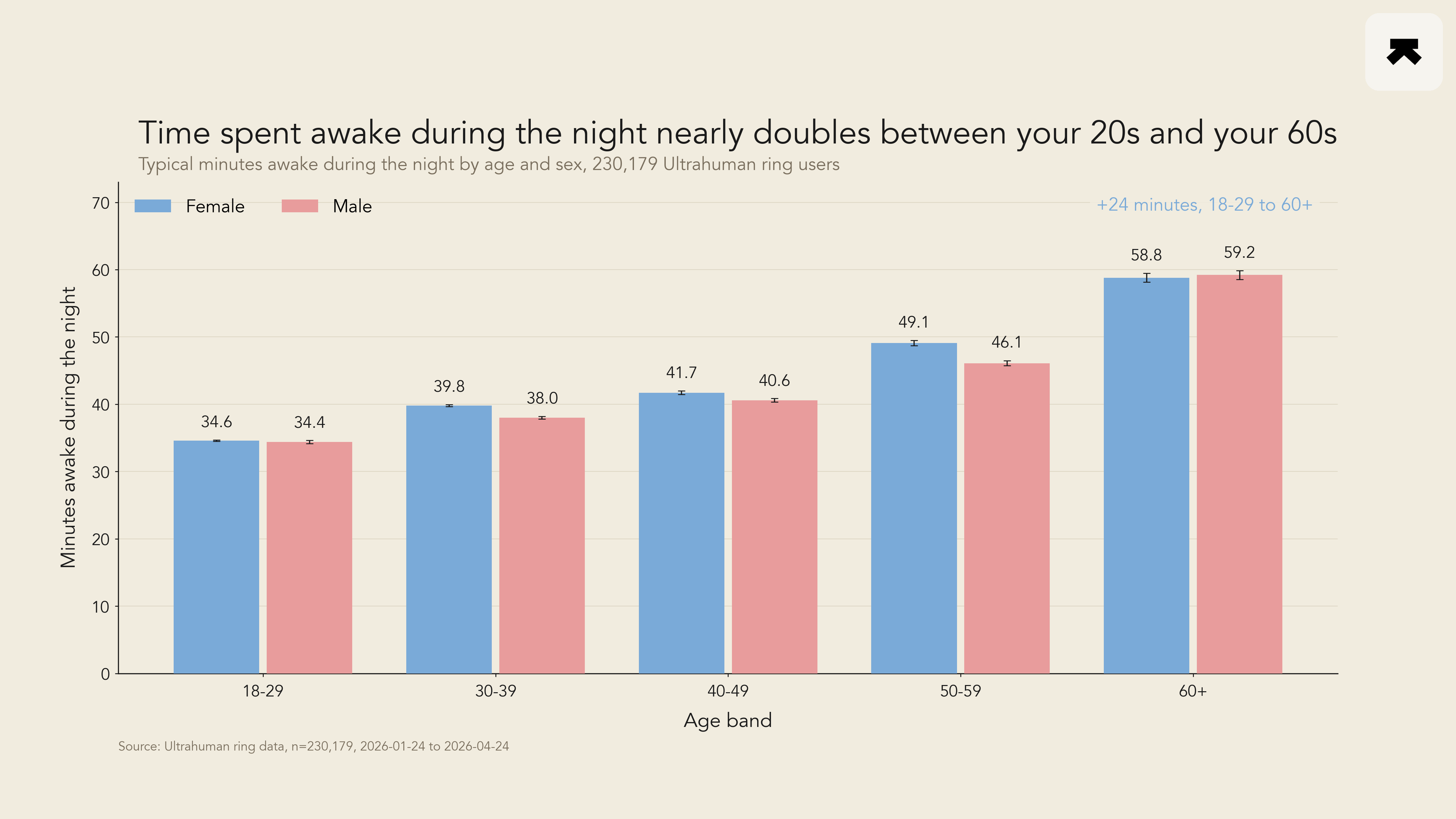
Figure 1. Mean per-member awake time during the night (minutes) by age band and sex, in 230,179 Ultrahuman Ring members with at least 21 valid main-sleep nights in the 90-day window ending 24 April 2026. Error bars are 95 percent normal-approximation confidence intervals.
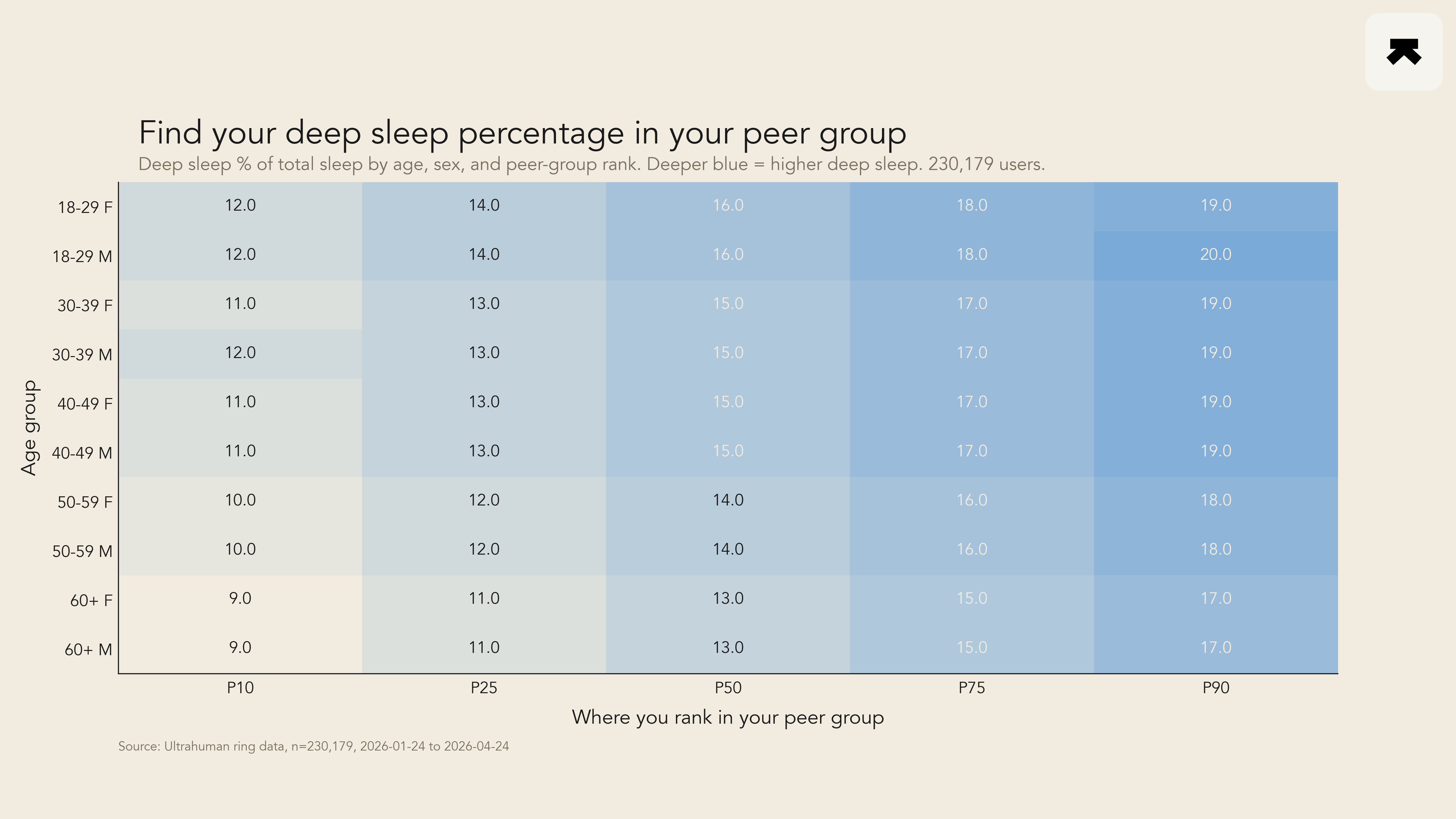
Figure 2. Deep-sleep percentage of total sleep by decade and sex (rows) versus peer-group rank (columns) across the same cohort as Figure 1. The decade-to-decade slope is about 3 percentage points across the adult lifespan; within-peer-group spread is about 7 to 8 percentage points wide between the 10th and 90th percentiles.
The steepest wake-time rise lands after 50, with the 50-59 to 60+ gap larger than any earlier decade step; in women that inflection overlaps the menopausal transition, where vasomotor symptoms drive overnight fragmentation, though this cross-sectional design cannot separate that from ageing alone. Within any decade-by-sex cell the deep-sleep spread runs about 7 to 8 percentage points wide between the 10th and 90th percentiles, comparable to the whole cross-decade slope, so a member’s peer median is only half the read and their rank in the band the other half. The comparison is across cohorts at different ages rather than one member over time, and the healthy-wearer selection in long-tenure wearable cohorts plausibly makes these slopes an underestimate of the true age effect. Cell-mean confidence intervals run ±0.10 to ±0.67 min, well under the age-band steps.
By their 60s, Ring members spend about 70 percent longer awake during the night than members in their 20s, while deep and REM sleep slip only a few points. Fragmentation, not deep-sleep loss, is the age signal the Ring sees most clearly, and the one the memory-consolidation literature ties most directly to cognition.
More bytes
Keep exploring
Time in target holds until the diabetic line, then collapses, across 1,169 members
A faster resting pulse than age- and sex-matched peers carries a nightly recovery cost across 229,963 Ring members