Bedroom air pollution at night is geographic: India crosses the WHO ceiling about ten times as often as the US
Bedroom air at night is mostly a geography story: across 275,083 nights from the Ultrahuman Home, Indian bedrooms crossed the WHO 24-hour fine-particulate ceiling about ten times as often as US bedrooms.
The 2021 update to the WHO Global Air Quality Guidelines cut the ceiling for fine particulate matter (PM2.5, airborne particles under 2.5 micrometres that lodge deep in the lung) from 10 μg/m³ to 5 μg/m³ for annual-mean exposure, and to 15 μg/m³ for the 24-hour mean, on pooled cohort evidence that cardiovascular and respiratory mortality rose with no observable safe-exposure floor. Why a bedroom reading should govern that exposure is the older question. A landmark exposure-assessment study built on the National Human Activity Pattern Survey, a nationally representative diary of where Americans spend their time, found the average American spends about 87 percent of waking hours indoors, so indoor microenvironments dominate total particulate dose even when the outdoor air reads dirtier per cubic metre (Klepeis, 1999). What that work could not reach was how often real bedrooms cross the ceiling at consumer-monitor resolution. This analysis answers that at field scale.
The Ultrahuman Home is a bedside device that logs nightly bedroom PM2.5, formaldehyde, noise, carbon dioxide, temperature and humidity. The cohort is every member who ran an active Home on at least one night between January 2024 and April 2026, contributing 275,083 bedroom-nights. Member-level rates use only members with at least fourteen valid PM2.5 nights, and country rates are reported only where a country had enough members to give a stable figure, with smaller countries pooled into a rest-of-cohort group.
Against the WHO 24-hour ceiling (15 μg/m³), the median member’s bedroom crossed on about 9 percent of nights (interquartile range 1 to 47 percent). The spread is wide: 17 percent of members never crossed it, while 23 percent crossed it on at least half their own nights and 10 percent on 90 percent or more. The cohort-wide rate is modest; the action sits in where members live.
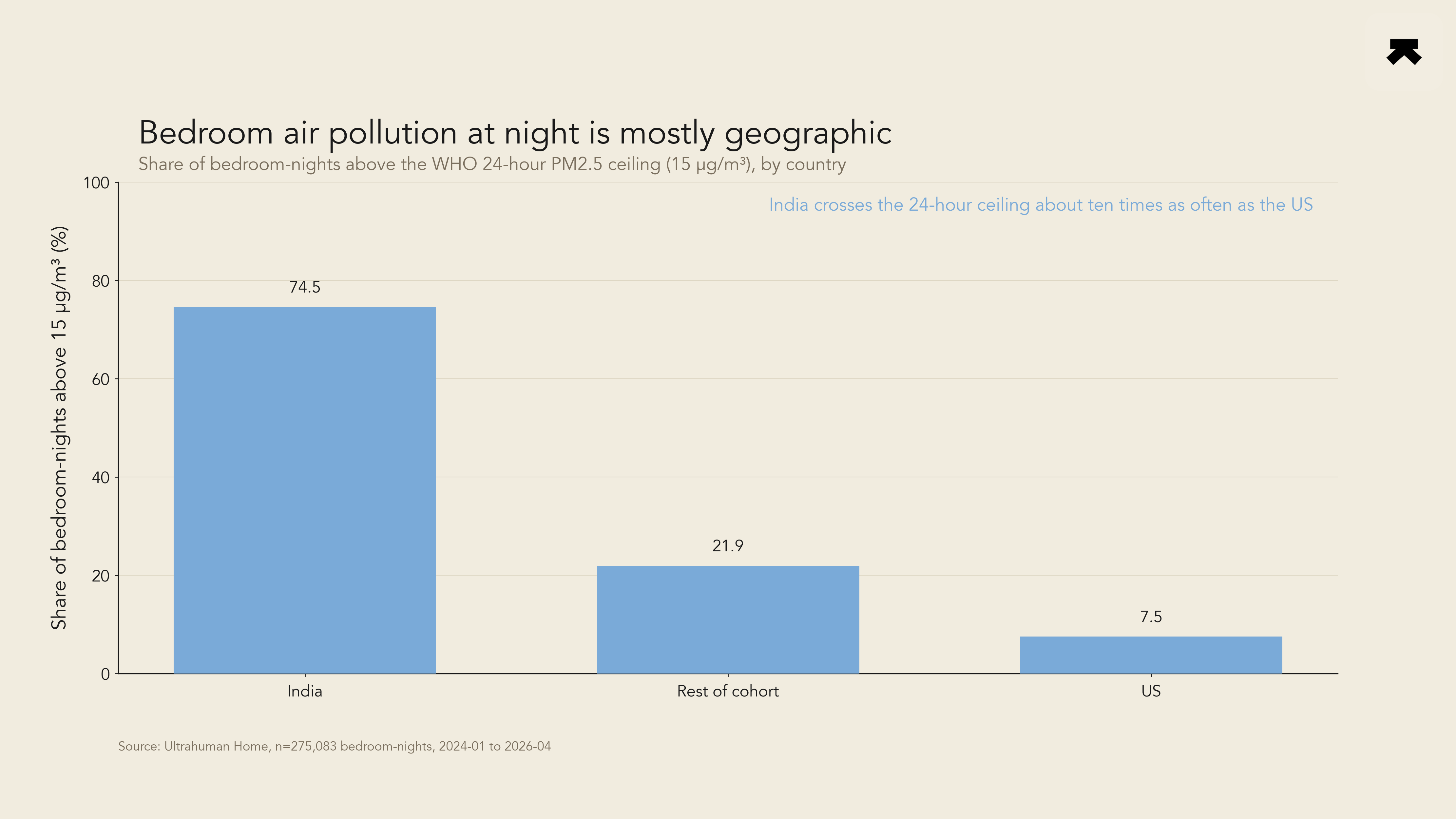
Figure 1. Share of bedroom-nights with PM2.5 above the WHO 24-hour ceiling (15 μg/m³) by country, across 275,083 bedroom-nights from January 2024 to April 2026. Indian bedrooms crossed on 74.5 percent of nights, the pooled rest of the cohort on 21.9 percent, and US bedrooms on 7.5 percent, a roughly tenfold India-to-US gap from the same device against the same line.
The country split is the spread. Against the WHO 24-hour ceiling, Indian bedrooms crossed on 74.5 percent of nights, the pooled rest of the cohort on 21.9 percent, and US bedrooms on 7.5 percent, a roughly tenfold India-to-US gap. The same device and the same thresholds produce an order-of-magnitude difference, tracking the documented gap in outdoor PM2.5 between Indian and US cities, which is the residential-scale signature of Klepeis’s point that outdoor air feeds indoor air (Klepeis, 1999). PM2.5 was the most-crossed of six axes: bedroom noise above the WHO 40 dB night limit on 30.5 percent of nights, formaldehyde above 0.08 mg/m³ on 24.2 percent, temperature above 75 °F on 33.6 percent, and daily-average carbon dioxide above the ASHRAE 1,000 ppm threshold on 9.9 percent, rising to 13.9 percent at a 1,500 ppm peak. The design reads the bedrooms of members who chose to monitor, and the daily average folds daytime cooking and candle spikes in with overnight air, so the numbers describe exposure prevalence in an engaged cohort rather than a population health estimate. One device caveat weighs on the country gap: low-cost optical particulate sensors can over-read in humid air, so part of the India-to-US difference may reflect humidity as well as particulate load until the Home’s humidity compensation is confirmed.
Against the WHO 24-hour ceiling, bedroom air pollution at night is mostly a geography story. Most members rarely cross it, but where a member lives sets the rate far more than how clean the room looks, with Indian bedrooms running close to ten times the US crossing rate. Indoor air inherits its outdoor baseline, and that baseline is not equal across the world.
- Klepeis NE. An introduction to the indirect exposure assessment approach: modeling human exposure using microenvironmental measurements and the recent National Human Activity Pattern Survey. Environmental Health Perspectives, 1999. PMID: 10350522.
More bytes
Keep exploring
Across 230,179 Ring members, the dominant age change in sleep is more time awake at night, not less deep sleep
Time in target holds until the diabetic line, then collapses, across 1,169 members