Glucose time-in-range tracks overnight heart rate and variability across 1,437 Ring members
Across 1,437 members wearing both a Ring and a CGM, more time in the healthy glucose range tracked a quieter overnight heart signal: about 2.9 bpm and 2.3 ms in the metabolically-healthy subset, wider once poorly-controlled members are included.
Continuous glucose monitoring has reframed what a single blood draw can miss. Hall and colleagues showed in normoglycemic adults that classification by fasting glucose and HbA1c overlooks a substantial share of time spent in prediabetic glucose ranges, with individual patterns varying widely between people whose static labs looked identical (Hall et al., 2018). Berry and colleagues established in PREDICT 1 that postprandial glucose responses to identical meals are highly person-specific (Berry et al., 2020). Building on that line, a Nature Communications analysis this year pooled 3,634 metabolically healthy adults across the PREDICT 1, 2 and 3 cohorts and found that CGM time-in-range, the share of readings between 70 and 180 mg/dL, discriminated predicted 10-year cardiovascular risk at an area-under-the-curve of 0.75 (0.5 is chance, 1.0 perfect) and tracked with lower HbA1c and positively with diet quality and sleep (Bermingham et al., 2026). That study named a question it could not reach: whether time-in-range also leaves an autonomic signal a consumer wearable can read overnight.
The cohort answers it directly. Eligible members had at least 14 valid Ring nights and at least 10 valid CGM days in the 120 days ending 22 April 2026, were aged 18 to 75 with sex recorded, and were sorted into four equal groups by their own average time-in-range. Overnight resting heart rate and heart-rate variability came from their Ring sleep summaries in the Ultrahuman app.
The lowest and highest time-in-range quartiles separate cleanly on both overnight heart metrics, and the separation tracks how high glucose runs. Within the metabolically-healthy subset (mean glucose below 117 mg/dL), the lowest-versus-highest gap is 2.9 bpm in overnight resting heart rate and 2.3 ms in heart-rate variability. Across the full cohort the gap widens to 8.2 bpm and 7.6 ms, but that wider figure is pulled by the lowest quartile’s 148 mg/dL average, which sits in clinically poor-control territory: overnight resting heart rate fell from 63.7 bpm there to 55.5 bpm in the highest quartile (95% CIs 62.8 to 64.6 against 54.7 to 56.2), and variability rose from 36.7 ms to 44.3 ms (35.6 to 37.8 against 43.0 to 45.6). Mean glucose across the four quartiles ran 148, 96, 91 and 88 mg/dL.
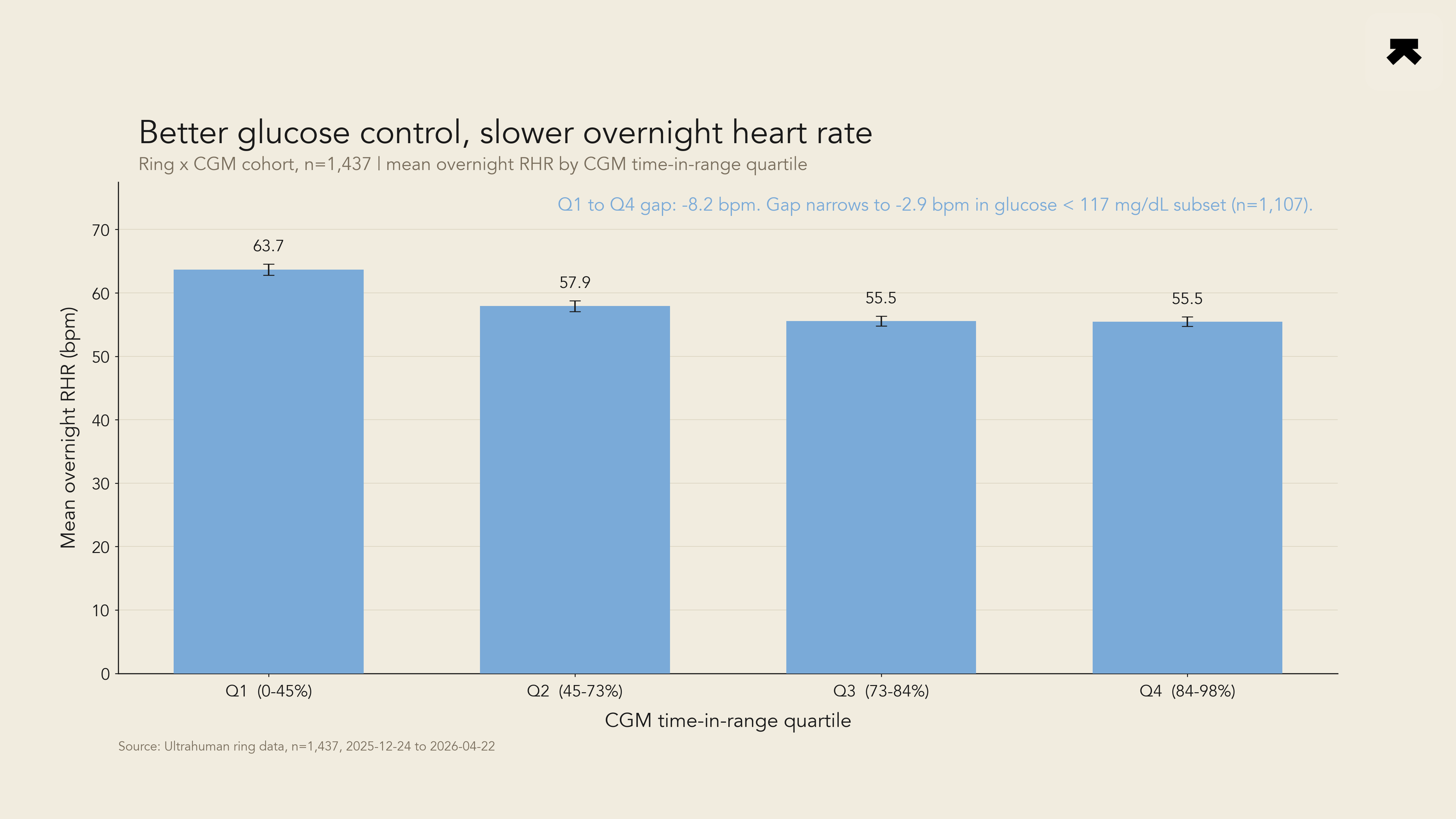
Figure 1. Mean overnight resting heart rate by within-cohort CGM time-in-range quartile across 1,437 Ultrahuman members wearing both a Ring and a CGM over a 120-day window. Quartile cut-points 0 to 45, 45 to 73, 73 to 84 and 84 to 98 percent; error bars are 95% confidence intervals.
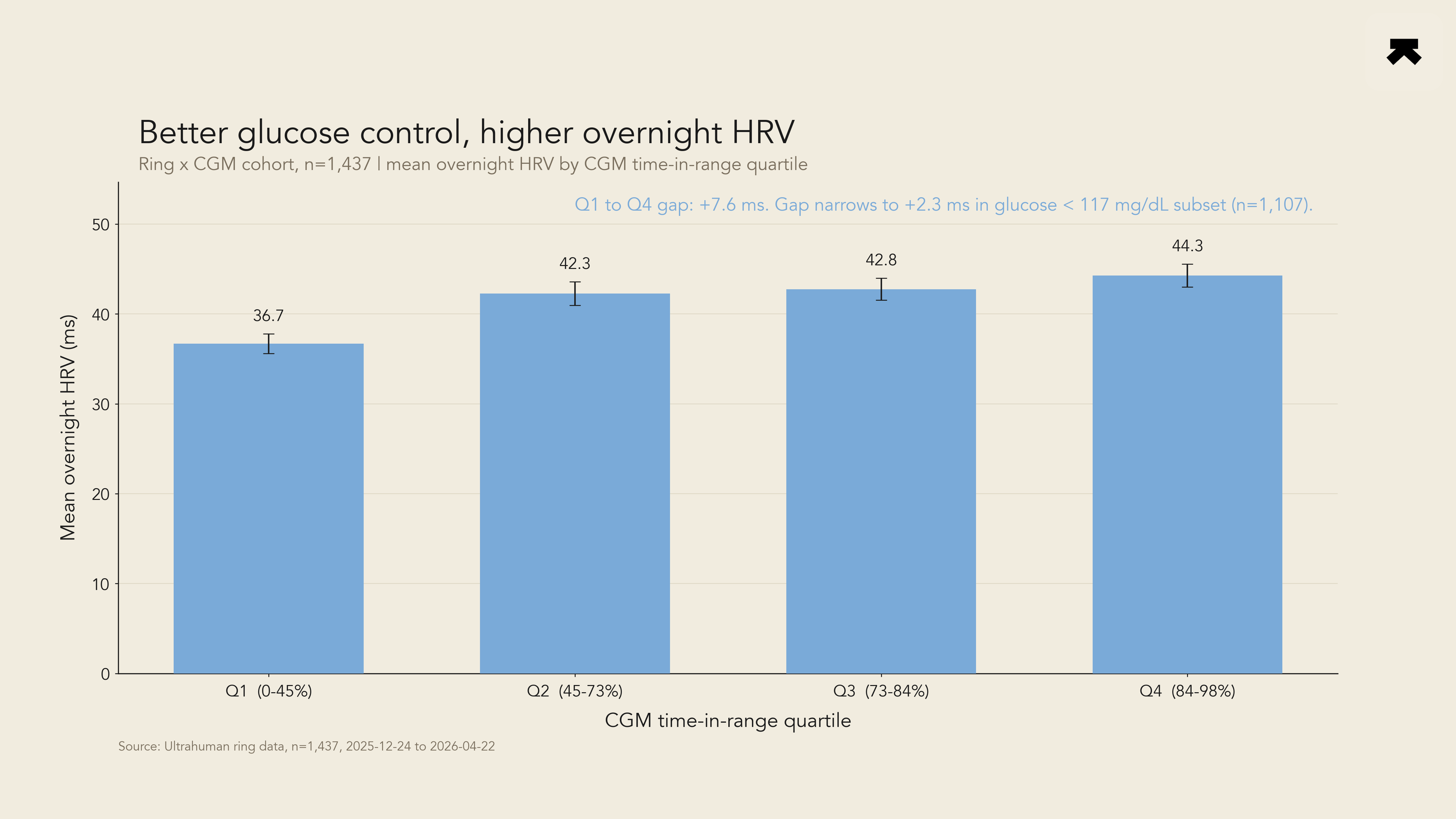
Figure 2. Mean overnight heart-rate variability by within-cohort CGM time-in-range quartile, same cohort and window as Figure 1; the lowest-to-highest gap of 7.6 ms attenuates to 2.3 ms in the subset with mean glucose below 117 mg/dL.
These effect sizes are large: Cohen’s d, a standardised gap where 0.2 is small, 0.5 medium and 0.8 large, reaches 1.04 on resting heart rate and 0.66 on variability. The full-cohort gap blends two stories. The lowest quartile averaged 148 mg/dL, clinically poor-control territory, while the highest averaged 88 mg/dL. Restricting to the 1,107 members whose mean glucose sat below 117 mg/dL, the upper edge of non-prediabetic territory, isolates the metabolically-healthy comparison: the resting-heart-rate gap holds at 2.9 bpm and the variability gap at 2.3 ms, same direction, smaller size. Sorting members by glucose coefficient of variation instead returned flat heart-rate variability and resting heart rate across those quartiles: the level of glucose carries the wearable signal, the swings around it do not. The association reads as correlation rather than cause: members with lower time-in-range also tend to carry more adiposity and lower cardiorespiratory fitness, both of which independently raise overnight resting heart rate and lower variability, and this analysis does not adjust for them. A thicker female cohort will sharpen the within-sex gradients downstream of this contrast.
Members who hold more of their day inside the healthy glucose range run a quieter cardiovascular signal overnight, lower resting heart rate and higher heart-rate variability, as measured by two independent sensors. The Ring reads the autonomic side of metabolic control a single fasting blood draw cannot see.
More bytes
Keep exploring
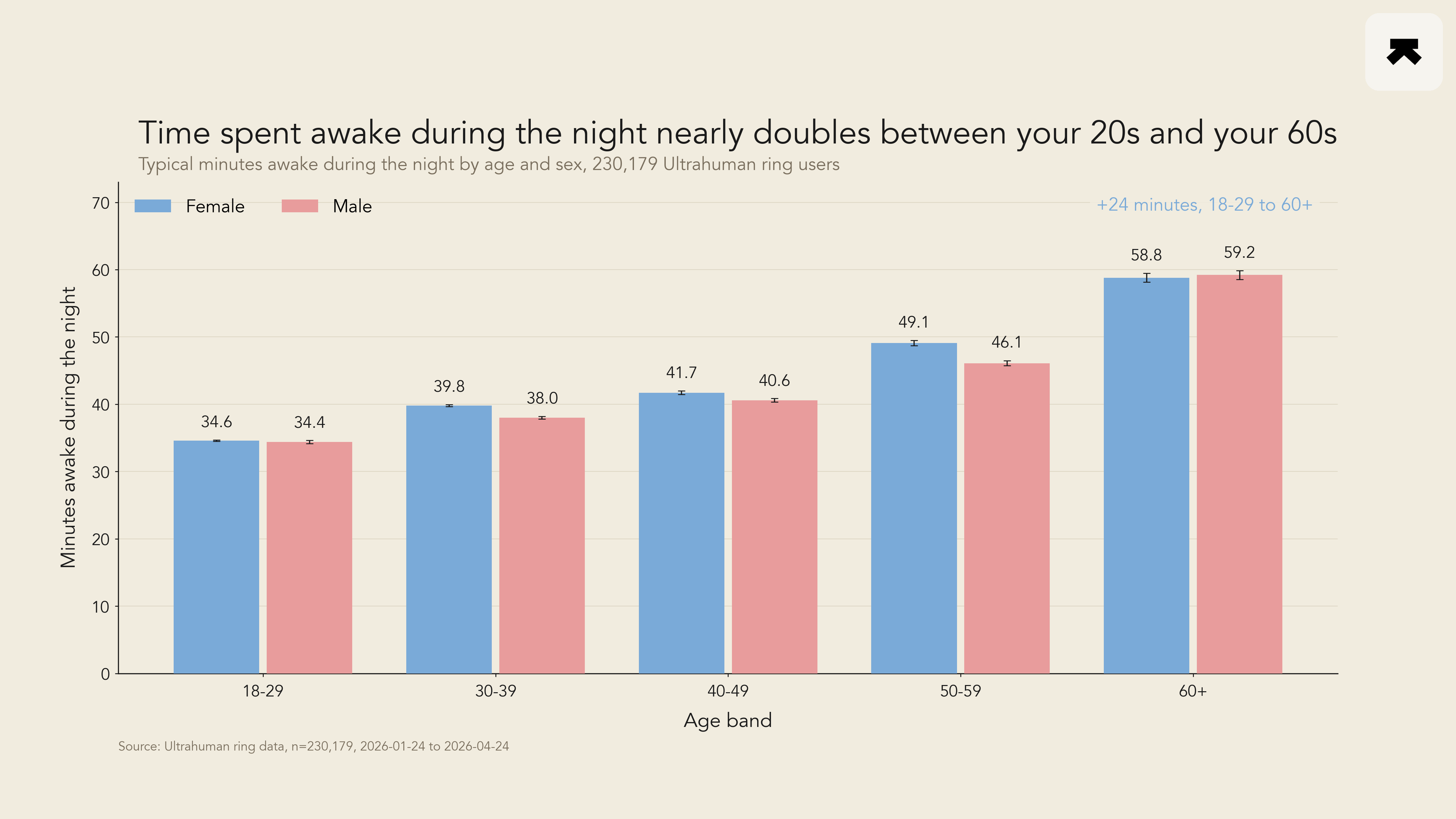
Across 230,179 Ring members, the dominant age change in sleep is more time awake at night, not less deep sleep
Time in target holds until the diabetic line, then collapses, across 1,169 members