Higher blood inflammation tracks a 4.3 bpm faster overnight heart rate across 2,788 Ring members
Across 2,788 members, those in the highest blood-inflammation band ran their nights about 4 bpm faster than the lowest, a gradient that holds in members under 35 and aged 36 to 50.
High-sensitivity C-reactive protein (hs-CRP), a blood marker of chronic, low-grade inflammation calibrated to the small concentrations that matter for cardiovascular risk in apparently healthy adults, has anchored primary-prevention risk scoring for two decades. The American Heart Association and Centers for Disease Control and Prevention fixed three risk bands (low below 1 mg/L, intermediate 1 to 3, high above 3) in a 2003 scientific statement (Pearson et al., 2003). That classification has held: a 2024 study followed 27,939 initially healthy women for 30 years and found a single baseline hs-CRP independently predicted cardiovascular events three decades out, with hazard ratios (the relative event rate between groups) near 1.7 for the highest versus lowest quintile (Ridker et al., 2024). The biology underneath is inflammaging, the idea that sterile, low-grade inflammation accumulates with age and pushes disease-risk curves upward, proposed in 2000 (Franceschi et al., 2000) and now treated as a hallmark of aging (Baechle et al., 2023). What the literature leaves open is whether the same gradient shows up on a consumer ring; the closest prior read validated a study wearable’s overnight resting heart rate against ECG (intraclass correlation 0.946) and saw it track higher C-reactive protein across its cohort (Feng et al., 2024).
We took 2,788 Ultrahuman members who logged a Blood Vision panel carrying an hs-CRP value between August 2025 and April 2026, and paired each result with that member’s own Ring resting heart rate across the 30 nights ending on the blood draw, requiring at least 14 valid nights. Members were sorted into the three published AHA bands rather than within-cohort cut-points.
Resting heart rate climbed step by step across the three inflammation bands, and the top-versus-bottom gap held its size whether members were young or middle-aged. Mean nightly resting heart rate ran 55.0 bpm in the low tertile, 56.9 bpm in the intermediate, and 59.2 bpm in the high, a high-versus-low gap of +4.28 bpm (95% CI +3.56 to +5.01). The intermediate band sits midway, consistent with a continuous dose-response rather than a step at either cut-point.
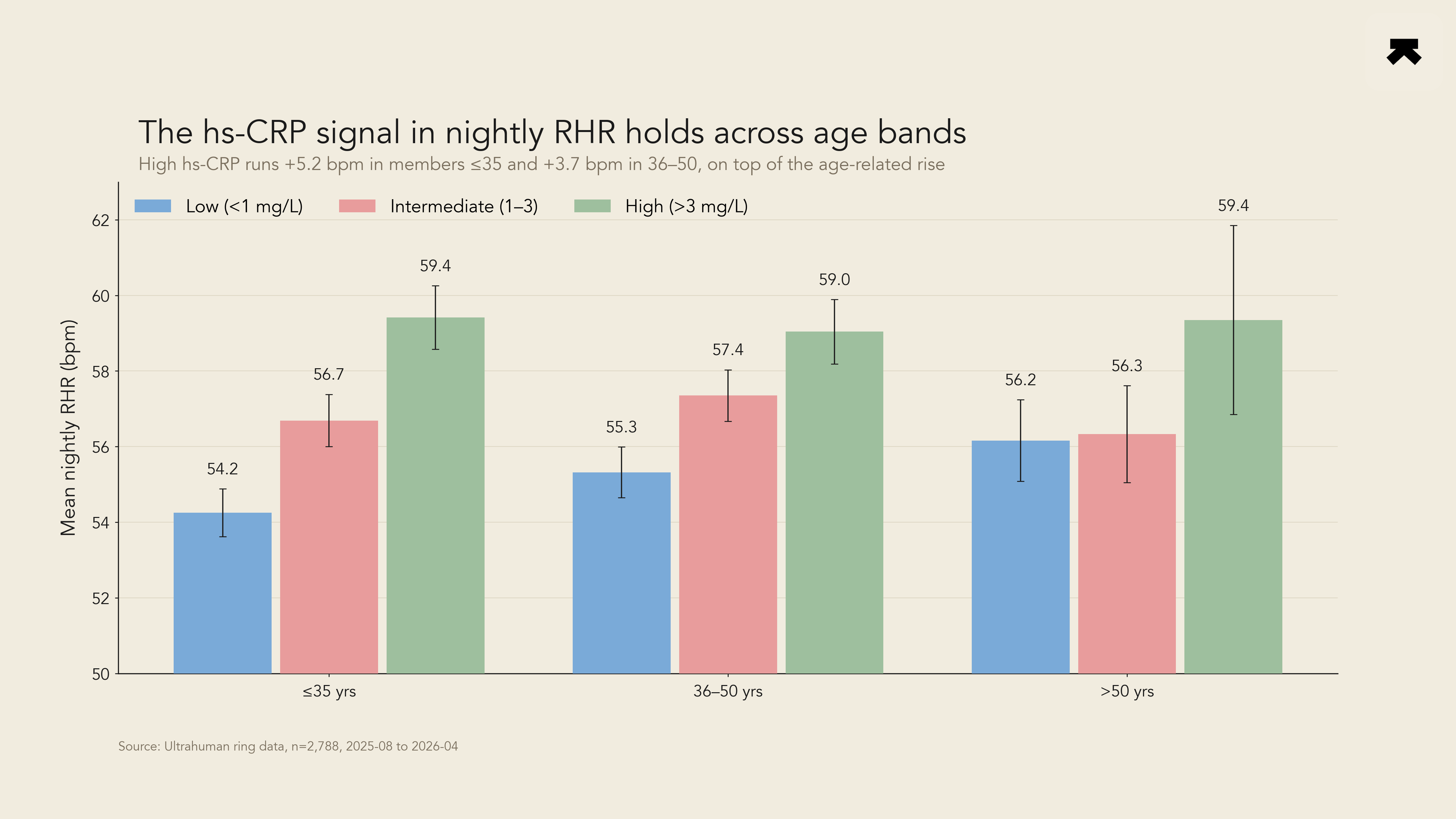
Figure 1. Mean overnight resting heart rate by hs-CRP tertile and age band, in 2,788 Ultrahuman members with a Blood Vision panel including hs-CRP and at least 14 valid Ring nights in the 30-night window ending on the blood draw. Tertile cut-points follow the AHA/CDC scientific statement (low below 1 mg/L, intermediate 1 to 3, high above 3). Error bars are 95% normal-approximation confidence intervals; the high-versus-low contrast holds in members 35 and under (+5.17 bpm) and 36 to 50 (+3.72 bpm), with the over-50 high-tertile cell shown for completeness only.
Splitting by age supplies one confound check. The high-versus-low gap ran 5.2 bpm in members 35 and under and 3.7 bpm in those 36 to 50; both bands carry it cleanly. Baseline resting heart rate rises with age here as in published wearable cohorts, but that rise sits on top of the inflammation-related rise rather than absorbing it, so the gradient is not an age artefact. The design is observational, and age is the only confound the data lets us rule out. Two others it cannot: body fat raises both hs-CRP and resting heart rate, so adiposity could account for part of the gap, and a single hs-CRP draw can be transiently elevated by acute illness rather than chronic inflammation. We did not adjust for either, so read the gradient as an association, not an isolated inflammation effect.
Across 2,788 members, those carrying the most blood-borne inflammation run their nights about 4 bpm faster, roughly the gap a clinician would attribute to a full decade of aging. The Ring’s overnight resting heart rate tracks hs-CRP, the same blood marker that has predicted long-term cardiovascular risk in decades-long studies, in a cohort several times larger than the prior wearable study.
- Pearson TA, et al. Circulation, 2003. PMID: 12551878.
- Ridker PM, et al. New England Journal of Medicine, 2024. PMID: 39216091.
- Franceschi C, et al. Annals of the New York Academy of Sciences, 2000. PMID: 10911963.
- Baechle JJ, et al. Molecular Metabolism, 2023. PMID: 37329949.
- Feng KY, et al. Journal of Medical Internet Research, 2024. PMID: 39705694.
More bytes
Keep exploring
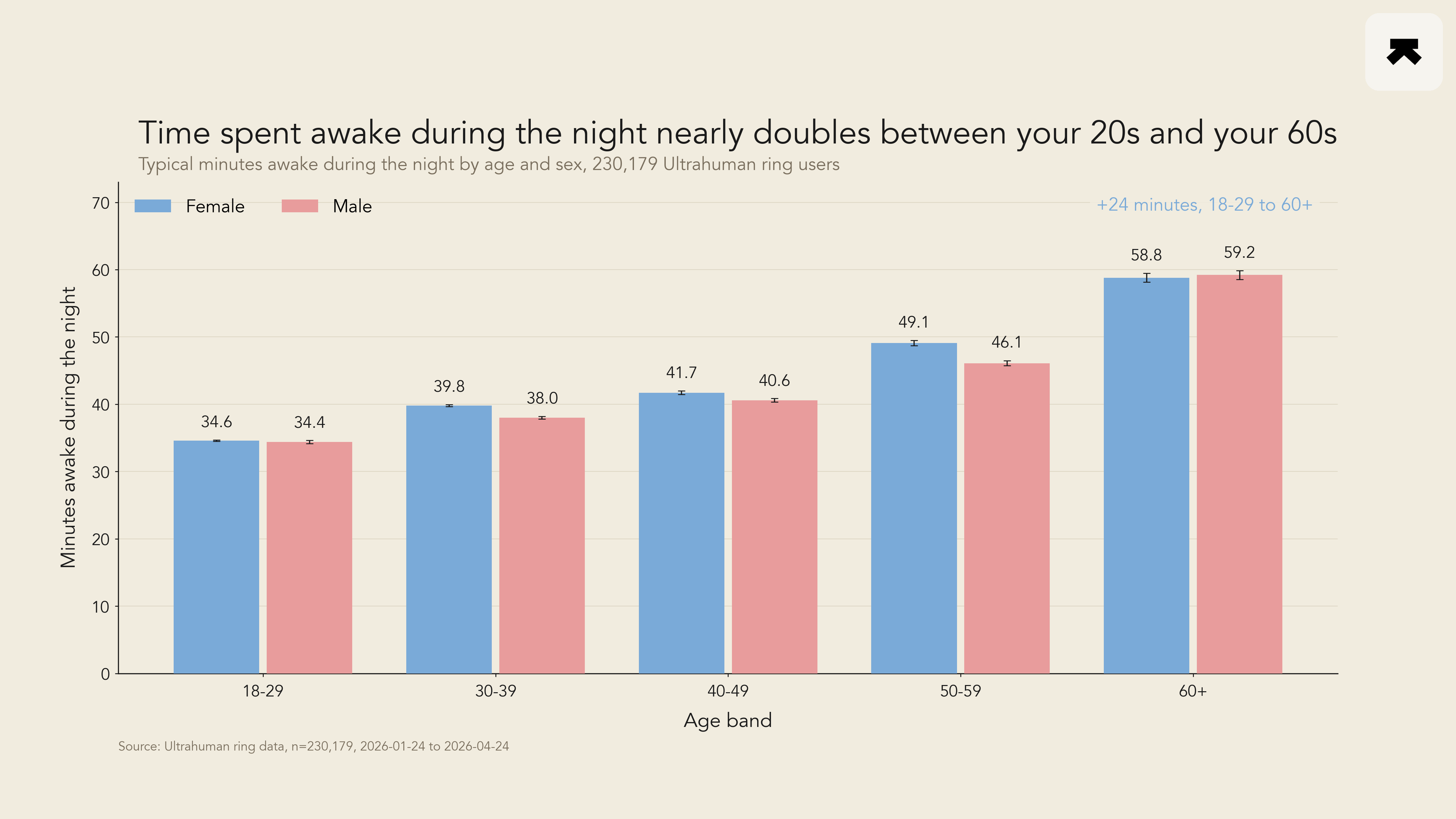
Across 230,179 Ring members, the dominant age change in sleep is more time awake at night, not less deep sleep
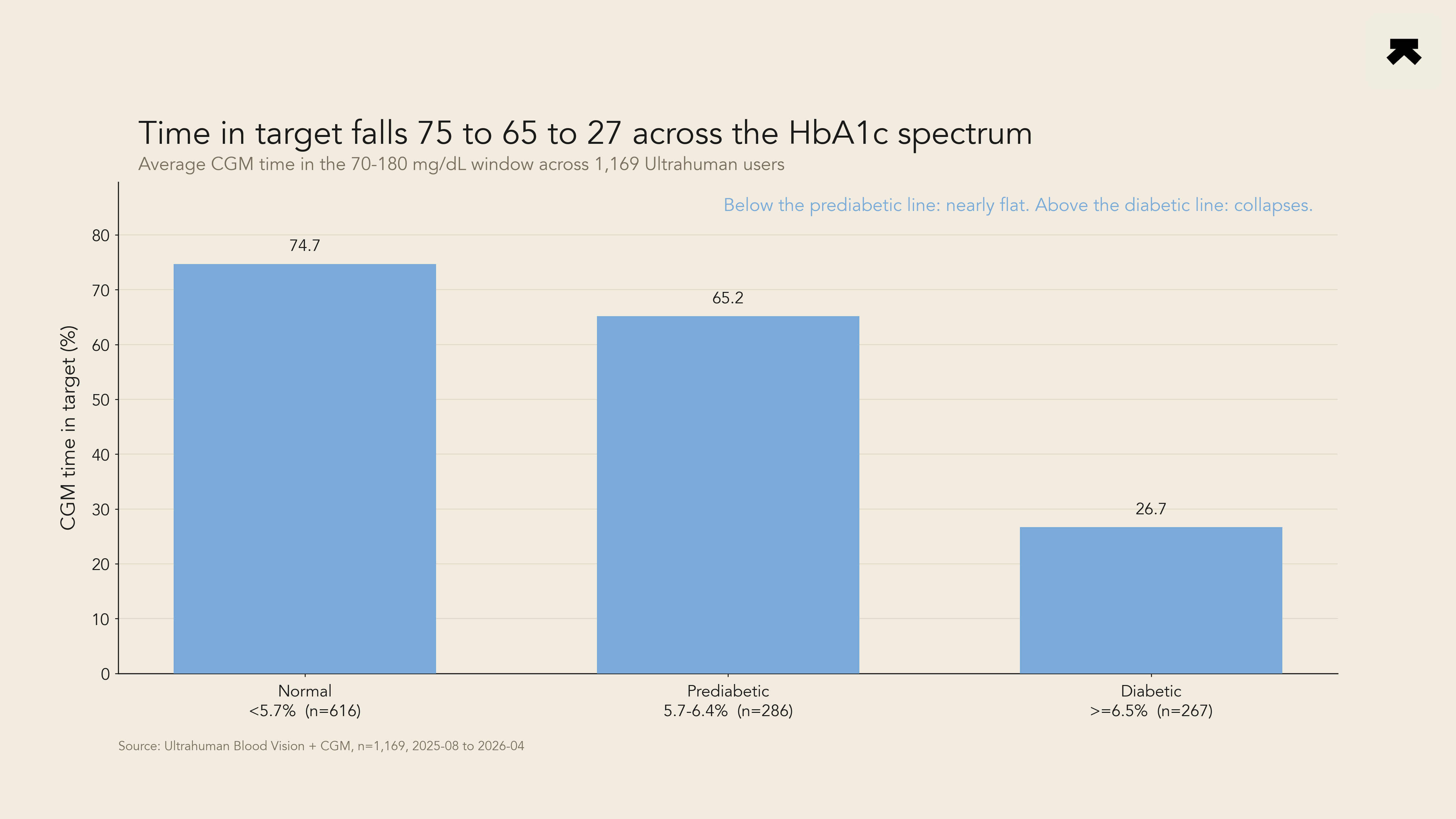
Time in target holds until the diabetic line, then collapses, across 1,169 members