Updated Nov 2026
Choose a smart ring for cycle tracking that reads your temperature nightly, confirms ovulation instead of only predicting it, and publishes its accuracy for irregular cycles. Our Ultrahuman Ring PRO does all three: with Cycle & Ovulation Pro, it predicts ovulation and confirms it from your sustained temperature rise.
TL;DR
- What to look for: nightly finger temperature scored against your own baseline, ovulation confirmation, and published accuracy for irregular cycles.
- Why a run of nights matters: the rise after ovulation averages 0.26 °C at the finger. That’s smaller than the average 0.38 °C change from one night to the next we see across 1,487 adult members of all genders.
- Our ring: Ultrahuman Ring PRO predicts your period for free, plus a seven-day fertile window with the Conception goal. Cycle & Ovulation Pro ($3.99 a month) confirms ovulation and flags cycles that may not have had one.
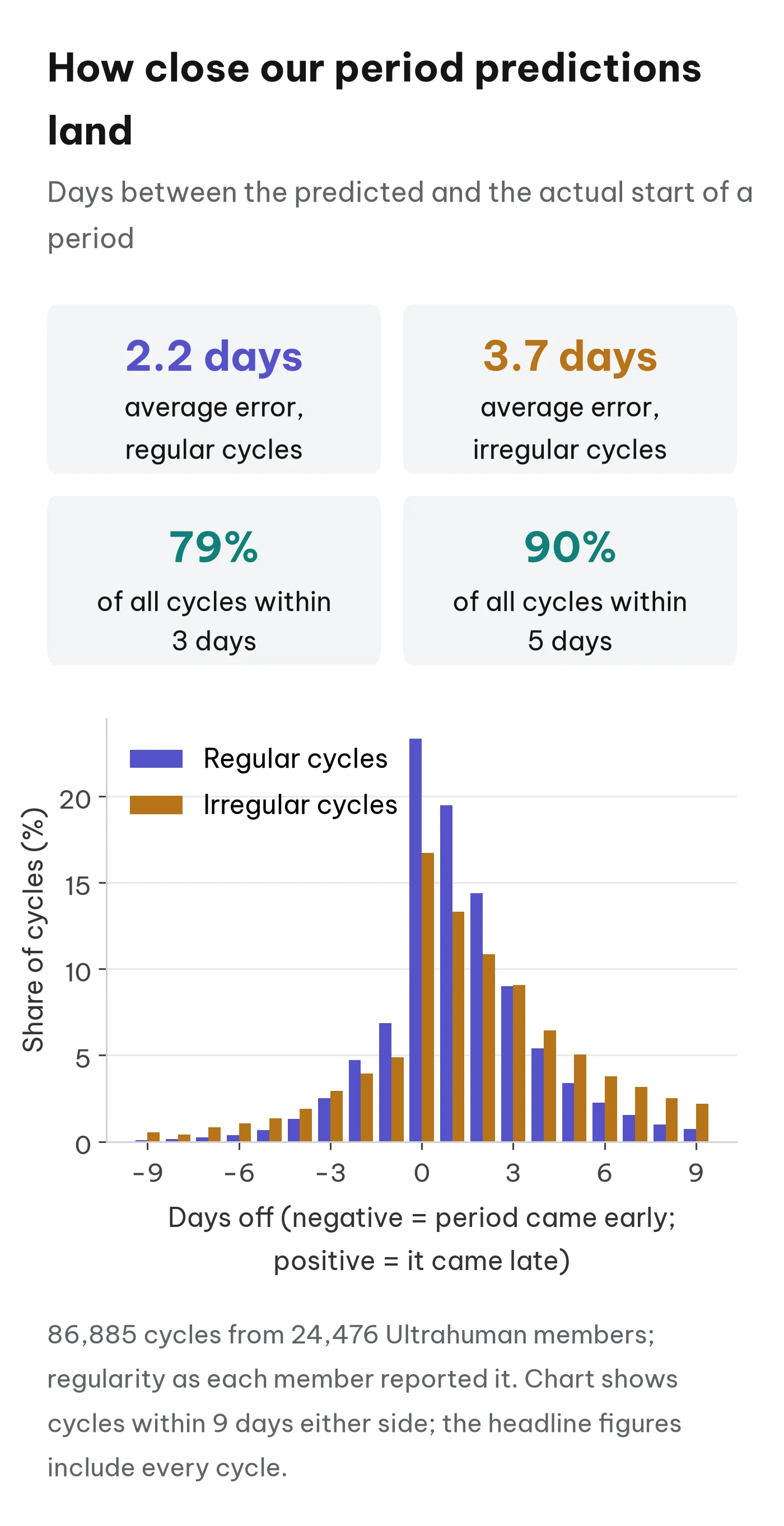
- Accuracy: across 86,885 cycles, our period predictions landed within 3 days 79% of the time.
- Irregular cycles and PCOS: in 772 cycles from 421 members who report PMOS (formerly PCOS), our ring placed ovulation within two days of their logged ovulation tests in 74.5% of cycles.
- Perimenopause and menopause: across 809 members aged 40 to 60, nights with a logged hot flash ran 0.2 °C warmer, with more time awake and less deep and REM sleep.
- Know the limits: a ring reads patterns, not hormones. Cycle & Ovulation is a wellness feature, not a medical device. It isn’t birth control, and it isn’t intended for conception planning, medical diagnosis or as a fertility guarantee.
What a smart ring measures across your cycle
Your hormones leave a trace in three signals a ring can read while you sleep: skin temperature, resting heart rate and heart rate variability (HRV).
Your core temperature is typically 0.3 to 0.7 °C higher in the luteal phase, the stretch between ovulation and your next period (Baker et al., 2020 ).
At the wrist, a study of 437 cycles found a 0.33 °C rise early in that phase (Shilaih et al., 2018 ). At the finger, the average shift in our member data is 0.26 °C.
Your heart follows your cycle too. In 45,811 cycles from 11,590 people, resting heart rate was lowest around day 5 and highest around day 26 (Jasinski et al., 2024 ). A meta-analysis of 37 studies found HRV lower in the luteal phase than before ovulation (Schmalenberger et al., 2019 ).
Our own data shows the same mirror image. Across 13,577 cycles from 4,881 members, HRV peaked around the period and dipped in the luteal phase, while skin temperature did the opposite. On hormonal birth control, the HRV curve was flatter (HRV for women ).

If you want the phase-by-phase story, read our guide to the four phases of the menstrual cycle .
Why one warm night tells you little
The rise after ovulation is real, but it’s small. Across 1,487 adult members of all genders, skin temperature changed by 0.38 °C between back-to-back nights on average (night-to-night temperature ). That average change is bigger than the 0.26 °C shift you’re looking for.
So one warm night may be ordinary night-to-night variation: in those same 1,487 members, about 2 nights a month ran at least 0.5 °C warmer than usual. A rise that holds for several nights in a row is what points to ovulation.
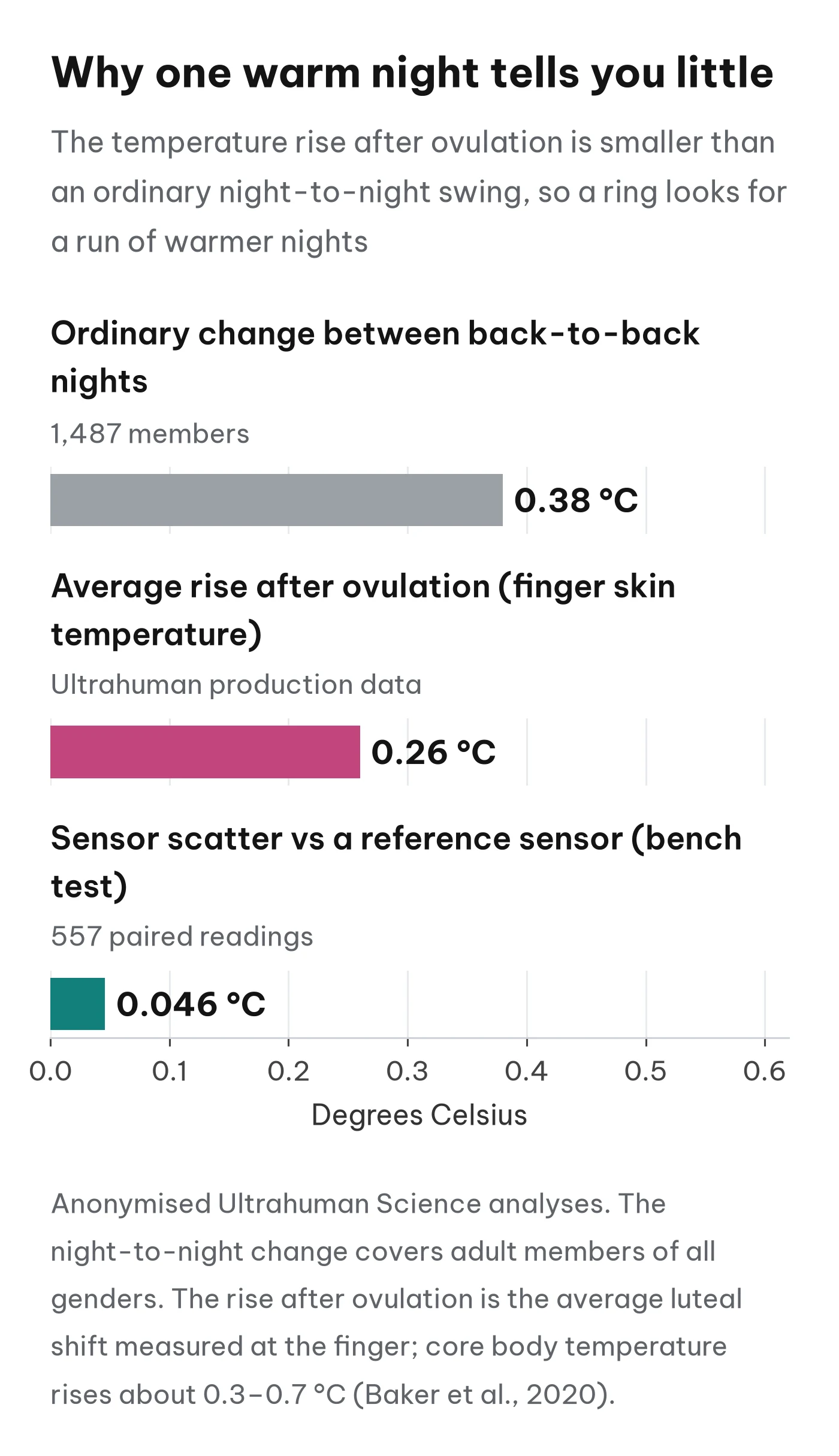
The sensor itself is the easier part. In a bench test of 557 paired readings against a reference sensor, our ring held a steady 0.114 °C offset, and readings strayed 0.046 °C on average around it (temperature accuracy ).
The harder part is the method. Our algorithm first learns a 30-day baseline of your own nights. It then waits for your temperature to settle above that baseline and stay there.

This is also where a ring differs from a morning thermometer. A late alarm, a bad night or getting up before you measure can skew a manual reading. Your ring takes many readings while you sleep, so there’s no reading for you to remember.
How an ovulation tracking ring works: prediction vs confirmation
A prediction estimates your next period and fertile window from your cycle history and nightly signals. Confirmation goes a step further. It checks your temperature after the fact for the sustained rise that follows ovulation.
That difference matters because your cycle rarely follows the textbook. In 612,613 ovulatory cycles tracked in an app, the average length was 29.3 days (Bull et al., 2019 ). In another 75,981 cycles from 32,595 women, only 12.4% of users had a 28-day cycle (Soumpasis et al., 2020 ).
Even regular cycles don’t always include ovulation. In a year-long study of 53 women screened for normal cycles and ovulation, 17% had at least one cycle without ovulation. More than half, 55%, had more than one short luteal phase (Henry et al., 2024 ).
On our Ultrahuman Ring PRO, the free Cycle & Ovulation PowerPlug reads your temperature, HRV and resting heart rate to predict your period.
Choose the Conception goal, and it adds a seven-day fertile window: the five days before ovulation, the day itself and the day after. It shows patterns in your own data; it can’t guarantee when you will or won’t conceive.
Cycle & Ovulation Pro ($3.99 a month) adds the confirmation. It predicts your ovulation day, marks it once the rise holds, and flags cycles with a pattern that suggests possible anovulation. It also forecasts up to 12 cycles ahead and builds a PDF report of your last six cycles to discuss with your doctor.

So how close does it get? In a pilot of 22 women and 48 cycles on Ring AIR, our lighter ring, the ovulation call landed a median of one day from the peak hormone surge. The calendar method landed two days away (cycle insights ).
In a second comparison, also in 22 women, the ring’s ovulation calls agreed with an at-home test of four hormone metabolites 92.9% of the time (ovulation accuracy ).
Your period predictions get the same scrutiny. Across 86,885 cycles from 24,476 members, 79% of predictions landed within 3 days of the real start and 90% within 5 days. The average error was 2.2 days in regular cycles and 3.7 days in irregular ones (period prediction accuracy ).
Smart ring tracking for irregular cycles and PCOS
A smart ring can help you track patterns in irregular cycles and PCOS by looking for a sustained temperature rise instead of only counting days. It can’t diagnose PCOS or tell you why a cycle is irregular.
If your cycles are irregular, counting days is less reliable. In our ovulation pilot, the calendar method’s gap widened to about five days for women with irregular cycles and for older women (cycle insights ).
PCOS (polycystic ovary syndrome) affects an estimated 10 to 13% of women of reproductive age, and up to 70% of them don’t know it (WHO ).
In 772 cycles from 421 Ultrahuman members who report PMOS (formerly PCOS), our ring placed ovulation within two days of the point their logged ovulation tests indicated in 74.5% of cycles (PMOS accuracy ).
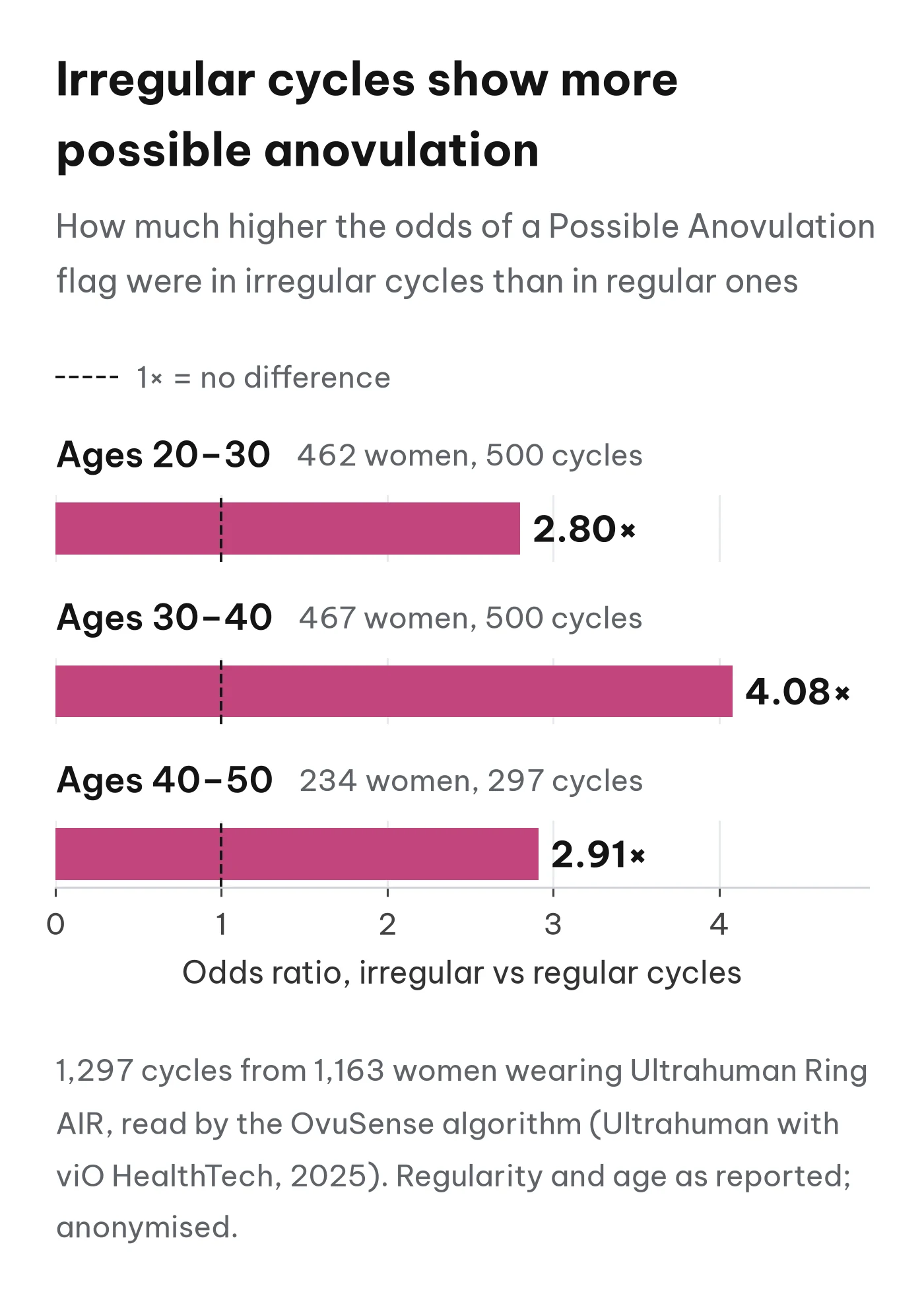
With Cycle & Ovulation Pro, Cycle Flags then point out where your cycle left its usual arc, such as a cycle with no clear rise. In a study with viO HealthTech of 1,297 cycles from 1,163 women, irregular cycles had 2.8 to 4.1 times higher odds of a Possible Anovulation flag (Cycle Flags study ).
Your lifestyle shows up in the data too. In 4,055 cycles from 2,745 women wearing Ring AIR, higher BMI and constant high stress were linked to more variable cycle lengths (BMI and stress study ). For practical steps, read how to track ovulation with PCOS .
How heart rate and recovery change across the menstrual cycle
To read cycle changes in your heart rate, start with your own normal. Women’s resting heart rate runs a little higher than men’s: across 506,310 members with at least seven valid nights, women averaged 58.5 bpm overnight and men 55.2 bpm (resting heart rate for women ).
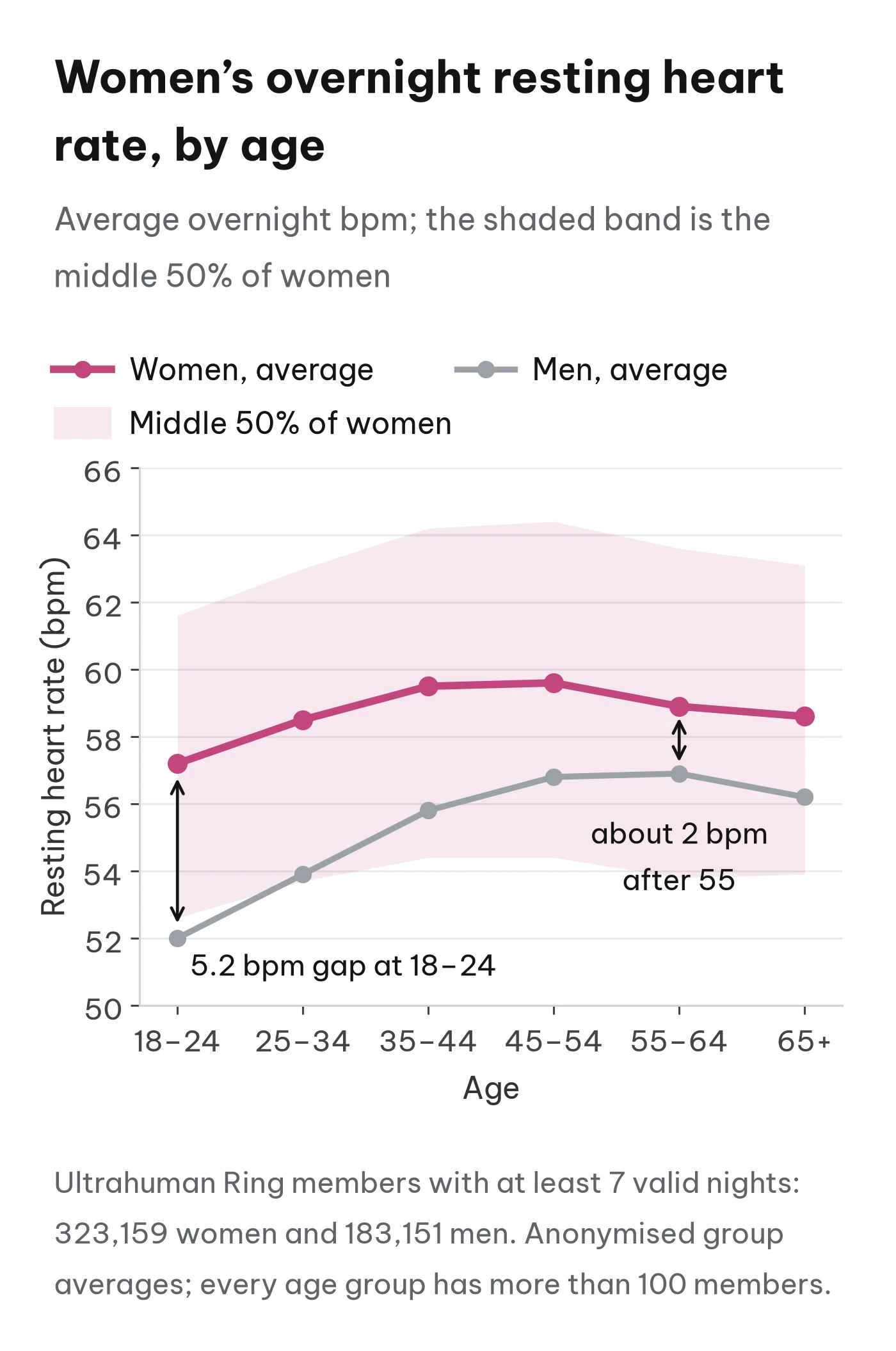
The gap is widest at 18 to 24, at 5.2 bpm, and shrinks to about 2 bpm after 55. Women’s average peaks at 59.6 bpm at ages 45 to 54 and eases to 58.6 by 65+. The middle half of women sits between 53.6 and 63.1 bpm, so your normal may differ from a friend’s.
Your recovery moves with your cycle as well. Across 19,910 women and about 440,000 nights, we lined up readings around each cramps day they logged. These women are a separate group from the chart above, so watch the change across the days rather than the starting numbers.
From five nights before to one night after, HRV rose from 44.2 to 47.2 ms and resting heart rate fell from 70.0 to 67.3 bpm (recovery before your period ).
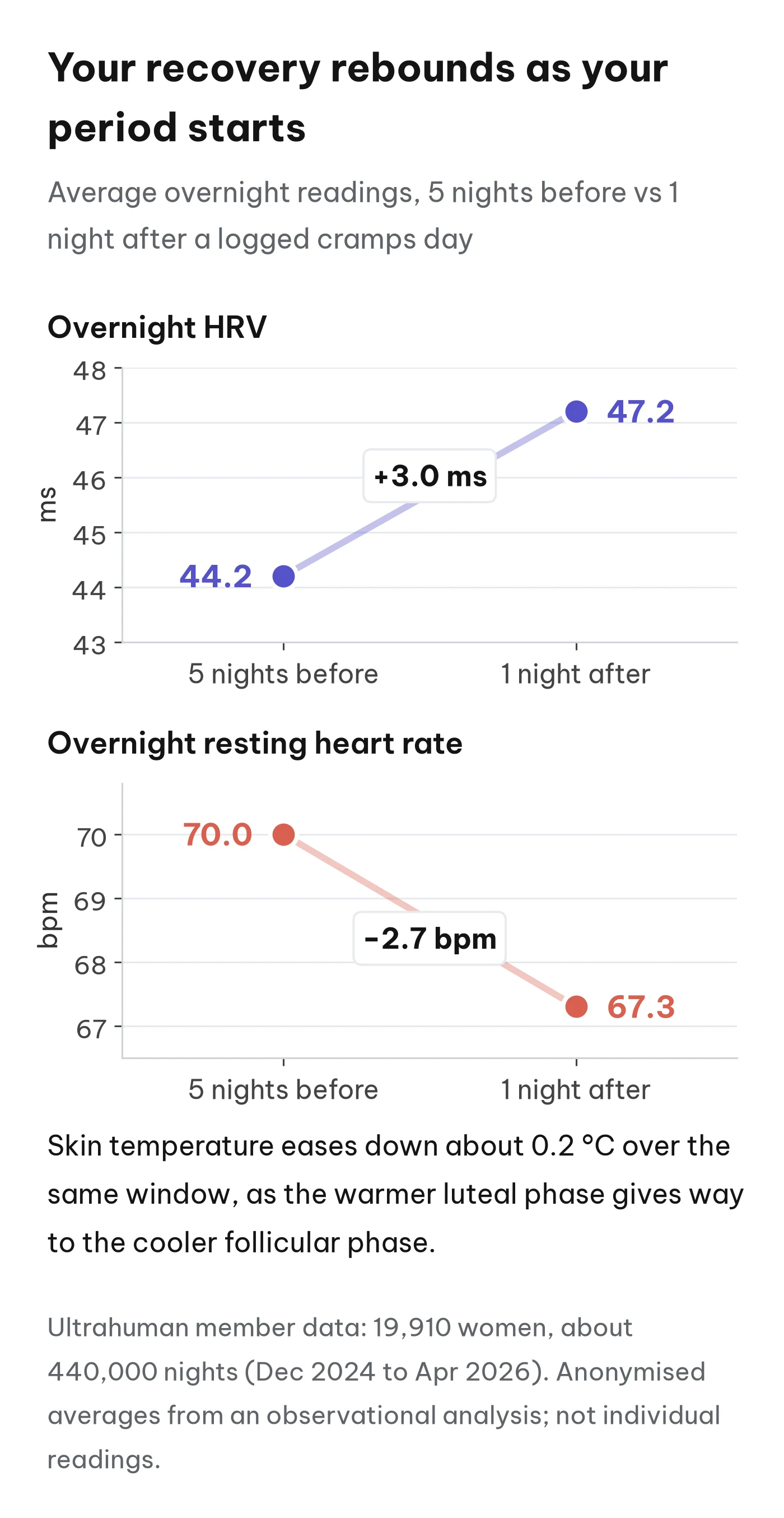
So if your HRV dips in the days before your period, your cycle may be the reason. Knowing your phase helps you read a lower number with less worry.
Smart ring tracking in perimenopause and menopause
In perimenopause and after menopause, a smart ring can show how hot flashes change your nights: your skin temperature, time awake, and deep and REM sleep.
In the menopause transition, about 26% of women have sleep problems severe enough to count as insomnia (Baker et al., 2018 ). In 168 midlife women measured at home, 78% of hot flashes during sleep came with waking (Thurston et al., 2019 ).
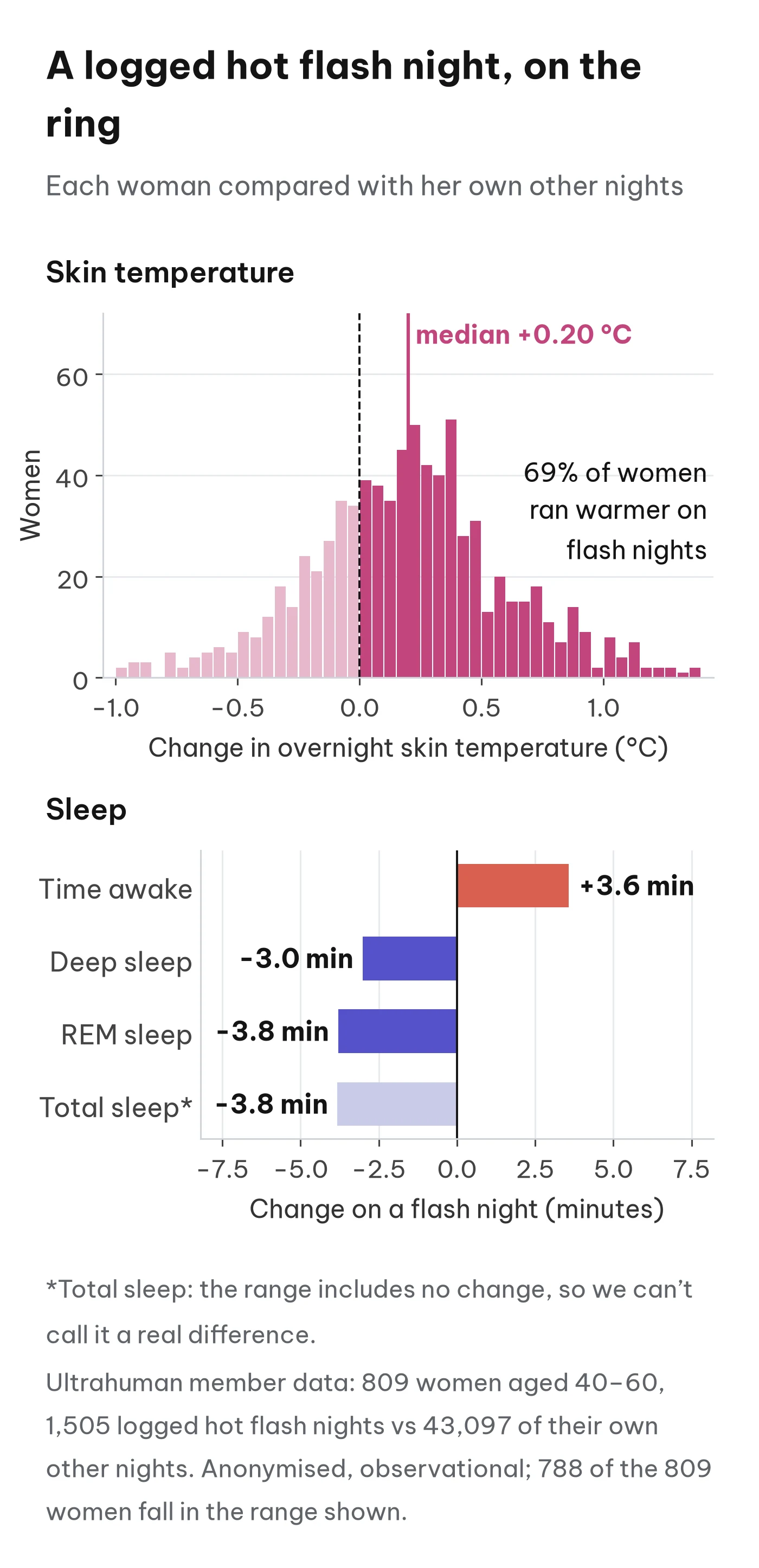
Our Ultrahuman member data shows what a hot flash night looks like from the finger. Across 809 members aged 40 to 60, nights with a logged hot flash ran 0.2 °C warmer than their other nights, and 69% of the women ran warmer on those nights.
They also had 3.6 more minutes awake, 3.0 fewer minutes of deep sleep and 3.8 fewer minutes of REM sleep (hot flashes and sleep ). Members chose to log their hot flashes, so this shows a pattern, not a cause.
In a separate accuracy study of 96 women past their last period, hot flash nights ran 0.32 °C warmer, and 88% showed the shift (menopause accuracy ). Logging symptoms next to your nightly data gives you and your doctor a clearer record of the transition.
Wearing a smart ring during pregnancy
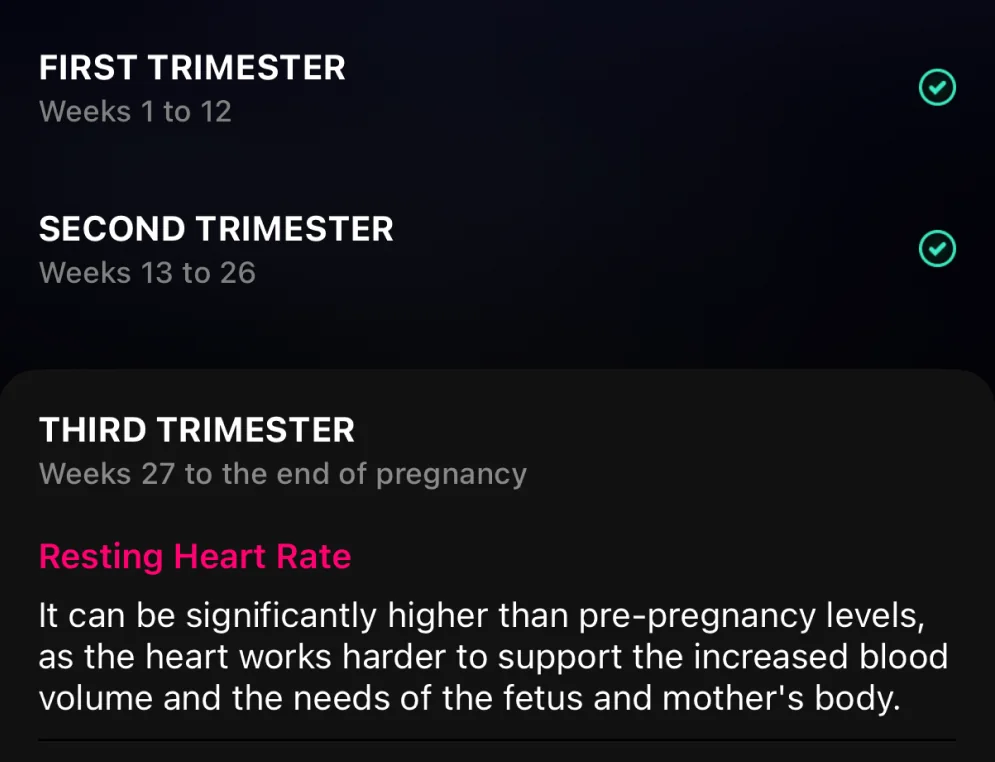
Pregnancy resets your baseline. Across 39 studies, average heart rate rose from 79.3 bpm at 10 weeks to 86.9 bpm at 40 weeks (Loerup et al., 2019 ).
Scores built on your pre-pregnancy normal can misread that change.
On Ultrahuman rings, our free Pregnancy Insights PowerPlug reads your sleep, movement, heart rate, resting heart rate, HRV and temperature against your trimester instead. You enter your due date, and the app works out your week (Pregnancy Insights ). It isn’t a pregnancy test or a medical diagnosis.
Which smart rings and wearables track ovulation?
Ultrahuman Ring PRO tracks ovulation by reading nightly finger temperature to predict your fertile window, confirm ovulation and flag possible anovulation, including in irregular cycles. Samsung Galaxy Ring also uses skin temperature in cycle tracking, while Apple Watch, Garmin and Fitbit offer cycle tracking on the wrist or in the app.
The real difference is whether a device predicts your fertile window, estimates ovulation after the fact, or confirms it and flags cycles without it.
| Device | Signals used | Ovulation | Worth knowing |
|---|---|---|---|
| Ultrahuman Ring PRO | Nightly finger temperature, HRV and resting heart rate | Fertile window free with the Conception goal; ovulation day, confirmation and possible-anovulation flags with Pro | iPhone and Android; up to 15 days per charge, 15+ days in Chill Mode |
| Samsung Galaxy Ring | Cycle history, improved by skin temperature | Predicts fertile periods and ovulation dates | Android only, in Samsung Health; skin temperature needs a Galaxy Watch5 or newer, or the Galaxy Ring |
| Apple Watch (Series 8 or later, Ultra) | Logged cycles, heart rate and wrist temperature | Retrospective ovulation estimates | Ovulation estimates only in certain countries or regions |
| Garmin (compatible watches) | Logged cycles plus overnight skin temperature | Predicts the fertile window | No fertile window for cycles under 20 or over 45 days, or with hormonal birth control on |
| Fitbit (Google Health app) | Logged periods, symptoms and ovulation tests | Moves your fertile window after a positive ovulation test | Ovulation day set to the day after a positive test |
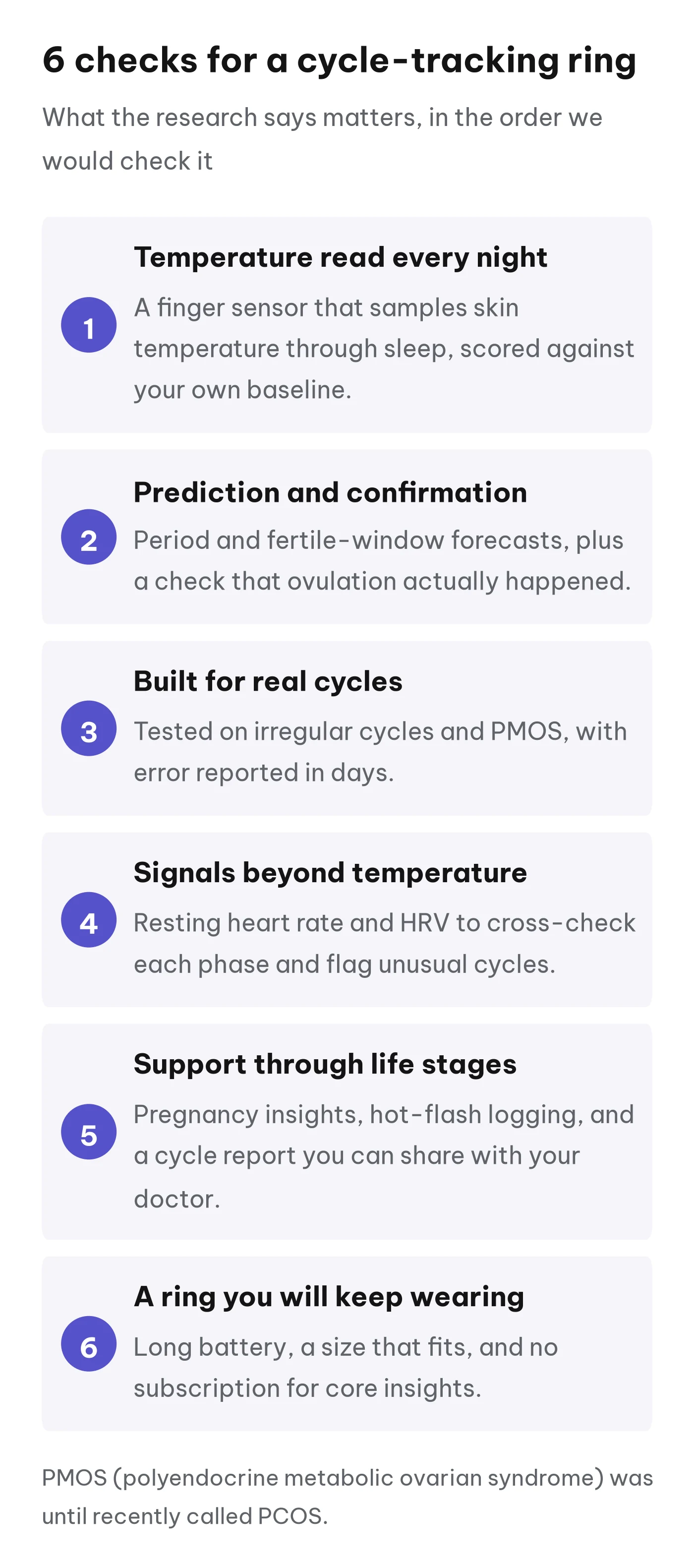
For an ovulation tracking ring, nightly wear matters most. Every missed night leaves a gap in your temperature curve. Ring PRO runs up to 15 days per charge, 15+ days in Chill Mode, and up to 45 days away from a wall outlet with the PRO Charger.
For a side-by-side of each smart ring for women’s health by fit, price and battery, see our guide to smart rings for women .
How to get cleaner cycle data
- Wear it every night. Your ring needs a 30-day baseline of your own nights before predictions settle.
- Log your period. Logging the start of your next period closes your completed cycle’s report.
- Log ovulation tests if you use them. You can then see your hormone surge next to your temperature shift.
- Note unusual nights. If you had a late drink, felt unwell or slept somewhere hotter, note it so you can read an odd reading in context.
- Read trends with your birth control in mind. Hormonal methods flatten the natural HRV pattern.
Ring Tip: open your cycle report after each period. It sets that cycle against your own recent ones, not a 28-day textbook average.
FAQ
What does a Possible Anovulation flag mean?
It means your temperature didn’t show the sustained rise that usually follows ovulation in that cycle. One flag isn’t a diagnosis. It marks one cycle that left your usual pattern. If you see it across several cycles, take your cycle report to your doctor.
How long does a smart ring need to build a cycle baseline?
Allow 30 days of nightly wear for your first baseline. Keep logging after that to give the feature more of your cycle history. The Pro cycle report becomes available after those first 30 days.
Does a smart ring work if I’m on hormonal birth control?
It can still track your logged periods, sleep and recovery. Hormonal methods flatten the natural HRV pattern, and many work by stopping ovulation, so ovulation confirmation may not apply to you. The ring doesn’t replace your birth control, and Cycle & Ovulation isn’t intended for conception planning.
Can a ring detect perimenopause?
No. A ring can’t diagnose perimenopause, but it can track changes over time, such as warmer nights alongside logged hot flashes and shifts in your cycle length. You can share those patterns with your doctor.
Why might my ring’s ovulation day differ from my ovulation test?
An ovulation test catches the hormone surge that comes before ovulation, while your ring looks for the temperature rise that follows it. In 772 cycles from 421 members who report PMOS, our detected day landed 1.7 days after the logged test peak on average.
Should I choose Ring PRO or Ring AIR for cycle tracking?
Both work with Cycle & Ovulation in the Ultrahuman app, and our ovulation studies used Ring AIR. Ovulation confirmation, Cycle Flags and the downloadable cycle report need the Cycle & Ovulation Pro subscription. Pick Ring PRO for fewer charging gaps, at up to 15 days per charge, 15+ days in Chill Mode. Pick Ring AIR for a lighter ring, from 2.4 g with up to 10 days per charge.
In the US, Ring PRO is available for purchase here
Sources
- Baker FC, Siboza F, Fuller A. Temperature regulation in women: effects of the menstrual cycle. Temperature, 2020. PubMed 33123618
- Shilaih M, et al. Modern fertility awareness methods: wrist wearables capture the changes in temperature associated with the menstrual cycle. Bioscience Reports, 2018. PubMed 29175999
- Jasinski SR, et al. A novel method for quantifying fluctuations in wearable derived daily cardiovascular parameters across the menstrual cycle. npj Digital Medicine, 2024. PubMed 39715818
- Schmalenberger KM, et al. A systematic review and meta-analysis of within-person changes in cardiac vagal activity across the menstrual cycle. Journal of Clinical Medicine, 2019. PubMed 31726666
- Bull JR, et al. Real-world menstrual cycle characteristics of more than 600,000 menstrual cycles. npj Digital Medicine, 2019. PubMed 31482137
- Soumpasis I, Grace B, Johnson S. Real-life insights on menstrual cycles and ovulation using big data. Human Reproduction Open, 2020. PubMed 32328534
- Henry S, Shirin S, Goshtasebi A, Prior JC. Prospective 1-year assessment of within-woman variability of follicular and luteal phase lengths. Human Reproduction, 2024. PubMed 39320898
- Baker FC, et al. Sleep problems during the menopausal transition: prevalence, impact, and management challenges. Nature and Science of Sleep, 2018. PubMed 29445307
- Thurston RC, et al. Hot flashes and awakenings among midlife women. Sleep, 2019. PubMed 31152182
- Loerup L, et al. Trends of blood pressure and heart rate in normal pregnancies: a systematic review and meta-analysis. BMC Medicine, 2019. PubMed 31506067
- World Health Organization. Polycystic ovary syndrome fact sheet .
- Ultrahuman Science:
- Device features:
THE AUTHOR