Horlicks has been the go-to bedtime drink for over a century. Warm, malty, comforting. But the nutrition label tells a different story from the marketing – that soothing mug packs a serious hit of sugar, right before your body wants to wind down for the night.
Horlicks is a malted milk drink fortified with vitamins, minerals, protein and carbohydrates. The claims around sleep and relaxation are more about advertising than clinical evidence. Any warm milky drink at bedtime has a calming ritual to it, and that’s about the size of it.
Reviewed by Mukul Mittal, MD, Medical Director at Ultrahuman
The sugar hit
A standard serving – 25g of powder in 200ml of semi-skimmed milk – contains around 19.2g of sugar. That’s more than five teaspoons, and close to two-thirds of the NHS daily limit for free sugars, in a single mug.
For anyone paying attention to their metabolic health, that’s a lot to send in just before sleep.
What the CGM data shows
The Ultrahuman Open Glucose Database is the world’s largest open-source record of glucose responses to real food, built on CGM data from Ultrahuman members. Looking at the Horlicks-with-semi-skimmed-milk entry , 69% of users recorded an unstable glucose response. The average peak hit 153 mg/dL – outside the range typically considered normal for a non-diabetic.
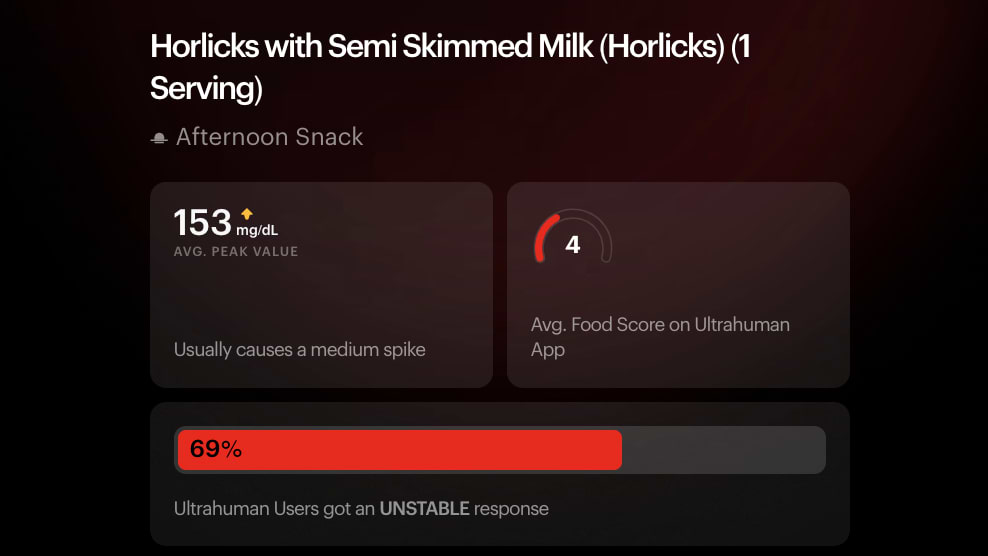
The simple sugars in Horlicks cause a sharp rise in glucose levels – known as a hyperglycaemic spike. Frequent spikes and crashes like this can, over time, increase the risk of insulin resistance and metabolic dysregulation.
Proprietary data from the Ultrahuman Open Glucose Database — the world’s largest open-source glucose response database built on CGM food logs — shows that 69% of users recorded an unstable glucose response after consuming Horlicks with semi-skimmed milk. The average peak blood glucose level hit 153 mg/dL, which is considered outside of the “normal” range for a non-diabetic.
Why bedtime makes it worse
A sharp glucose rise before bed is more disruptive than the same rise at breakfast. Overnight glucose swings have been linked to more fragmented sleep, and the early-morning hormonal surge can amplify whatever your metabolism is already dealing with.
Read next: Why 3AM wakeups could be your metabolism
How to enjoy Horlicks without a spike
If Horlicks is a habit you don’t want to break, a few tweaks help:
- Switch the milk: Full-fat milk slows glucose absorption. Semi-skimmed and skimmed spike harder.
- Pair it with fat or fibre: A small handful of almonds or a spoon of nut butter alongside the mug blunts the rise.
- Don’t drink it on an empty stomach: Have it after a meal with protein and fibre.
- Cut the frequency: A few times a week is more forgiving than every night.
- Try a reduced-sugar variant. Horlicks Lite exists, though it’s more common in India than on UK shelves.
The takeaway
Horlicks isn’t uniquely bad. Plenty of everyday drinks do worse things to your glucose. The point is that without CGM data, you’d never know – a drink marketed for decades as a sleep aid turns out to be a bedtime sugar rush for the majority of people who try it. If you’re using an M2 Live CGM, log your next Horlicks and see where your response lands against the 69%.
THE AUTHOR