Updated Nov 2026
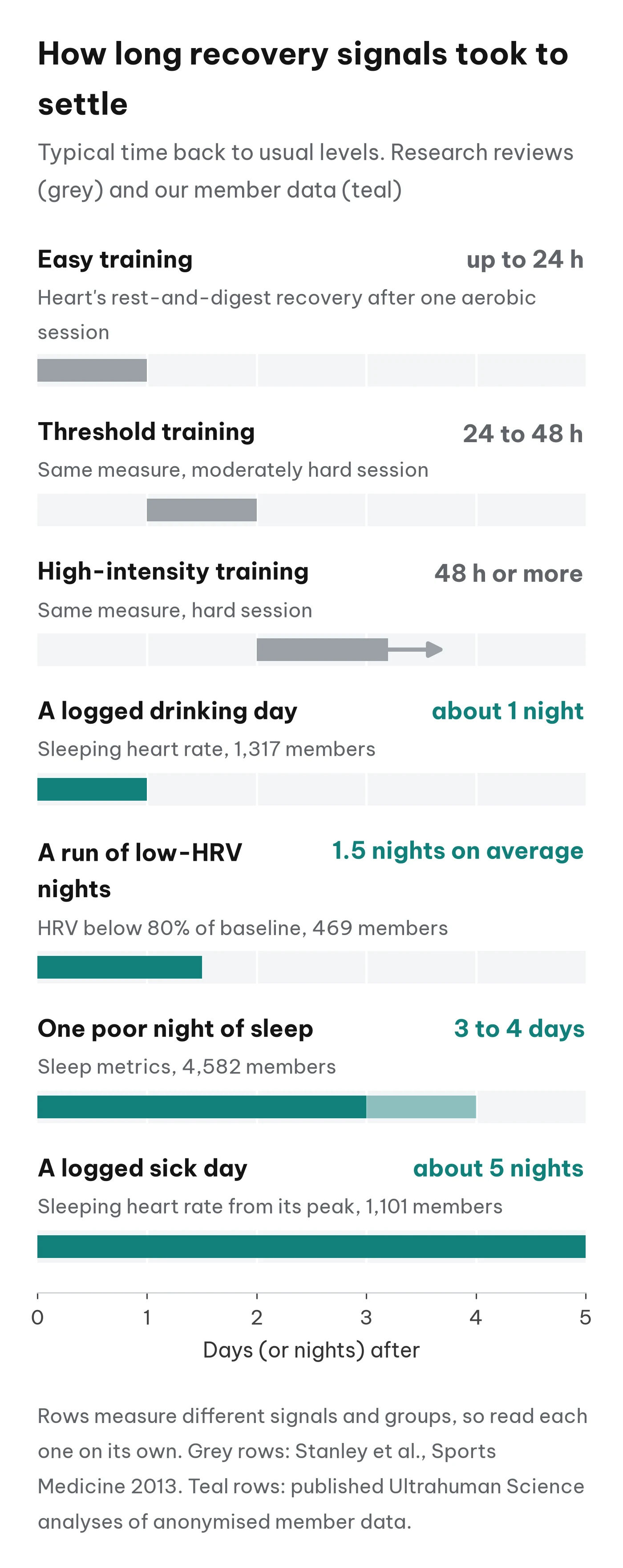
HRV usually recovers within 24 hours of easy aerobic exercise, 24–48 hours of threshold work, and 48+ hours of high-intensity training. Our members’ low-HRV runs averaged 1.5 nights (469 members); sleeping heart rate settled a night after drinking (1,317 members).
TL;DR
- After exercise: the harder the aerobic session, the longer recovery takes: up to about 24 hours after easy work, 24 to 48 hours after threshold work, and 48 hours or more after high-intensity training.
- After one low night: in our analysis of 469 members, the next night was low 28.6% of the time. Only 1.6% of single low nights became a full low week.
- After alcohol: research links more alcohol to lower HRV-based recovery in early sleep. In 1,317 members, sleeping heart rate ran 0.6 bpm above usual after a logged drinking day, with no rise by the next night.
- Around illness: sleep HRV sat 3.8 ms below baseline on a flagged sick night (211 wearers). In 1,101 members, sleeping heart rate peaked 4.4 bpm above usual the night before a logged sick day and was back near usual five nights after that peak.
- After short sleep: in 1,024 members, average HRV didn’t sit clearly below baseline after three short nights in a row. Sleep that keeps changing length was linked with lower HRV.
- What to do: read your trend over several nights, not one morning. Use a run of low nights as a reason to ease off and look at context, especially if your resting heart rate or temperature moves too.
What HRV recovery means
Heart rate variability (HRV) is the small change in time between one heartbeat and the next. A common measure, RMSSD, mostly reflects your vagus nerve, the brake of your rest-and-digest system. Our RMSSD vs SDNN guide explains the two main measures.
Hard training, alcohol, a fever or stress tip your body toward fight-or-flight. Your heart rate tends to rise and HRV to fall. Heart rate variability recovery is the return to your usual range.
That range is personal, and median HRV in our members falls with age. Our HRV by age guide shows typical values, but your own nights are the better yardstick.
Night readings give you a steady baseline. In 15 runners, nocturnal HRV was highly repeatable across two nights after identical easy sessions, with ICC 0.92 to 0.97 (Nuuttila et al., 2022 ).
How long does HRV take to recover after exercise?
After a workout, the harder your session, the longer HRV takes to recover. A review of post-exercise studies (Stanley et al., 2013 ) found that your heart’s rest-and-digest activity, measured through heart rate and HRV, fully recovered after a single aerobic session on this timeline:
| Aerobic session | Typical full recovery |
|---|---|
| Low intensity (easy aerobic) | Up to about 24 hours |
| Threshold intensity | 24 to 48 hours |
| High intensity | 48 hours or more |
Night readings show the same pattern. In 10 men, RMSSD over a four-hour period starting 30 minutes after bedtime fell to 87% of baseline after a moderate endurance session and to 55% after a marathon (Hynynen et al., 2010 ).
In 23 runners after a 3,000 m running test, the change was larger in the first four hours of sleep than across the whole night (Nuuttila et al., 2022 ).
Is one low HRV night a problem? What our data shows
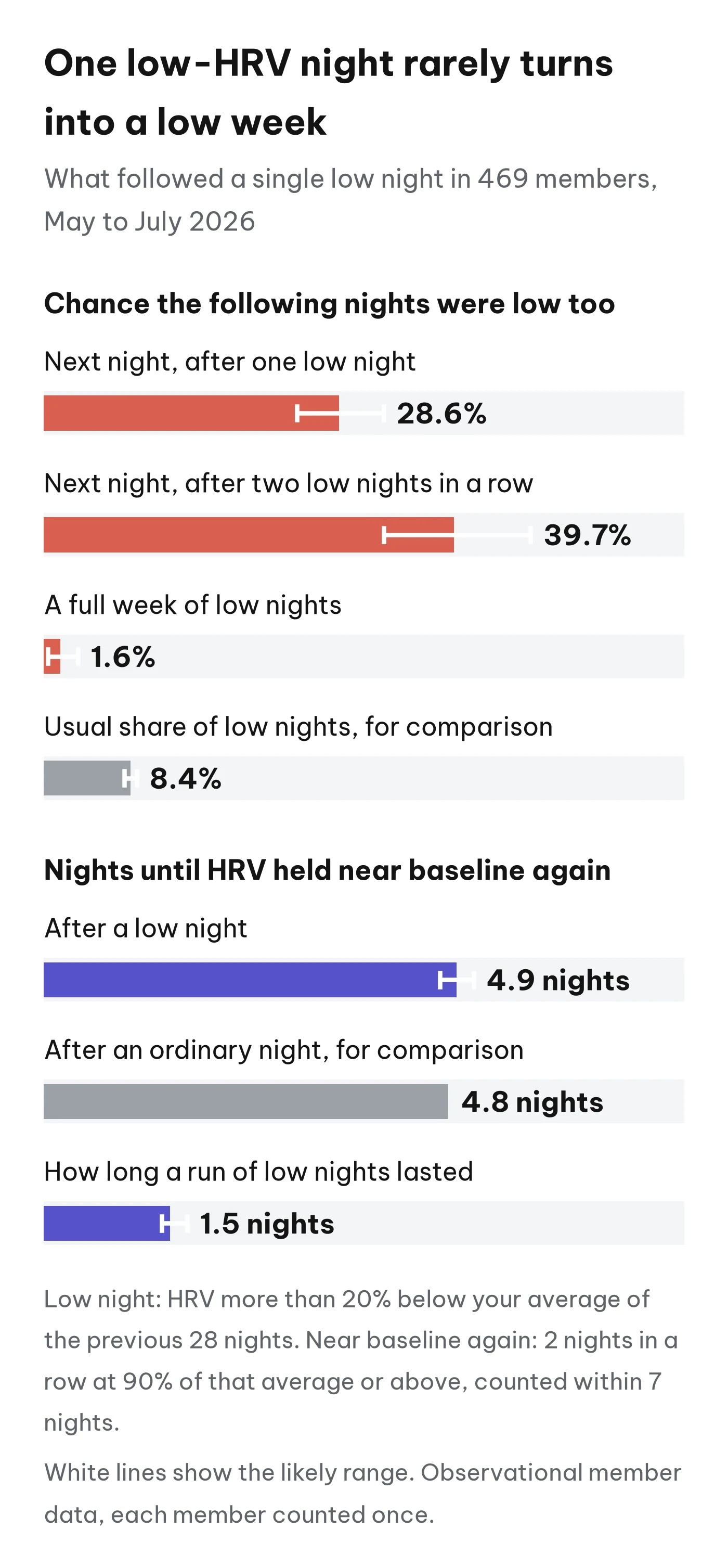
A sudden drop in HRV for one night rarely turns into a low week. We followed nightly HRV in 469 members from May to July 2026 (low-HRV night persistence ). A night counted as low when HRV fell more than 20% below that member’s average of the previous 28 nights.
- After one low night, the next night was low 28.6% of the time (412 members).
- After two low nights in a row, the next night was low 39.7% of the time (164 members).
- Only 1.6% of single low nights were followed by a full week of low nights.
- A run of low nights lasted 1.5 nights on average.
For comparison, 8.4% of these members’ earlier nights were low. So another low night was more common right after a low night, but runs stayed short.
Our return test, two nights in a row back at 90% of baseline or above, took 4.9 nights on average within a 7-night window. After an ordinary night, the same test took 4.8 nights. So much of that wait comes from the test itself, not from the low night.
This is why sports scientists read HRV as a rolling average. In a case study of two elite triathletes, the 7-day average of HRV fell steadily before one became overreached, while the other’s stayed stable (Plews et al., 2012 ).

How long does alcohol affect HRV and sleeping heart rate?
In our members, a logged drinking day was linked with higher sleeping heart rate for about one night. Research on alcohol and HRV links drinking with lower HRV-based recovery in the first three hours of sleep, and more alcohol with a bigger drop.
In 4,098 Finnish employees (Pietilä et al., 2018 ), that recovery measure fell 9.3 percentage points after low intake, 24.0 after moderate intake and 39.2 after high intake.
Our member analysis tracked sleeping heart rate. Across 1,317 members and 2,116 logged drinking days, sleeping heart rate averaged 0.6 bpm above usual on the night after drinking. By the second night, the average showed no rise.
Our app doesn’t record amounts, so this average can’t show how dose changes the timing.
Does HRV drop when you’re sick? What our data shows
Often. In our study of 211 ring wearers around an illness flagged in the app, mostly by the ring’s own illness checks, sleep HRV sat 3.8 ms below baseline on the sick night. Group-average HRV fell from 46 ms three nights before to 42 ms, while resting heart rate rose from 58 to 62 bpm.
Sleeping heart rate starts changing earlier. In 1,101 members, it climbed in the nights before a logged sick day (illness analysis ). It peaked 4.4 bpm above usual on the night before the sick day (946 members with a reading that night), then was back near usual five nights after that peak.

In the 211-wearer study, any one signal on its own flagged fewer than half of sick nights. Reading HRV alongside resting heart rate, temperature and how you feel gives you more context.
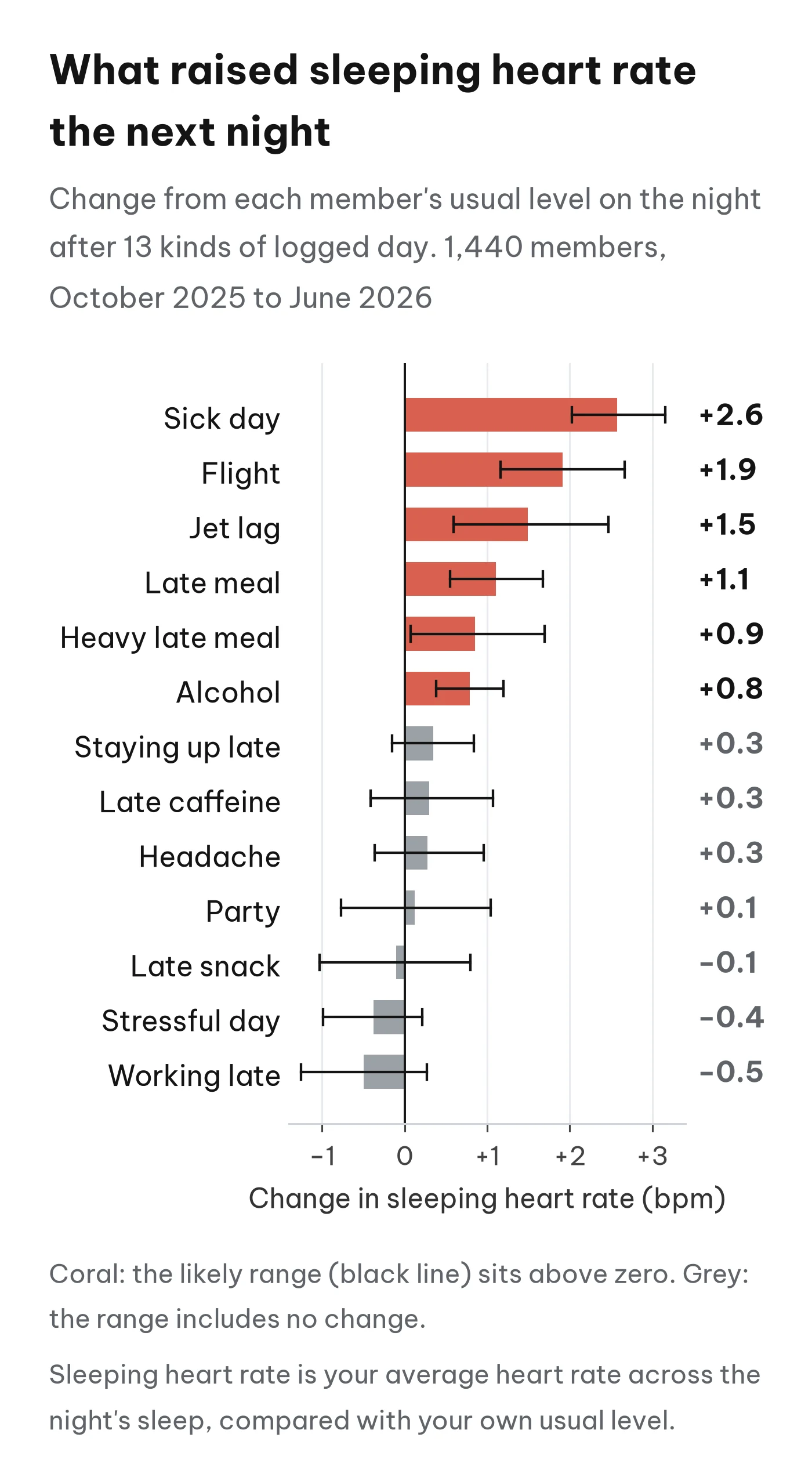
In a separate sample of 1,440 members , with 130 to 553 per kind of day, a sick day moved next-night sleeping heart rate the most of 13 kinds of logged day, followed by a flight and jet lag. A logged drinking day in this sample was followed by a 0.8 bpm rise.
A stressful day showed no clear change; our HRV and stress guide covers ongoing stress.
Does short sleep lower HRV?
In lab studies, sleep deprivation lowers RMSSD. A 2025 meta-analysis of 11 trials with 549 participants found a significant drop (Zhang et al., 2025 ).
Everyday short nights looked milder in our data. We studied 1,024 members who had both a single short night and three short nights in a row. A short night meant a sleep window more than 60 minutes shorter than their 28-night average.
In these 1,024 members, after either one short night or three in a row, average HRV stayed within a millisecond of baseline on every night of the next week.
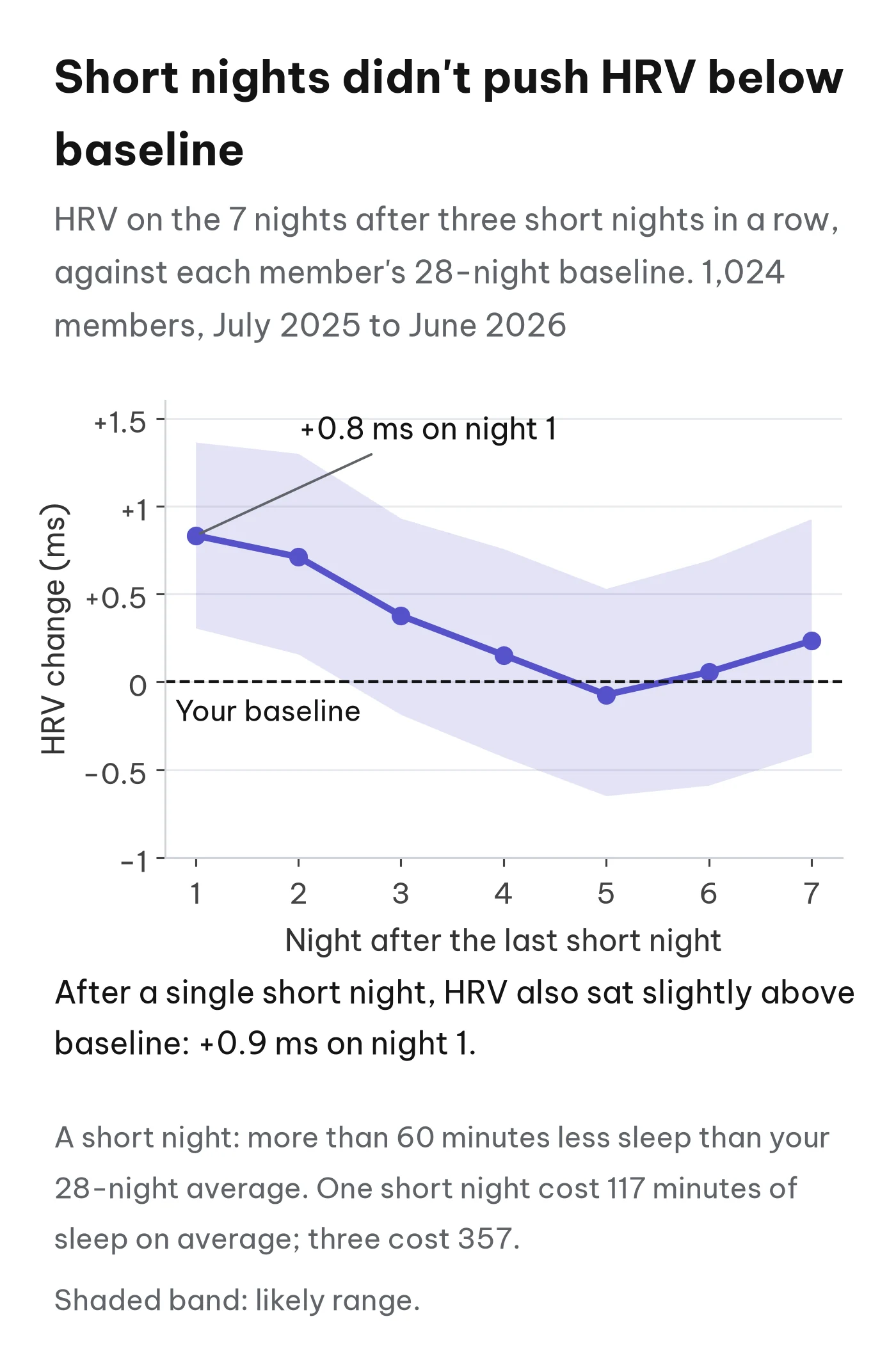
On nights 5 and 6, HRV after three short nights sat up to 0.9 ms below HRV after one. That’s a small gap, and with seven nights compared, one or two differences can appear by chance.
Your sleep also needs time to settle. In our study of recovery after one bad night , involving 4,582 Ring AIR users, sleep metrics took about three to four days to return to their usual level after one poor night. Our sleep debt guide covers catching up.
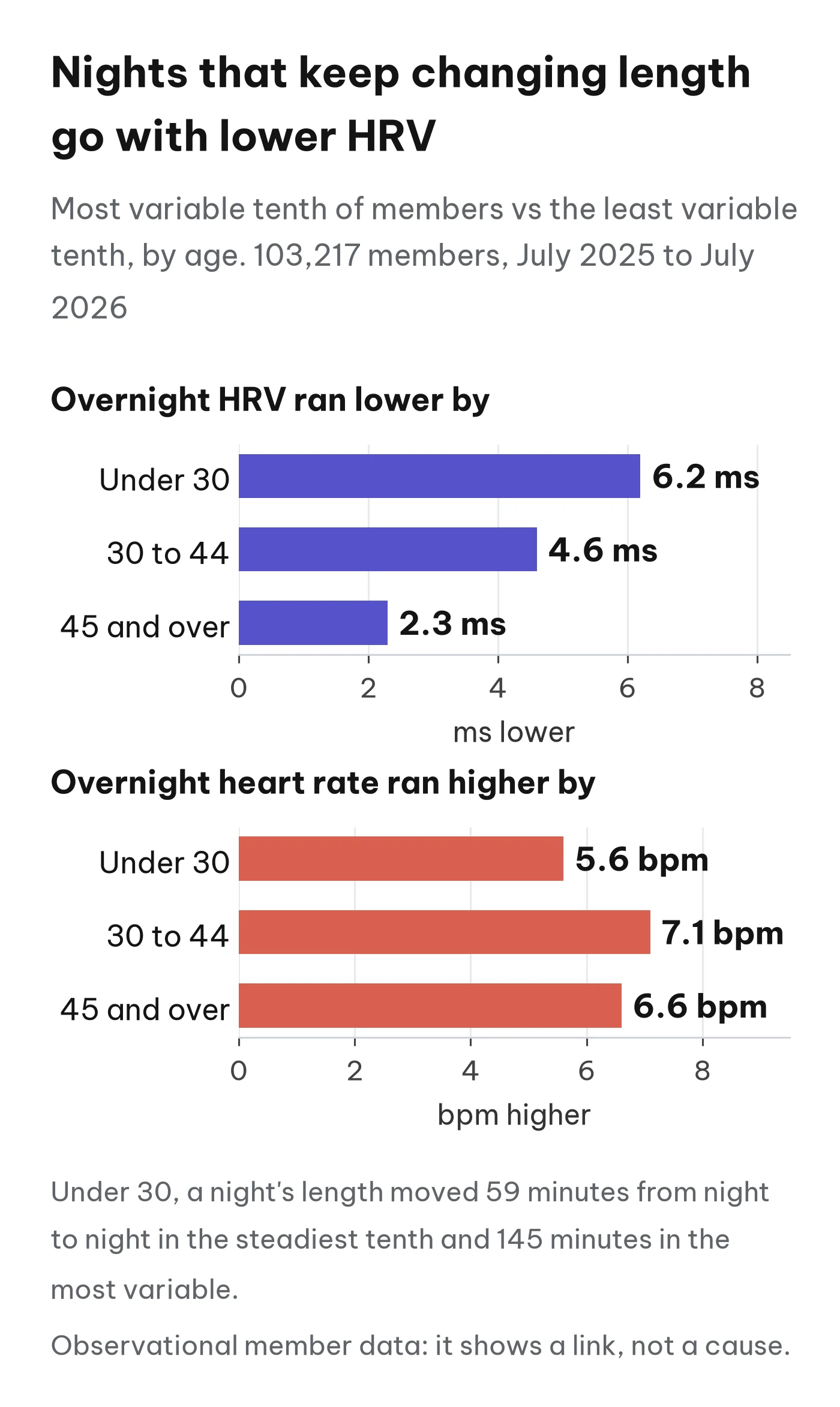
Night-to-night swings in sleep length showed a clearer link. Across 103,217 members , the tenth whose sleep length swung most from night to night had lower overnight HRV than the steadiest tenth, in every age band. This shows a link, not proof that steadier sleep raises HRV.
Should you train or take a rest day when HRV is low?
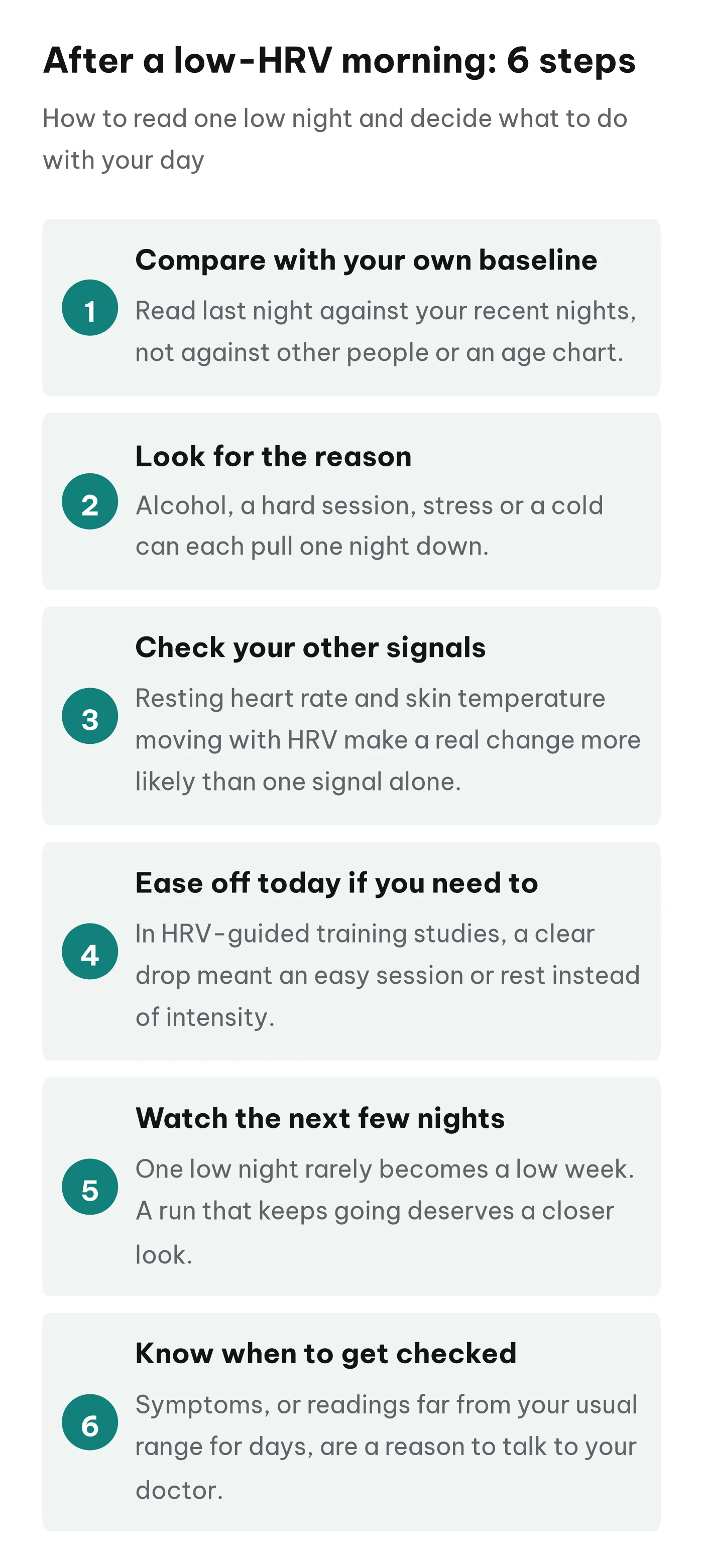
If your HRV trend sits in its usual range and you feel well, train as planned. If the trend drops below that range, switch to an easy session or rest. Researchers judge changes against normal day-to-day noise and your training context, not one reading (Buchheit, 2014 ).
In HRV-guided studies, endurance trainees went hard when HRV sat in their usual range and went easy or rested when it dropped.
In one trial of 40 runners (Vesterinen et al., 2016 ), the HRV-guided group did fewer hard sessions, 13.2 vs 17.7. Their 3,000 m running performance improved 2.1%, a significant gain that the planned group (1.1%) didn’t show, though the gap between groups was small.
Across studies, HRV-guided training gave a significant rise in vagal HRV, while its fitness edge was small and not statistically significant (Manresa-Rocamora et al., 2021 ). See how to train with HRV for five practical ways to use it.
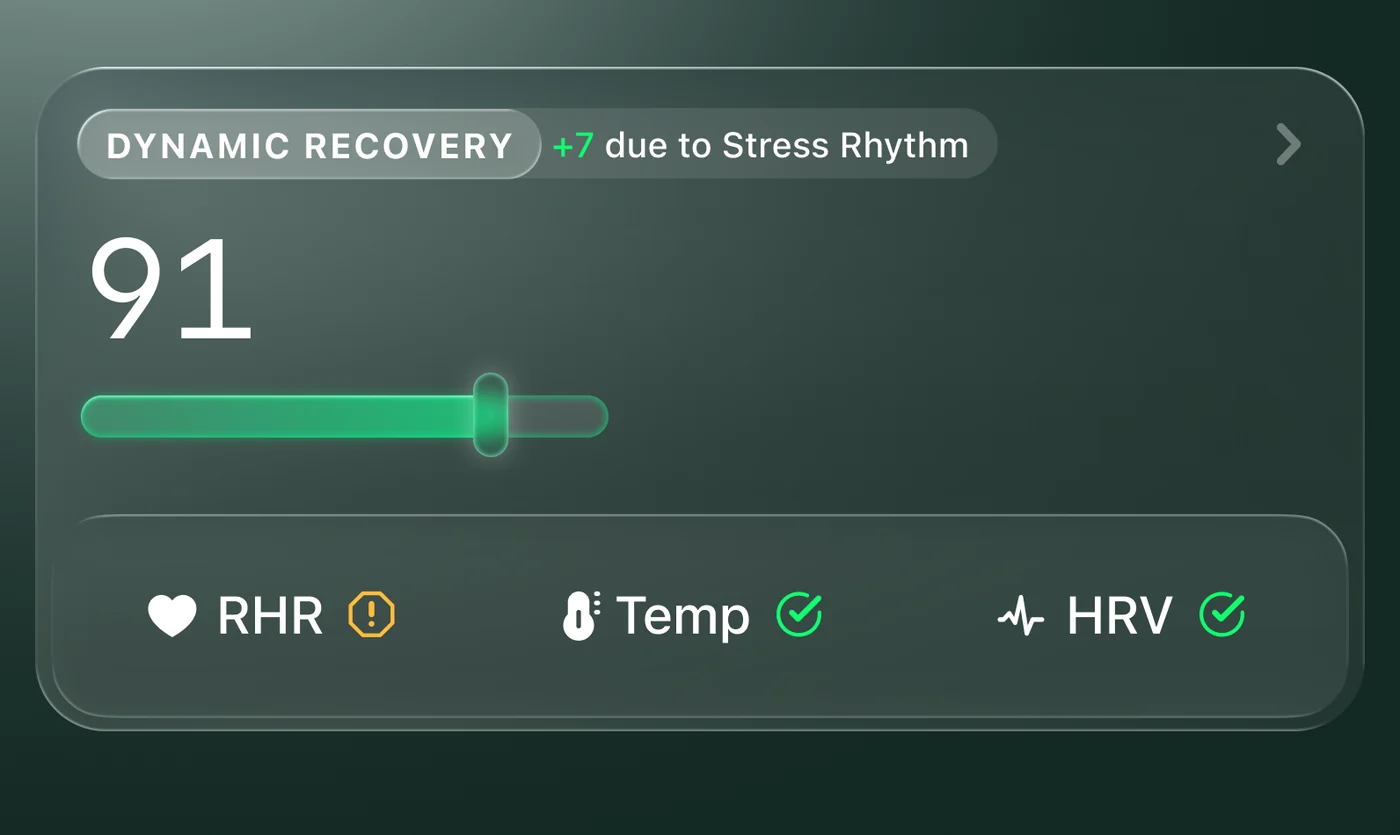
Ring Tip: open your Dynamic Recovery score and tap its contributors. It weighs your sleep, resting heart rate, HRV, skin temperature and Stress Rhythm against your own baseline, and Stress Rhythm can move it up to 10 points through the day (how the score works ). Our recovery score guide explains each part.
What helps HRV recover
- Aim for a steady sleep length. In our members, big night-to-night swings were linked with lower HRV.
- Plan easy days after hard ones. Recovery after high-intensity work can take 48 hours or more.
- Keep drinks away from key nights. Alcohol’s effect on HRV grows with the dose.
- Try cold water after hard sessions. In 18 cyclists, cold water immersion raised post-exercise ln rMSSD 16.0% more than passive rest and eased soreness, though performance didn’t change (Stanley et al., 2012 ).
- Breathe slowly. Slow breathing at about six breaths a minute (0.1 Hz) raises vagally mediated HRV (Sevoz-Couche and Laborde, 2022 ).
- Train regularly. In randomized trials, exercise training raised RMSSD (Amekran and El Hangouche, 2024 ).
Our guide to improving your HRV has more.
When to see a doctor
HRV is a wellness signal, not a diagnosis. See your doctor if low readings come with symptoms such as chest pain, fainting, breathlessness or a fever that won’t settle. Do the same if your readings stay far from your usual range for days with no clear reason.
FAQ
Does workout timing affect overnight HRV?
It may. In our study of 2,345 male Ring AIR users , morning exercisers, training before 1 p.m., had sleep HRV 2 to 23 ms higher than those training between 1 and 8 p.m. in most regions and activity groups, though not all. If you train late, compare late-workout nights with each other.
Does regular exercise protect you from alcohol’s effect on HRV?
No. In the study of 4,098 employees (Pietilä et al., 2018 ), alcohol’s effect on HRV-based recovery was similar for active and inactive people and for men and women. It was stronger in younger people.
Can a ring tell you you’re getting sick?
It can show a change, not a diagnosis. In our illness study , a combined score of four signals separated sick nights from ordinary nights in 203 wearers with 62% sensitivity and 81% specificity. Treat it as context alongside how you feel.
How big does an HRV drop need to be before I change my training?
One HRV-guided training trial (Kiviniemi et al., 2007 ) set a simple rule: drop to an easy day or rest when HRV fell below the 10-day average minus one standard deviation, or fell two days in a row. Otherwise, train as planned. Dynamic Recovery also reads each night against your own baseline.
Can HRV be too high after hard training?
Sometimes. In a meta-analysis of endurance overreaching (Bellenger et al., 2016 ), when performance had dropped, resting RMSSD rose slightly on average instead of falling. A reading above your usual range isn’t automatically good news, so read it alongside how you feel and how training is going.
In the US, Ring PRO is available for purchase here
Sources
- Stanley J, Peake JM, Buchheit M. Cardiac parasympathetic reactivation following exercise: implications for training prescription. Sports Medicine, 2013. PubMed 23912805
- Hynynen E, et al. Effects of moderate and heavy endurance exercise on nocturnal HRV. International Journal of Sports Medicine, 2010. PubMed 20419617
- Nuuttila OP, et al. Reliability and sensitivity of nocturnal heart rate and heart rate variability in monitoring individual responses to training load. International Journal of Sports Physiology and Performance, 2022. PubMed 35894977
- Bellenger CR, et al. Monitoring athletic training status through autonomic heart rate regulation: a systematic review and meta-analysis. Sports Medicine, 2016. PubMed 26888648
- Buchheit M. Monitoring training status with HR measures: do all roads lead to Rome? Frontiers in Physiology, 2014. PubMed 24578692
- Pietilä J, et al. Acute effect of alcohol intake on cardiovascular autonomic regulation during the first hours of sleep in a large real-world sample of Finnish employees. JMIR Mental Health, 2018. PubMed 29549064
- Zhang S, Niu X, et al. Effects of sleep deprivation on heart rate variability: a systematic review and meta-analysis. Frontiers in Neurology, 2025. PubMed 40895095
- Kiviniemi AM, et al. Endurance training guided individually by daily heart rate variability measurements. European Journal of Applied Physiology, 2007. PubMed 17849143
- Vesterinen V, et al. Individual endurance training prescription with heart rate variability. Medicine & Science in Sports & Exercise, 2016. PubMed 26909534
- Manresa-Rocamora A, et al. Heart rate variability-guided training for enhancing cardiac-vagal modulation, aerobic fitness, and endurance performance: a methodological systematic review with meta-analysis. International Journal of Environmental Research and Public Health, 2021. PubMed 34639599
- Stanley J, Buchheit M, Peake JM. The effect of post-exercise hydrotherapy on subsequent exercise performance and heart rate variability. European Journal of Applied Physiology, 2012. PubMed 21710292
- Sevoz-Couche C, Laborde S. Heart rate variability and slow-paced breathing: when coherence meets resonance. Neuroscience & Biobehavioral Reviews, 2022. PubMed 35167847
- Amekran Y, El Hangouche AJ. Effects of exercise training on heart rate variability in healthy adults: a systematic review and meta-analysis of randomized controlled trials. Cureus, 2024. PubMed 39015867
- Plews DJ, et al. Heart rate variability in elite triathletes, is variation in variability the key to effective training? A case comparison. European Journal of Applied Physiology, 2012. PubMed 22367011
- Ultrahuman Science:
THE AUTHOR