You’re motivated to improve your sleep. You’ve invested in a sleep tracker. You’re monitoring your sleep every night.
That means you’re guaranteed to sleep better, right?
Unfortunately, it’s not that simple.
In a recent study involving 229 older adults, simply providing regular reports about sleep did not improve insomnia symptoms. Participants who also received guidance on sleep habits and daytime activity, however, experienced improvements.
The message? Collecting sleep data isn’t the same as improving sleep.
In 7 years of sleep coaching clients, I’ve found that sleep tracking data – like that from the Ultrahuman Ring PRO or Ring AIR – can be incredibly helpful for reinforcing new habits. However, I’ve also seen wearable data generate unnecessary anxiety.
The value of sleep tracking wearables depends on how we interpret the information, and what we do with it.
In this guide, I outline how tracking can enable people to improve the quality and duration of sleep.
Which sleep measurements are most useful?
Sleep duration is a useful place to start. Most working age adults need at least seven hours of sleep , but our sleep needs vary depending on age, genetics, as well as our recent sleep history.
Your average sleep duration over a couple of weeks is more important than any single night. Are you regularly getting enough sleep to feel alert and function well during the day? Are you using sugar or caffeine to compensate for lack of sleep? Sleeping for longer at weekends is often a sign that you would benefit from more sleep during the week.
If you regularly sleep for eight or more hours, but your recovery is stubbornly below 70, this could be a clue that something is interfering with the quality of your sleep.
Sleep consistency , or regularity is increasingly recognised as a key metric for health, safety and performance . Our bodies run on approximately 24-hour circadian rhythms, and maintaining reasonably regular sleep and wake times helps keep these rhythms aligned, and the body working efficiently.
Sleep consistency has also been linked to better sleep quality. For example, in an analysis of 97,000 Ultrahuman users, members whose bedtimes got 25%+ more regular slept about 3.5 minutes more a night, because they spent less time awake. That’s based on about 40,000 improvers and 13,000 stable users over two 4-week windows, adjusted for how irregular each person started out.
These differences may sound small in absolute terms but those extra minutes of sleep could make a meaningful difference over time. This analysis cannot establish cause and effect but the findings complement wider research linking sleep regularity to health.
For example, a 2026 study by Ultrahuman, Bangor University and Stanford University’s Snyder Lab and others, analysed more than 227,000 nights of paired sleep and glucose data, found that less consistent sleep was associated with higher overnight glucose levels and less time spent within a recommended glucose range. This study provides an intriguing example of how regular sleep patterns may be relevant to metabolic health as well as sleep itself.
What about Sleep Index and Recovery scores?
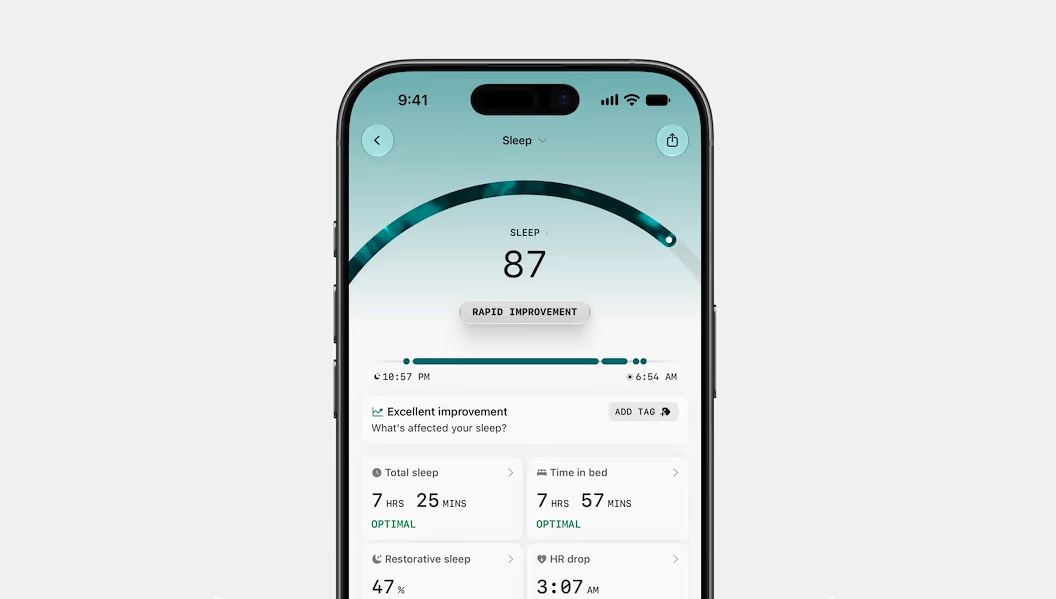
Composite scores, such as Ultrahuman’s Sleep Index and Dynamic Recovery Score , combine multiple measurements to provide a more holistic overview of your sleep and physiological recovery.
These scores can be useful for spotting trends, particularly when you explore the impact of specific behaviours on both sleep and recovery. For example, you could compare the effect of a glass of wine at 5pm or 9pm on your sleep and recovery.
It’s important to emphasise that no single score can capture everything that influences how well you feel.
So, what about how you actually feel?
There’s one important thing your sleep tracker can’t measure directly: your personal experience of sleep.
You might wake feeling refreshed and energised, only to discover that your tracker has given you a disappointing score. Equally, you might achieve an excellent score but still feel exhausted.
Neither experience is necessarily wrong.
Research suggests that objective measurements of sleep, such as duration and fragmentation, are often only weakly associated with how well people feel they’ve slept .
That’s partly because they’re measuring different things. A tracker estimates aspects of your sleep physiology and behaviour, while your own assessment reflects how restorative and satisfying that sleep felt.
Both perspectives matter. In fact, research suggests that subjective and objective sleep disturbances can each provide information about future health outcomes.
You could try recording a simple daily rating of sleep satisfaction or morning energy alongside your tracker data. Over time, you may discover which patterns are most closely associated with feeling and functioning at your best.
How to use sleep data to improve your sleep
One of the most powerful ways to use a tracker is to combine what the technology measures with what you notice about yourself.
For example, could getting outside for a morning walk help you sleep better?
Light is one of the strongest signals to our internal biological clock. Exposure to bright light in the morning can help shift our circadian rhythms earlier, while research has linked greater daytime outdoor light exposure with better sleep, mood and morning alertness.
- Start by observing: For a week, follow your usual routine. Notice your average sleep duration, bedtime and wake-up time, and how satisfied you feel with your sleep each morning.
- Then experiment. For the next two weeks, try spending 30 minutes outside in the morning, ideally soon after waking. A walk is a lovely way to combine light exposure with movement, although sitting outside with your morning coffee counts too.
- Compare: Has your sleep timing become more consistent? Are you falling asleep earlier, sleeping for longer, or feeling more refreshed?
Look for patterns across the weeks rather than judging individual nights. Other factors, including stress and changes in routine, may also influence your results. If the experiment seems helpful, you might choose to continue. If not, there’s always something else to explore.
Jade, Ultrahuman’s biointelligence AI, can help you understand how changes are affecting your sleep. You can ask natural language questions, such as “how has my sleep trends changed in the past 2 weeks” and get a full picture of duration, consistency, and sleep index scores over that period.
Ultrahuman’s Smart Tags can help you record everyday activities alongside your physiological data. You could also keep a simple note of how refreshed you feel each morning.
If feelings of fatigue and tiredness aren’t changing with improved sleep, then a blood test can look for deeper issues. Ultrahuman’s Blood Vision (available in U.S, India and UAE) can look for this, or any blood test can be uploaded to the Ultrahuman app to be analyzed by Jade alongside sleep data.
Trackers can be incredibly helpful for facilitating this trial-and-error approach, to explore what works for us as individuals.
When tracking becomes counterproductive
I’ve worked with clients for whom wearable data has been profoundly helpful for motivating behaviour change. For example, when it comes to reducing alcohol consumption or reducing phone use before bed. However, I have also met clients who have admitted to waking up in the early hours and then checking their sleep score, just to confirm their worst fear… a poor night’s sleep.
There’s a phenomenon known as orthosomnia , where people become so preoccupied with achieving perfect sleep data that the effort itself can interfere with sleep.
If you wake feeling refreshed but your tracker gives you a disappointing score, it’s easy to start questioning your own experience.
Sleep is particularly sensitive to pressure. Worrying about whether you’re getting enough deep sleep, for example, could make it harder to relax.
If tracking increases your anxiety, it may help to review your data less frequently, or even take a break for a few weeks.
I’d argue that the goal of sleep tracking isn’t to achieve perfect sleep data. It’s to understand the habits and routines that help you sleep well enough to thrive in your waking hours.
Dr Sophie Bostock is a sleep scientist, speaker and founder of The Sleep Scientist. With a PhD from UCL and five years working on Sleepio, an evidence-based digital treatment for insomnia, she translates sleep science into practical strategies to improve health, wellbeing and performance, helping people sleep better and live better.