Heart rate variability is a core marker for underlying health, and a common question Ultrahuman is asked is what counts as a good HRV for men and women.
The answer is nuanced. HRV changes as we age and is highly personal, so it is more useful to understand your own baseline than to compare it against anyone else’s.
That said, across 510,000 users, a good overnight HRV for women runs around 46 ms in their twenties and settles near 32 ms by the sixties. Men average 52 ms in their 20s down to 36 ms, roughly 4 to 6 ms higher at every age.
In this guide, we explain what HRV looks like by age and gender across 510,000 Ring users, and how to read your own number against theirs.
What is HRV
HRV is the variation in time between consecutive heartbeats, measured in milliseconds. A higher HRV means the autonomic nervous system can switch smoothly between active and rest states. A lower one means the parasympathetic, rest-and-digest side is dampened, often by stress, poor sleep, illness or aging.
Most Ring users see HRV reported as RMSSD, the root mean square of successive differences, measured overnight during sleep. It is one of the most commonly used time-domain metrics.
HRV by age and gender
We analyzed 510,000 Ultrahuman Ring users. This is the median overnight HRV for each gender, by decade.
| Age band | Women | Men |
|---|---|---|
| 20–29 | 46 ms | 52 ms |
| 30–39 | 41 ms | 45 ms |
| 40–49 | 35 ms | 40 ms |
| 50–59 | 33 ms | 37 ms |
| 60–69 | 32 ms | 36 ms |
| 70+ | 33 ms | 38 ms |
These are medians, and the spread around each one is wide. Among women in their twenties, the middle half ran from 36 to 58 ms, so two healthy 25-year-olds can sit more than 20 ms apart and both be entirely normal. That gap is larger than the whole decline from the twenties to the sixties, which is why your own baseline tells you more than any table does.
Men’s median HRV runs about 4 to 6 ms higher than women’s in every age decade of this dataset: about 6 ms in the 20s, 4 ms through the 30s to 60s, and 5 ms in the 70+ group.
Both sexes decline at roughly the same rate. From the 20s to the 60s the female median falls from 46 to 32, a drop of 14 ms, and the male median from 52 to 36, a drop of 16. Parallel curves, offset upward in men.
The slight uptick at 70+ in both sexes probably reflects survivor selection, since older adults who keep wearing a Ring tend to be in better cardiovascular health than the general 70+ population.
Methodology note. Anonymized Ring AIR users tracking sleep in the Ultrahuman app: about 510,000 users, 321,532 women and 188,939 men, across 77 million nights, ages 20 to 90. The 20s to 40s rows each draw on tens of thousands of users. The 70+ rows draw on fewer than 4,000 each, so those figures are less stable. Each night counts equally, so people who wear the Ring more often contribute more data. Gender is self-reported. Ring users are a self-selected, health-aware population, so the medians likely sit a little above a fully random sample. Observational wearable data, not a clinical study.
Why men typically have higher HRV
The 4 to 6 ms gap shows up consistently in cardiology research. Three mechanisms are usually proposed, and their relative contribution varies across studies.
- Vagal tone: men tend to show stronger parasympathetic dominance at rest in many studies, though the effect is smaller than the variation within each sex.
- Hormones: estrogen and progesterone shifts across the menstrual cycle subtly move HRV, which often runs lower in the luteal phase. Averaged across the cycle, this can pull HRV down for women of reproductive age.
- Heart size and body composition: differences between the sexes may contribute, though this is less established than the other two.
Voss 2015 found gender differences especially in the frequency domain, with the gap narrowing in the oldest decades. Umetani 1998 found similar age and gender patterns across nine decades, with the timing of gap closure depending on which measure was used.
In this dataset the gap is still present at 70+, which does not match the narrowing those studies describe. That said, the 70+ bands are the thinnest cells here, with fewer than 4,000 users each, so this is worth treating as a question for a larger sample rather than a settled finding.
For practical purposes, the variation within any age band, driven by lifestyle, sleep, training and alcohol, tends to be larger than the gap between men and women. Use your gender and age band as a reference point, and do not read much into sitting a few milliseconds either side of the median.
How to use HRV
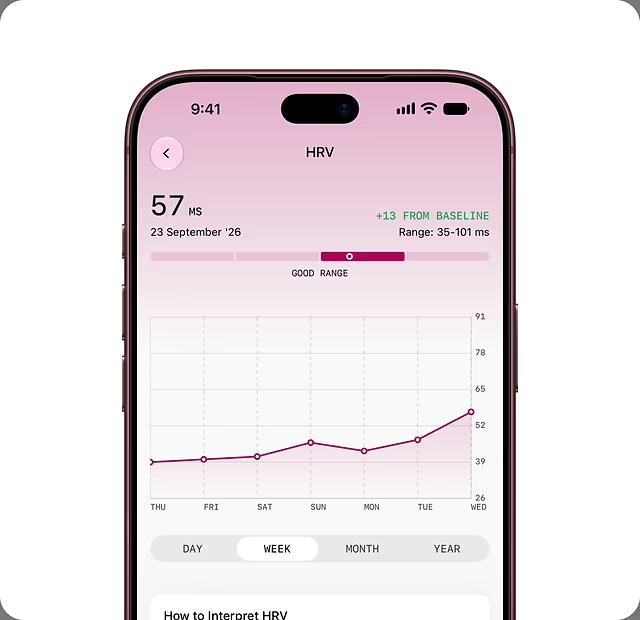
HRV is a highly individual marker, and two people of the same age and fitness can have very different numbers. There are broad trends, since HRV tends to be higher in well-trained people and falls as we age, but there are few useful comparisons to make person to person.
To get something out of it, follow two rules.
Compare against your own baseline first. Track HRV over time to establish a personal baseline (Plews et al., Sports Med 2013, PMID 23852425 ). Day-to-day swings are normal in healthy adults, and the trend across weeks is the more useful read.
Compare against your gender and age band second. If your two-week rolling average sits well below the median for your band, that is worth looking into. Even then it comes back to your baseline: if you normally run low while well rested, there may be nothing to explain.
Common reasons HRV reads low with nothing clinically wrong:
- A late, large or alcohol-paired dinner
- A hard training session in the days before, since HRV drops with training stress and rebounds with recovery
- Sleep deprivation or jet lag
- Being unwell, including in the day or two around an illness when you may not feel much yet
- Measurement noise, from a poor Ring fit, motion artifacts or a short recording window
For a deeper look at what trips up HRV measurement, see our guide to HRV measurement mistakes .
What shifts HRV at any age
These levers work at every age band and in both sexes, and their effects are often larger than the gender gap or a decade of aging.
Keep your sleep times consistent. Going to bed and waking at similar times helps steady HRV across the week, and regularity tends to do more than occasional extra hours at irregular times.
Cap evening alcohol. This is the clearest single-night lever we can measure, because members tag it themselves. Comparing 5,129 members against their own non-drinking nights, across 29,826 tagged nights, overnight HRV ran a median 12.6% below their own baseline on nights they logged a drink, and 77.6% of members showed the drop. More drinks meant a bigger fall: 17% lower on one, 18% on two, 21% on three or more. It clears quickly, with roughly a third of the effect still there the following night and none by the night after. The published literature points the same way (de Zambotti et al., Sleep 2021, PMID 32663278 ).
Add zone-2 cardio. Low-intensity training tends to be well tolerated for HRV in athletic-monitoring research, because it does not pile on the sympathetic load of hard intervals.
Manage stress structurally. Breathing protocols raise HRV while you do them and for a while afterwards. Changes to workload, schedule and relationships are what move the baseline.
Work the vagus nerve directly. Slow breathing with a long exhale raises HRV acutely through vagal pathways. See our piece on the vagus nerve for the biology, and 12 ways to improve HRV for structured interventions.
When low HRV is worth a clinical conversation
For most adults a low reading is a lifestyle signal rather than a medical one. Sustained low HRV is associated with higher cardiovascular risk in populations without known heart disease (Hillebrand et al., Europace 2013, PMID 23370966 ), though that work measured SDNN and LF/HF rather than the overnight RMSSD a Ring reports.
See a clinician if you notice:
- A sustained drop from your established baseline lasting several weeks, with no clear lifestyle explanation
- HRV dropping alongside new symptoms: palpitations, chest discomfort, unexplained fatigue, fainting or shortness of breath
- HRV that fails to recover after illness or training stress that used to resolve within days
- Low HRV alongside an abnormal resting heart rate, meaning sustained above 100 bpm without explanation, or below 60 bpm without an athletic one, using the AHA tachycardia and bradycardia thresholds
For how persistent low HRV connects to stress and burnout, see our piece on low HRV and stress .
This article is for information and is not medical advice. Interpreting HRV in the context of a medical condition or medication should involve a clinician. If you take medication that affects heart rate, such as beta-blockers, antiarrhythmics or certain antidepressants, read your HRV alongside guidance from your care team.
Frequently asked questions
What’s a normal HRV by age and gender?
For women, median overnight HRV runs about 46 ms in the 20s, falling to 32 or 33 ms by the 60s. For men the figures are about 52 ms in the 20s and 36 ms in the 60s, roughly 4 to 6 ms higher at every age. Both sexes show a wide normal range, and the trend over weeks matters more than the absolute number.
Why do men have higher HRV than women?
Across population studies, men show higher HRV largely because of differences in vagal tone, hormonal effects across the menstrual cycle, and heart size. The gap is consistent but smaller than the variation within each sex.
Does HRV decline with age?
Yes, in both sexes. The female median falls from about 46 ms in the 20s to 32 or 33 ms by the 60s, and the male median from about 52 to 36 over the same range. The steepest drop is between the 20s and 30s, and the decline is gradual after that.
What’s a good HRV for my age?
Use the table above as a reference. An overnight HRV at or above the median for your gender and age band reflects good autonomic recovery. Sitting well below that median is worth examining your sleep, alcohol, training load and stress for likely causes.
Why does my HRV change during my menstrual cycle?
HRV typically runs lower in the luteal phase, after ovulation, and higher in the follicular phase, which is consistent with progesterone’s effect on autonomic balance. The within-cycle pattern is usually smaller than the night-to-night noise from sleep and stress.
Why does my HRV fluctuate so much day to day?
HRV responds to sleep, alcohol, training, illness and stress. Large day-to-day swings are normal in healthy adults. Look at 7 and 14-day rolling averages to see the signal under the noise.
Can I improve my HRV after 50?
Yes. Sleep consistency, less alcohol, zone-2 cardio and stress management move HRV at every age and in both sexes. The aging effect is real but slow, and behavioral changes usually move the number faster.
Should I see a doctor about my HRV?
Most low readings are lifestyle signals, not medical ones. Clinical evaluation is warranted for sustained drops from baseline alongside symptoms, failure to recover from illness or training stress, or low HRV alongside an abnormal resting heart rate.
THE AUTHOR