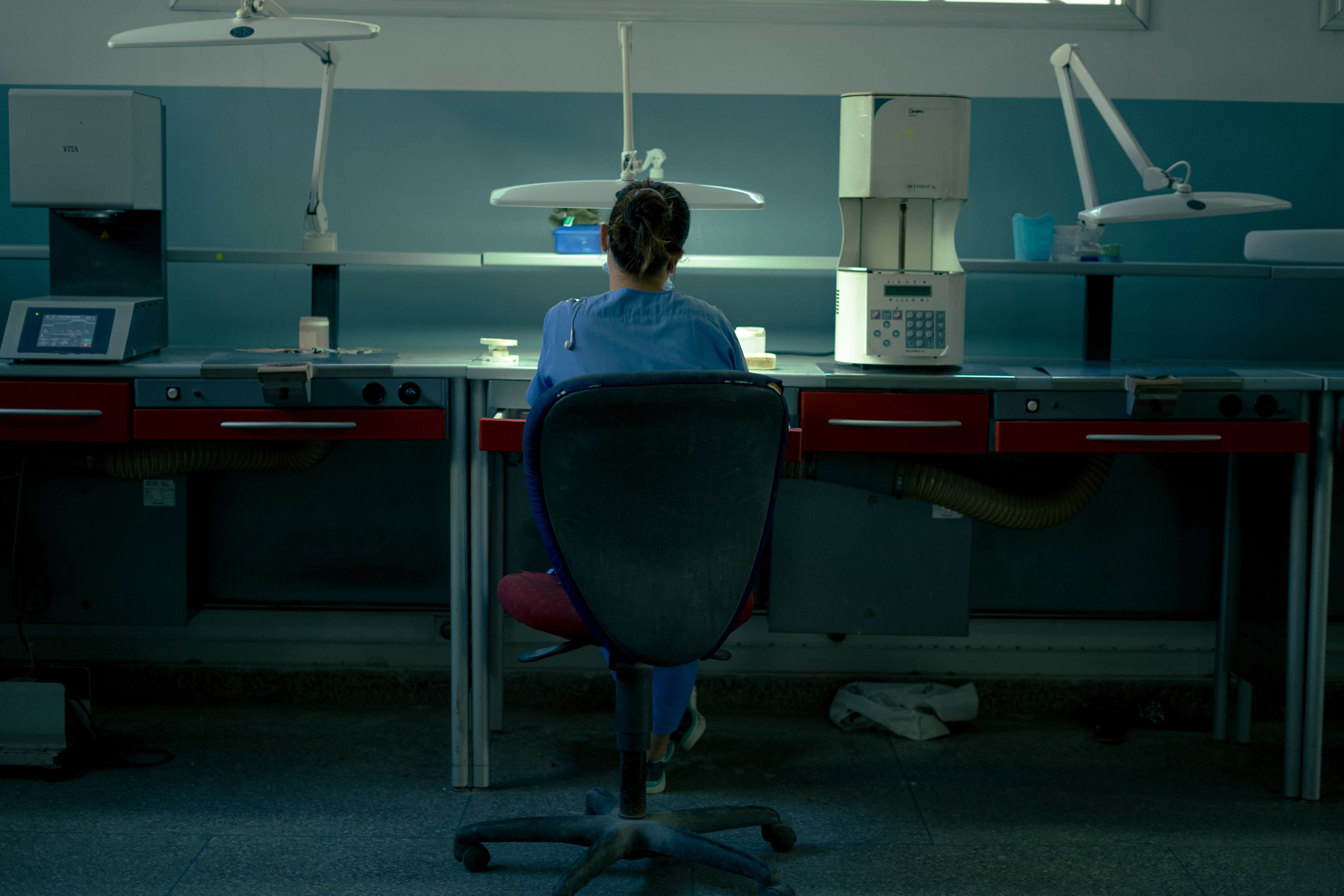
Our society is held up by shift workers – from doctors and nurses to first responders, people put their health second to be there when we need them. But it comes at a cost: shift work is linked to poor health outcomes and even sleep disorders such as SWSD.
Between 15 and 30% of adults work some kind of shift pattern, and 19% of Europeans work at least two hours between 10pm and 5am. For most of them the problem is not the number of hours they sleep. It is when those hours fall.
For some, it goes further than tiredness. Shift work sleep disorder is a recognized sleep disorder with its own diagnostic criteria, and in a review of 24 studies covering 15,479 nurses, 45.5% met them.
In this guide, we explain why night work is hard on sleep, what the diagnosis involves, what our own members’ nights show, and what actually helps.
Key takeaways
- Shift work affects sleep duration and timing. Eight hours of daytime sleep does not fix the detrimental effects of big swings in sleep timing.
- Shift work sleep disorder means serious sleepiness or trouble sleeping, caused by your schedule and lasting months rather than days.
- The strongest schedule risk factor is a short gap between shifts, which raised the odds around two and a half times.
- In our own data, members whose nights kept changing length ran 5.6 to 7.1 bpm higher overnight heart rate than members whose nights stayed a similar length.
- Falling asleep without meaning to, at work or at the wheel, is a reason to see a doctor rather than push on.
Why night work is hard on sleep
Your body clock governs more than tiredness. It sets the daily rhythm of blood pressure, hormone release, and how your body handles glucose.
Working nights creates two separate problems. Ordinary sleep loss can be fixed by sleeping longer – if that’s possible. But poor sleep timing consistency is harder to fix. Eating at 3am, working under lights at 2am and sleeping through daylight all tell your body it is a different time than it is. Your blood pressure, digestion, and glucose handling carry on out of sync – and that impacts your health.
A review of 34 studies covering 2,011,935 people found shift work associated with a 23% higher risk of heart attack, a 24% higher risk of coronary events and a 5% higher risk of ischaemic stroke.
Shift work sleep disorder
Shift work sleep disorder is one of the circadian rhythm sleep-wake disorders. To meet the criteria you need serious sleepiness or trouble sleeping, a pattern that follows your rota rather than appearing out of nowhere, and symptoms that have gone on for months.
Boivin and Boudreau describe it as sleepiness or sleep disruption lasting at least a month in relation to the work schedule. A doctor will usually want a sleep diary or a fortnight of tracking, because a single bad week is not the same thing.
Research has found that roughly 10% of shift workers can suffer from SWSD, and another study found that number as high as 45.5% of nurses in a2026 review .
What our members’ nights show
We looked at a year of nightly sleep from 103,217 Ultrahuman Ring members , comparing each member against their own nights. The members whose sleep length changed most from one night to the next ran 5.6 to 7.1 bpm higher overnight heart rate than the members whose length changed least, in every age band. Heart rate variability was lower in the same members.
These weren’t shift workers – just normal people with varied bedtimes. Shift workers switching between days and nights experience even bigger swings between their sleep timings.
How to mitigate the effect of shift work on sleep
The light rules for night work run backwards compared with ordinary sleep advice, and they follow the same logic as crossing time zones .
- Get bright light early in your shift: Strong light in the first hours keeps your clock where your schedule needs it, and keeps you alert when your body expects to be asleep.
- Wear dark sunglasses on the way home: This is the one most people get wrong. Morning daylight on the commute home is the strongest possible signal that it’s time to be awake, and not winding down to sleep. It’s the opposite of what a night worker needs.
- Sleep in real darkness: Blackout blinds, or an eye mask if that is not possible. Daylight leaking into a bedroom does more than wake you. It pulls your clock earlier.
- Push back on short turnarounds: This was the strongest single risk factor, and one of the few that sits with your rota rather than with you. If you get any say over your schedule, spend it here.
- Be realistic about rotating shifts: If your schedule changes every few days, your clock cannot fully adapt to any of them, and trying to flip each time completely makes it worse. A partial compromise you repeat beats a full one you chase.
- Keep meal times, caffeine and exercise as steady as the rota allows for the same reason.
- See a doctor if it has gone past tiredness: Book an appointment if you are falling asleep without meaning to, if your sleep has been bad for months rather than weeks, or if low mood or anxiety has arrived with it. Occupational health is often the faster route, and it can also do something about your rota.
The Ultrahuman Ring’s Shift Work PowerPlug does the tracking for you, adapting to irregular sleep timing and picking up daytime naps.
Frequently asked questions
How is it different from just being tired after a night shift?
Everyone is tired after a night shift. The criteria look for sleepiness or disrupted sleep that follows your work pattern over months and gets in the way of ordinary life.
Does sleep tracking still work if you sleep in the day?
Daytime sleep is the one part of sleep with no practical laboratory comparison, so Ultrahuman checks it against the person instead. The Ring flags what it thinks was a nap and asks. Across 555,000 answered prompts , nine in ten flagged naps came back confirmed by the wearer.
Will it go away if I stop working nights?
Often, yes, and that is part of how the diagnosis works: the symptoms are tied to the schedule. But how quickly varies, and long-running sleep problems can outlast the job that started them, which is worth raising with a doctor.
References
- Vyas MV, Garg AX, Iansavichus AV, et al. Shift work and vascular events: systematic review and meta-analysis. BMJ 2012;345:e4800. PMID 22835925 . 34 studies, 2,011,935 people.
- Boivin DB, Boudreau P. Impacts of shift work on sleep and circadian rhythms. Pathologie Biologie 2014;62(5):292-301. PMID 25246026
- Roth T. Shift work disorder: overview and diagnosis. Journal of Clinical Psychiatry 2012;73(3):e09. PMID 22490262
- The prevalence and risk factors of shift work disorder among nurses: a systematic review and meta-analysis. International Journal of Nursing Studies 2026;174:105273. PMID 41223687 . 24 studies, 15,479 nurses.
- Ultrahuman. Does an irregular bedtime raise your heart rate? Ask Our Data . 103,217 Ultrahuman Ring members, July 2025 to July 2026.
THE AUTHOR