When it comes to monitoring your health, atrial fibrillation (AFib) has emerged as a key feature of health wearables.
The need is clear. AFib causes about one in seven strokes , and carries roughly five times the risk of an ischaemic stroke. It frequently produces no symptoms at all, so a large number of people who have it do not know.
AFib is also challenging to diagnose, even in a clinic. Early atrial fibrillation is paroxysmal, so it can be absent on any single reading. This makes a wearable device far more useful than relying on symptoms to show up during a doctor’s appointment.
A handful of smart rings have AFib capability – but the way in which it works is different to the ECG features you may have seen on a smartwatch.
In this guide, we look at how smart rings track AFib, how to choose a smart ring that’s equipped for AFib detection, and how the Ultrahuman Ring uses FibriCheck’s medical technology to offer both screening and spot checks.
ECG and AFib
ECG has been synonymous with the detection of abnormal heart rate rhythms – but the technology is different from that on a smart ring.
An ECG reads the electrical signal that makes the heart contract, and recording one needs contact points on opposite sides of the body.
A ring tracks AFib differently, by using the PPG sensor data rather than an ECG.
In atrial fibrillation, the top chambers of the heart stop beating in time and start to quiver, so blood pools instead of moving cleanly through, and the pulse arriving at your finger turns irregular. ECG reads the quiver, but a smart ring can read the uneven pulse arriving downstream.
What to look for in an AFib smart ring
Products differ enormously here while looking identical in the marketing. So here’s what to look for:
Who made the algorithm, and are they named?
Plenty of wearables run interpretation software built in-house by a company whose main business is fitness tracking. Others license it from a company that does nothing else. Look for features backed by regulated partners.
What was it checked against, and in how many people?
An accuracy figure without a reference standard is marketing. The reference standard for heart rhythm is a 12-lead ECG read by cardiologists.
Is it a regulated medical device, or a wellness feature?
A product can show you a rhythm chart as a general wellness feature with no regulatory assessment behind it at all. That is legal and reasonably common, and the packaging rarely makes the difference obvious.
How Ultrahuman Ring’s AFib Detection works
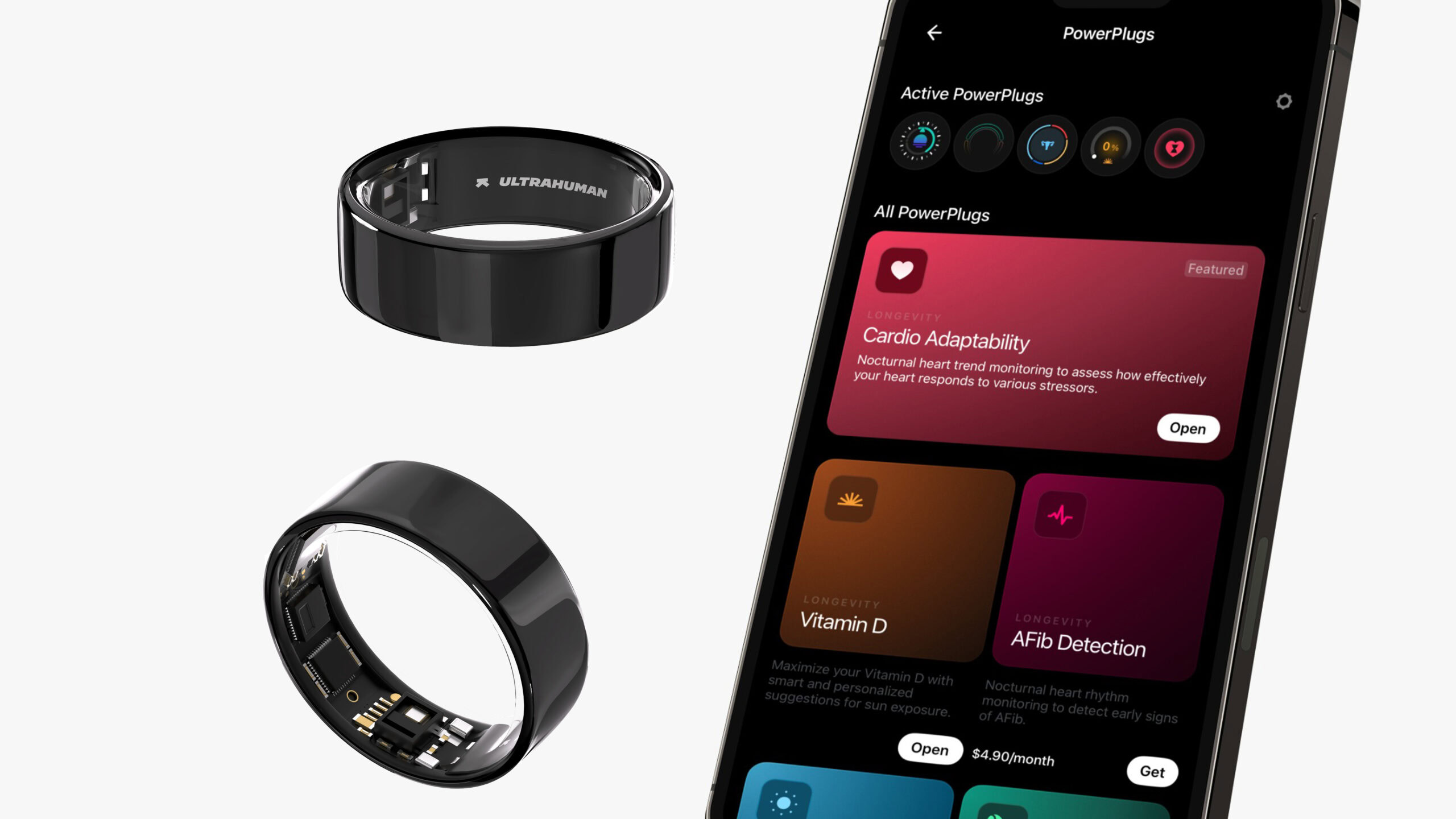
Ultrahuman Ring AIR and Ring PRO offer AFib detection via the AFib PowerPlug. It uses clinical-grade algorithms from FibriCheck, a CE-marked and FDA-cleared medical technology company specialising in heart rhythm diagnostics.
The PowerPlug runs passively while you sleep. It works on motion-free periods, when your heart is at rest, and sends what the ring records to FibriCheck’s algorithm, which sorts each night into one of three results.
Sinus rhythm means a normal, steady heartbeat. Possible irregularity means irregular patterns showed up, without being enough to call AFib. Possible AFib or atrial flutter is the result that asks you to do something. A fourth outcome, quality too low, means the night could not be analysed, usually from movement or poor ring contact. The result is in your morning summary, it builds a history over time, and you can export it to take to your doctor.
Passive screening from the AFib PowerPlug has now been joined by Heart Scan, a free 60-second spot check you can take at any time from the Ultrahuman dashboard.
This means that the Ultrahuman Ring offers both screening for AFib and the ability for users to take a heart rhythm reading, and generate a PDF to show their doctor. As symptoms of AFib are transient, this means a reading can be taken at the right moment.
FibriCheck’s multicentre validation ran across five hospitals, in 236 participants, and produced 2,195 readings each paired with a simultaneous 12-lead ECG, with every trace read independently by two cardiologists. Against that reference, the algorithm caught 99% of readings taken during atrial fibrillation and correctly cleared 98.7% of the rest, for 98.8% overall. It is published in npj Digital Medicine. A second validation tested the harder case, readings people took themselves at home without supervision, and caught 98.3% of atrial fibrillation with 99.9% specificity.
How to use AFib readings
If you get an AFib reading from your smart ring – the next step is an appointment with your doctor. Export the reading before you go.
The value in a consumer heart reading sits in handing the file to someone qualified to read it, so check that any product you buy gives you a file and does not lock the result inside its own app.
If you get symptoms – palpitations, a fluttering chest, light-headedness – write down when they happened and take a manual reading if your device offers this feature.
What a flag is not: a diagnosis, or a reason to change or stop any medication. If you have chest pain, call emergency services.
Where AFib Detection PowerPlug is available
AFib Detection PowerPlug is a regulated feature, so where it is sold depends on approval, not on where we ship rings.
It is available across the European Union, the United Kingdom and Switzerland, in Australia, Singapore, Hong Kong and Macau, across the Gulf in the United Arab Emirates, Saudi Arabia, Qatar, Kuwait and Bahrain, in Turkey and much of South and Southeast Asia, and in a long list of markets across Africa, the Caribbean and the Pacific. It is not currently available in the United States, Canada, India, Japan, Mexico, Brazil, New Zealand or South Africa. The PowerPlug store in the app shows what is available where you are, and that is the list to trust.
Heart Scan follows the same approvals. Where the AFib PowerPlug is sold, the 60-second check returns a heart rhythm result. Everywhere else it runs as a Cardio Adaptability check instead.
In markets without AFib Detection, the ring runs Cardio Adaptability. It is a wellness feature, and it answers a different question. It is built from the same raw measurement that HRV comes from: the gaps between your heartbeats.
A heart with good adaptability raises its output quickly when you climb a flight of stairs, then settles back soon after you stop. Cardio Adaptability looks at the quality of that movement, and whether your heart changes gear smoothly or in lurches, tracked every night so you can watch it shift with training, illness, alcohol and stress.
It does not estimate fitness, and it cannot diagnose a heart condition.
THE AUTHOR