Updated Nov 2026
Which smart ring suits your sleep depends on what you need: our Ring PRO for battery, Ring AIR for lighter wear, Galaxy Ring for apnea screening, RingConn Gen 2 for breathing, Gen 2 Air for price, Circular for silent alarms.
TL;DR
- Long battery and a detailed sleep score: Ultrahuman Ring PRO, our ring with up to 15 days per charge.
- Android (Samsung Galaxy) and snoring worries: Samsung Galaxy Ring, with an FDA-cleared sleep apnea risk check in the US (not a diagnosis; the sleep apnea feature needs a Samsung Galaxy phone).
- Breathing insights or a lower price: RingConn Gen 2 ($299) or Gen 2 Air ($199).
- Groggy mornings: Circular Ring 2, with a silent alarm on your finger.
- Our lighter ring: Ring AIR, 2.4–3.6 g, with the same app as Ring PRO.
- Know the limits: wearables tell sleep from wake more reliably than they tell stages apart, and none of these rings diagnoses a sleep disorder.
Smart rings for sleep tracking compared
| Ring | Best for | Price | Battery per charge | Stand-out sleep feature | Subscription | Phones |
|---|---|---|---|---|---|---|
| Ultrahuman Ring PRO | Our ring for long battery and a detailed sleep score | $479 | Up to 15 days (15+ days in Chill Mode) | Sleep Index, Smart Alarm, Caffeine Window | None for core insights | iPhone, Android |
| Samsung Galaxy Ring | Samsung Galaxy phone owners who want a sleep apnea risk check | $399.99 | Up to 6–7 days, by size | FDA-cleared sleep apnea feature | None listed | Android; some features need a Samsung Galaxy phone |
| RingConn Gen 2 | Breathing insights without a fee | $299 | 10–12 days | Sleep Breathing Insights | None | iPhone, Android |
| RingConn Gen 2 Air | A lower price | $199 | 10 days | Stages, heart activity, temperature | None | iPhone, Android |
| Circular Ring 2 | A silent alarm on your finger | $349 | 5–8 days, by mode | Smart alarm window, wake-up score | None required | iPhone, Android |
| Ultrahuman Ring AIR | Our lighter ring, 2.4–3.6 g | See your price | Up to 10 days | Same app and Sleep Index as Ring PRO | None for core insights | iPhone, Android |
Prices are US list prices as of November 2026 where shown. Sale prices may differ. Ring AIR pricing varies by country.
What we compared
Two of these six rings are ours: Ring PRO and Ring AIR.
The table compares every ring on the same points: price, battery per charge, its stand-out sleep feature, any subscription and which phones it works with. Each section below then explains what that ring offers for sleep, from how clearly the app explains your night to breathing and alarm features. No single ring suits everyone, so the list is sorted by sleep need.
Smart rings for sleep monitoring, by need
Ultrahuman Ring PRO: our ring for long battery and a detailed sleep score
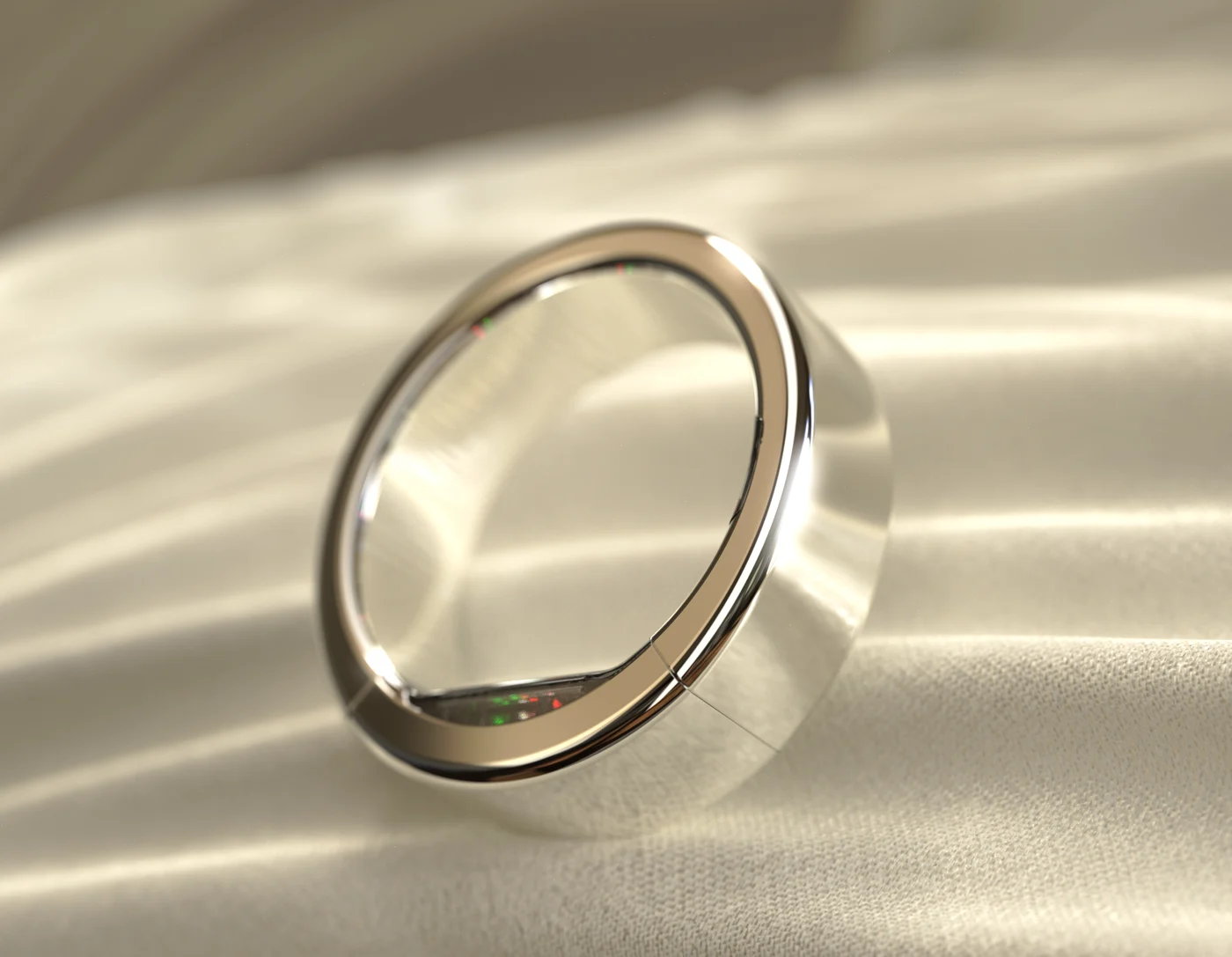
We built Ring PRO for people who want up to 15 days between charges, so charging rarely leaves gaps in your sleep data.
That’s about 12 days in Turbo Mode and 15+ days in Chill Mode. Pair it with the PRO Charger case and you get up to 45 days.
Each morning you get a Sleep Index from 0 to 100, plus stages, restorative sleep and overnight vitals. Smart Alarm, Caffeine Window, Social Jetlag and Shift Work are free PowerPlugs , so irregular weekends and night shifts don’t cost extra. There’s no subscription for core insights.
If you’d prefer a lighter ring for day and night wear, go for Ring AIR , at 2.4–3.6 g.
In the US, Ring PRO is available for purchase here .
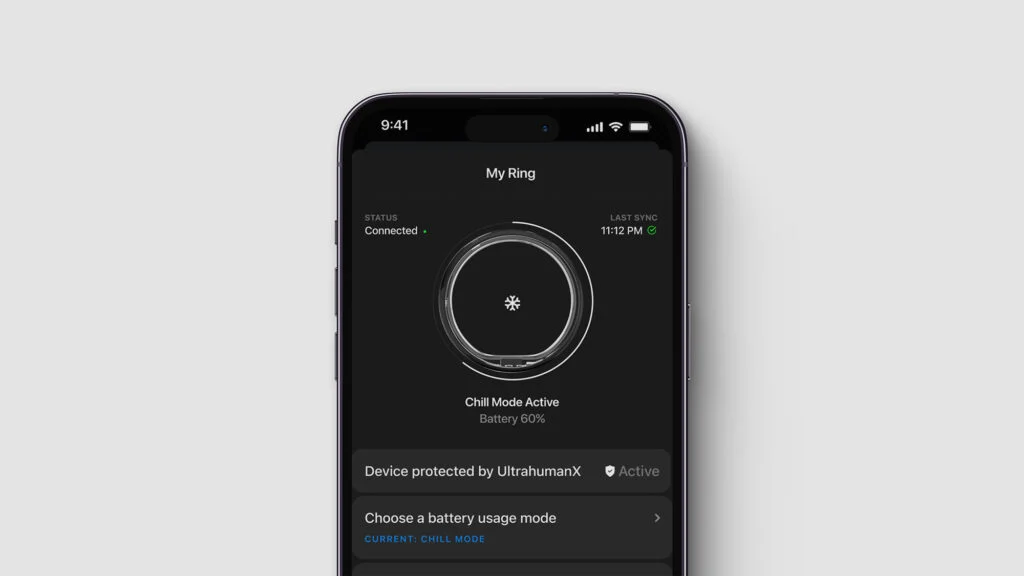
Chill Mode tracks heart rate and temperature mainly during sleep and rest. You still get your sleep and recovery insights, though stress tracking may look different. Switch to Turbo Mode if you want every sensor on all day.
Samsung Galaxy Ring: best for a sleep apnea risk check on Samsung phones
Who it’s for: you use an Android phone (the sleep apnea feature runs in Samsung Health Monitor on a Samsung Galaxy phone), you snore, and you’d like a screening signal before talking to a doctor.
Stand-out: on 3 November 2026, Samsung said its updated Sleep Apnea feature , FDA-cleared in July, is now available on Galaxy Ring in the US. It runs in the Samsung Health Monitor app for adults 18 and over.
It needs two nights of data within 10 days and estimates breathing disruptions per hour. Samsung says it isn’t for people already diagnosed and shouldn’t replace traditional methods of diagnosis. Galaxy Ring lists at $399.99 and weighs from 2.3 g, depending on size.
Trade-off: it sets up with an Android phone (Android 11 or later), the Samsung Health app and a Samsung account; some features — including Energy Score, Galaxy AI and the sleep apnea check in Samsung Health Monitor — need a Samsung Galaxy phone, and it doesn’t work with iPhone. Battery is up to 7 days for sizes 12–15, and up to 6 days for sizes 5–11. Snore detection needs your phone within 2 feet of you.
RingConn Gen 2: best for breathing insights without a subscription
Who it’s for: you want a breathing read on your nights, on iPhone or Android, with no monthly fee.
Stand-out: RingConn’s Sleep Breathing Insights report breathing quality during sleep. RingConn reports 90.7% accuracy for spotting obstructive sleep apnea patterns, tested on its own dataset against a lab sleep study. Battery runs 10–12 days, and the charging case holds up to 150 days. The ring weighs 2–3 g and costs $299.
Trade-off: RingConn states it isn’t a medical device and isn’t meant for diagnosis, so treat the breathing read as a prompt to talk to a doctor.
RingConn Gen 2 Air: best for a lower price
Who it’s for: you want stages, heart activity and temperature trends for less money.
Stand-out: RingConn Gen 2 Air costs $199 with no subscription, and RingConn lists a 10-day battery. It weighs from 2.5 g.
Trade-off: RingConn leads with breathing insights on Gen 2, not on Gen 2 Air. Sizes start at 6, so very small fingers are out.
Circular Ring 2: best for a silent alarm on your finger
Who it’s for: you share a bed, wake up groggy, or both.
Stand-out: with Circular Ring 2 , you set a wake-up window instead of a fixed alarm time, and its silent alarm is felt on your finger. Nobody else in the room hears it.
You also get a wake-up score, sleep stages, breathing, temperature and an ECG.
Trade-off: battery is shorter than most here: 8 days in Power Mode and 5 in Performance. The ring costs $349 and needs no subscription, though some advanced features are optional premium extras in the app. Sizes run US 6–14.
Ultrahuman Ring AIR: our lighter ring for everyday sleep tracking
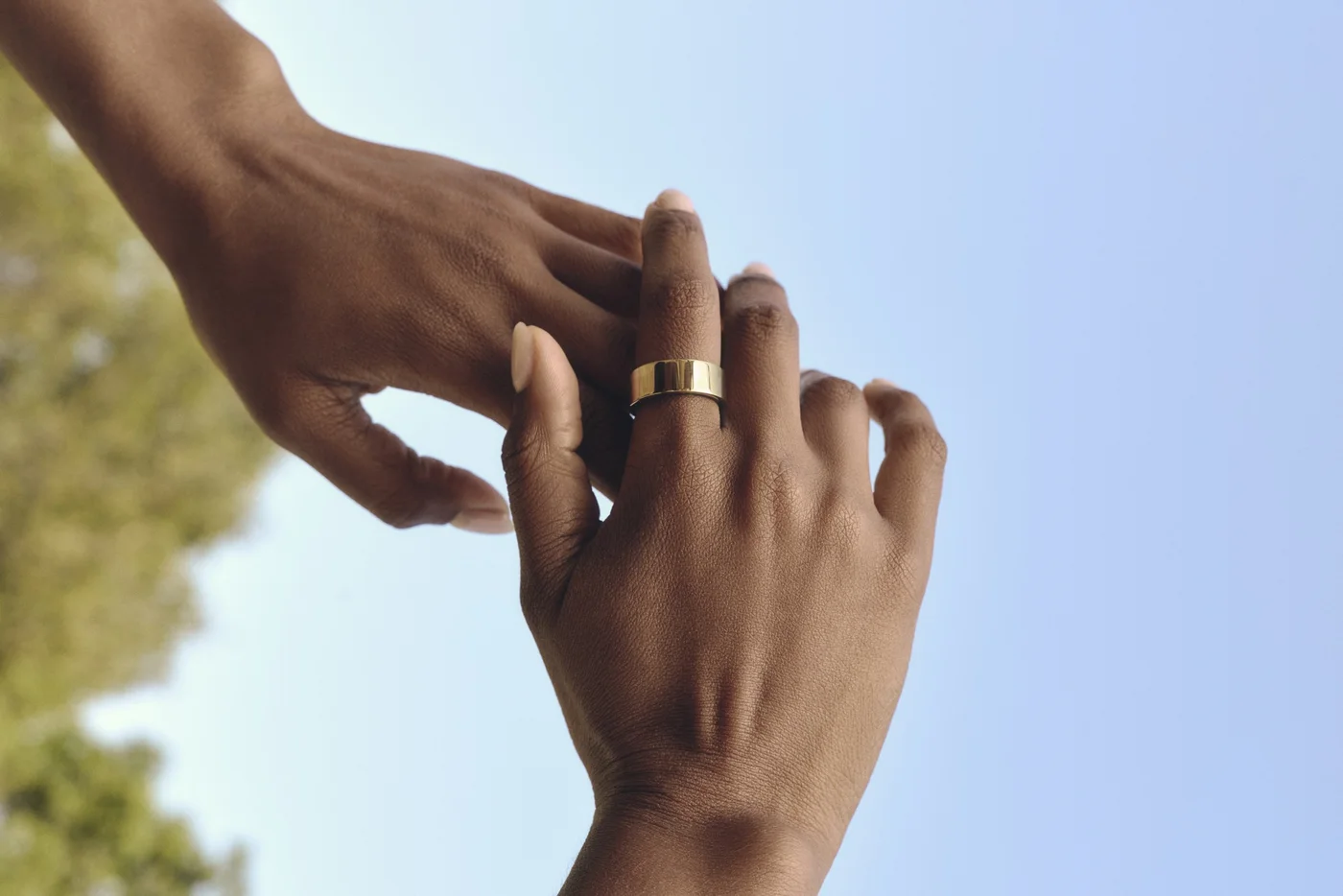
Ring AIR is our lighter ring, at 2.4–3.6 g depending on size. It’s comfortable and lightweight to wear day and night, and fits easily into everyday life, from work and workouts to sleep.
It runs the same app as Ring PRO, including the Sleep Index. There’s no subscription for core insights, and you can see your Ring AIR price here .
Ring AIR gives you up to 10 days per charge. If you want the longer battery, go for Ring PRO, with up to 15 days per charge.
Not a ring: WHOOP, best for people who’d rather sleep in a band
WHOOP is sold as a membership. WHOOP One costs $199 in the US and includes a 12-month membership. WHOOP lists 14+ days of battery for its WHOOP 5.0 and MG bands.
How to choose a smart ring for sleep tracking
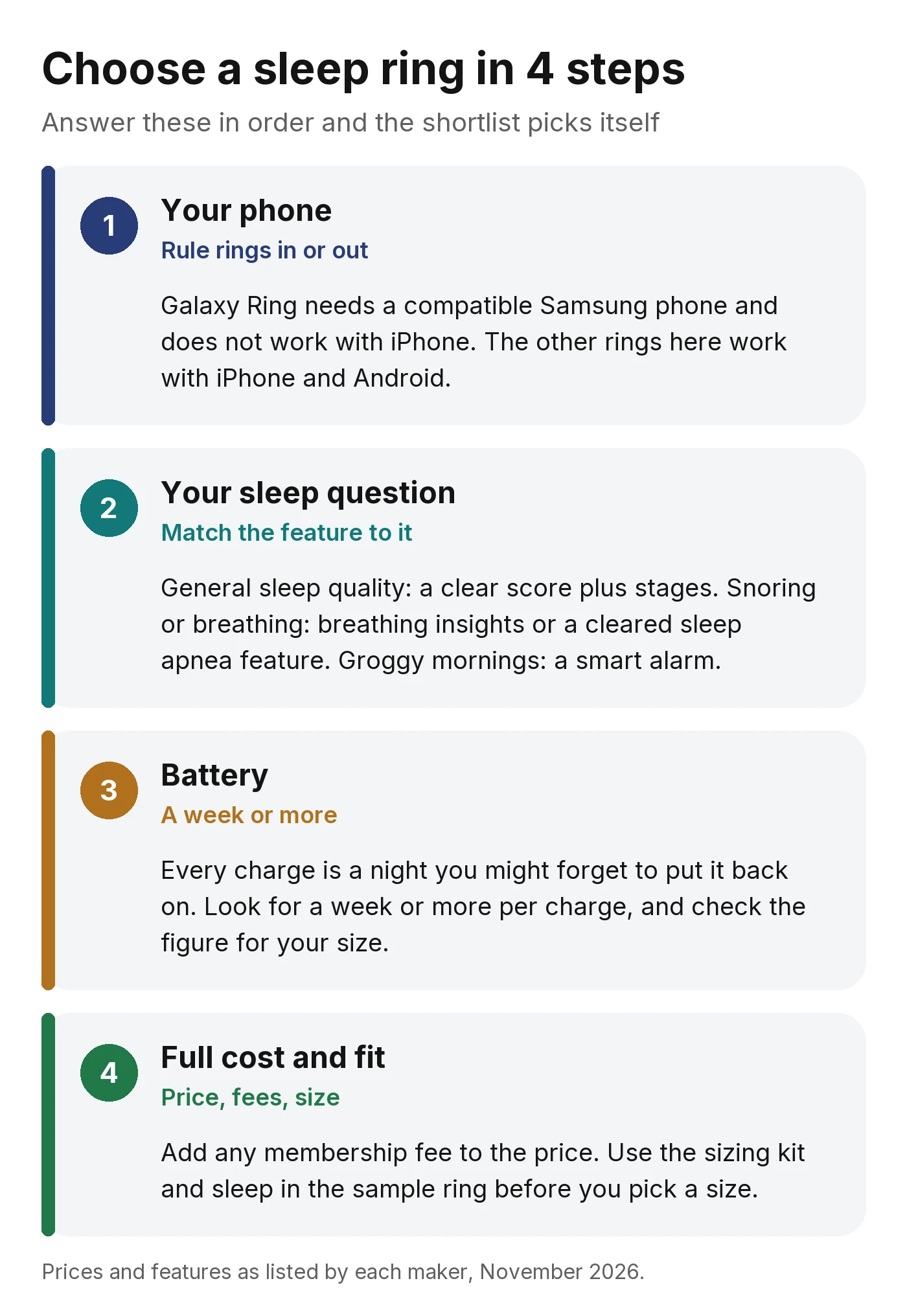
- Start with your phone. Galaxy Ring sets up with an Android phone, and some features need a Samsung Galaxy phone; it doesn’t work with iPhone. The other rings here work with iPhone and Android.
- Name your sleep question. For general sleep quality, look for a clear score plus stages. For snoring, look at breathing insights or a cleared apnea feature. For groggy mornings, look for a smart alarm.
- Check battery for your size. Every charging night is a night you might forget to put it back on. Aim for a week or more.
- Add the full cost and get the fit right. Add any membership to the price. Then use the sizing kit and sleep in the sample ring.
Fit matters more than most people expect. A loose fit lets light leak in, which leaves gaps in your data. Try your index, middle and ring fingers, and pick the size that sits snug at the base. It’s too loose if it spins or slides, and too tight if it hurts or is hard to remove.
Sleep metrics explained in plain English
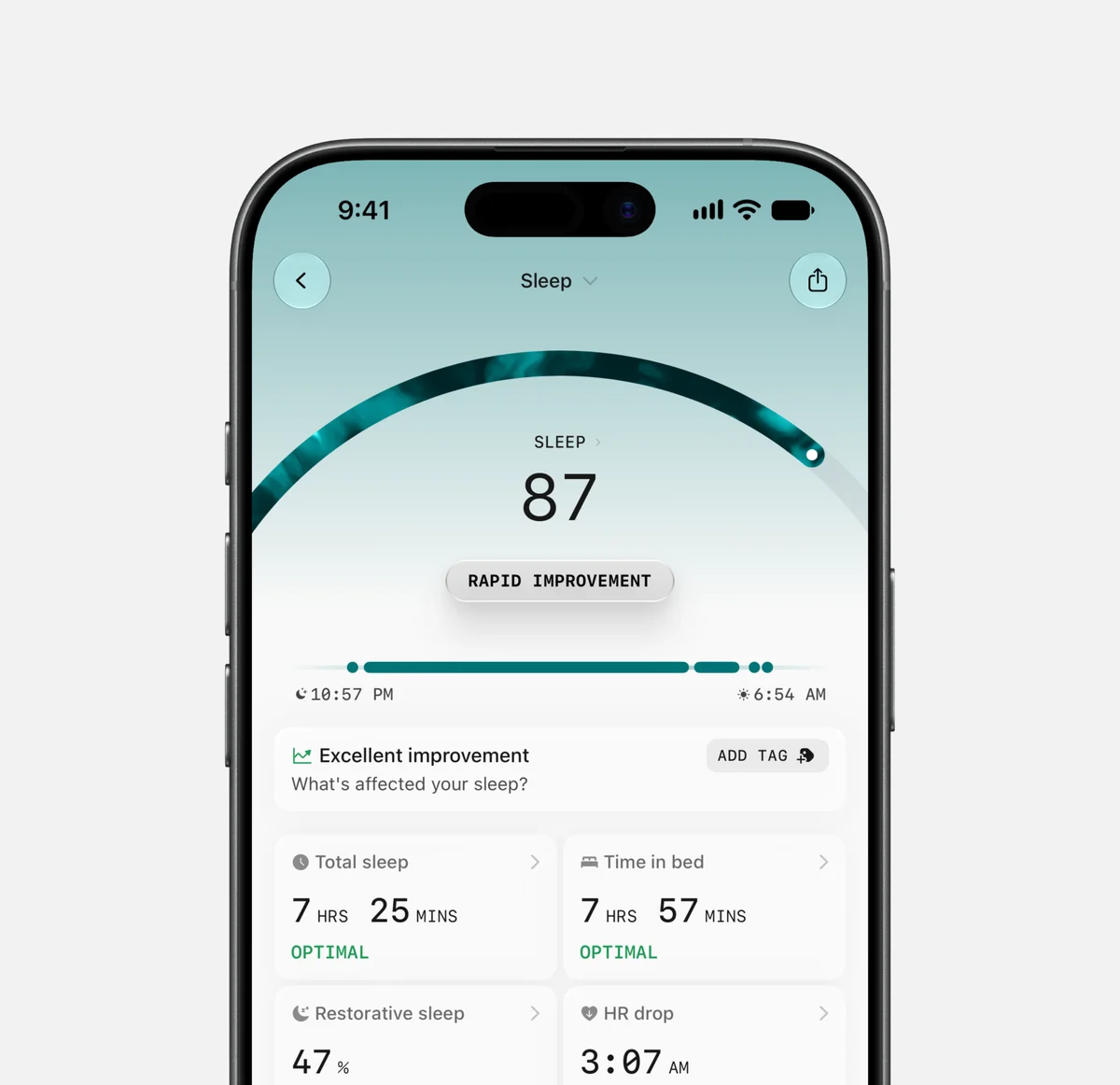
Your ring turns heart rate, heart rate variability, movement and finger temperature into a picture of your night. Here’s what each number means.
| Metric | What it means | What to look for |
|---|---|---|
| Sleep score (Sleep Index) | One 0–100 number built from duration, how settled you were, restorative sleep, timing and overnight vitals | 70–85 is a solid night for most adults |
| Total sleep vs time in bed | Time actually asleep vs time spent in bed | Our members’ median is about 8.1 hours in bed, with roughly 90% of it asleep |
| Light, deep and REM | Stages you cycle through about every 90 minutes; deep comes early, REM builds toward morning | Deep sleep averages 77.8 min at ages 20–29 and 67.6 min at 50+ in our members |
| Restorative sleep | Deep plus REM together | A little over a third of a healthy adult’s night |
| Awake time | Brief wake-ups during the night | A few brief wake-ups a night are normal |
| Overnight heart rate | How low your heart rate falls, and when | A rate that falls low and bottoms out early in the night counts toward a better score |
| HRV | The variation in time between heartbeats | Your own baseline is the useful reference, not other people’s numbers |
| Skin temperature | Change from your usual night | A fraction of a degree off can point to illness, alcohol, hard training or your cycle |
| Sleep consistency | How steady your bedtime and wake time are | Regular bedtimes are linked to a calmer heart. Across 103,490 Ultrahuman Ring members , the most irregular sleepers aged 30 and over had an overnight resting heart rate 3.6 bpm higher than the most regular, and 1.9 bpm higher among those under 30 |
| Blood oxygen and breathing | How steady your oxygen and breathing stay overnight | Rings can flag patterns, but only a sleep study diagnoses sleep apnea |
Want the detail behind each number? Our explainers cover heart rate variability , restorative sleep , sleep stages and time in bed .
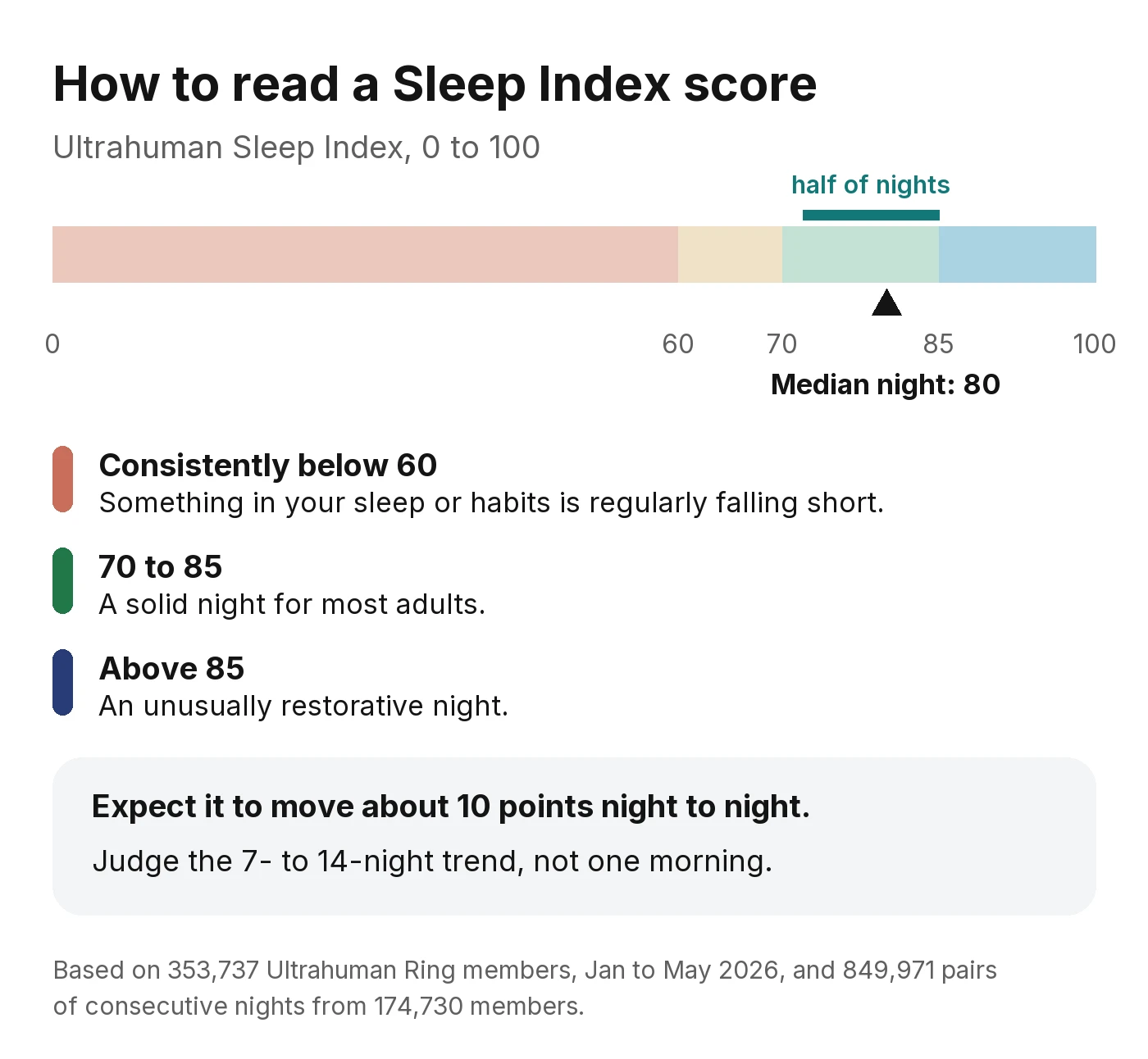
In our data from 353,737 members between January and May 2026, the median Sleep Index was 80. Half of all nights landed between 72 and 85. So if you’re in the high 70s most nights, you’re right in the middle.
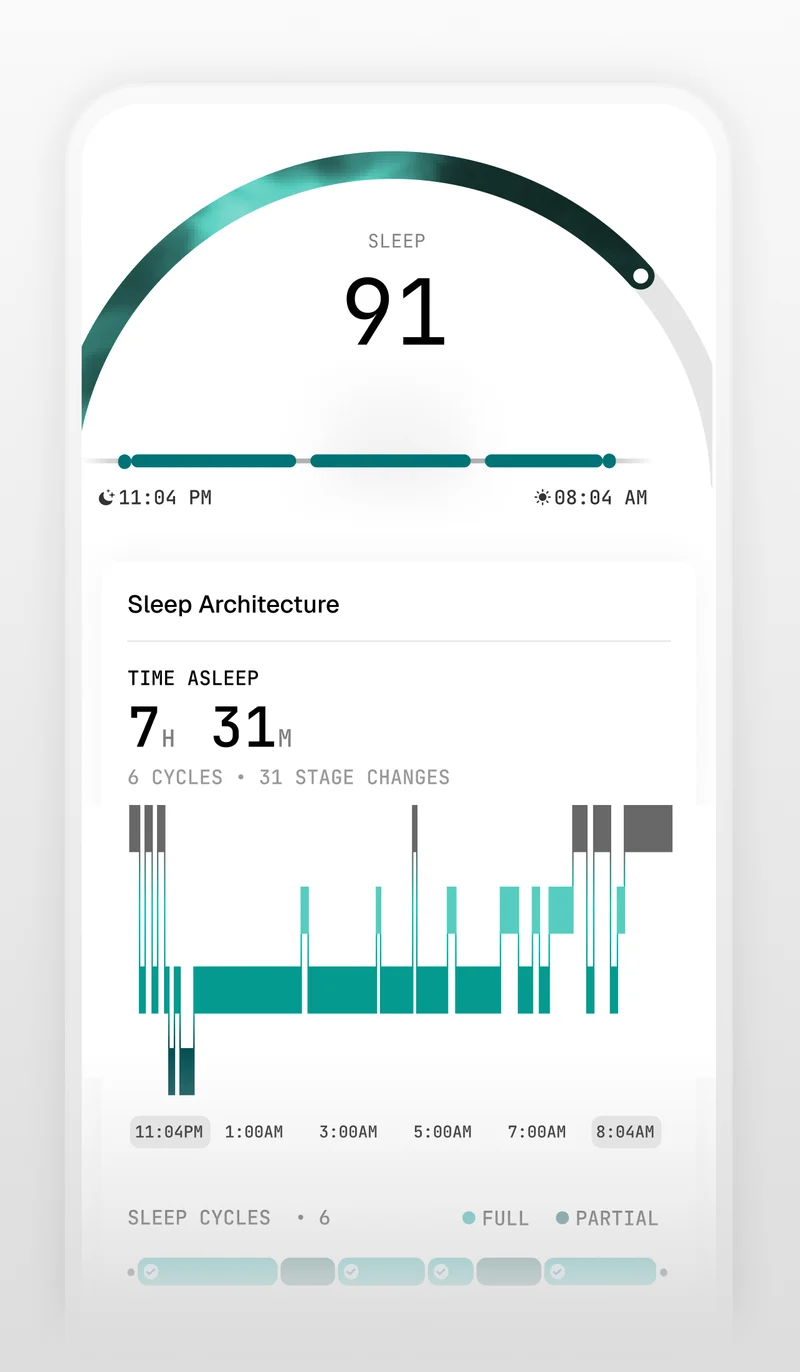
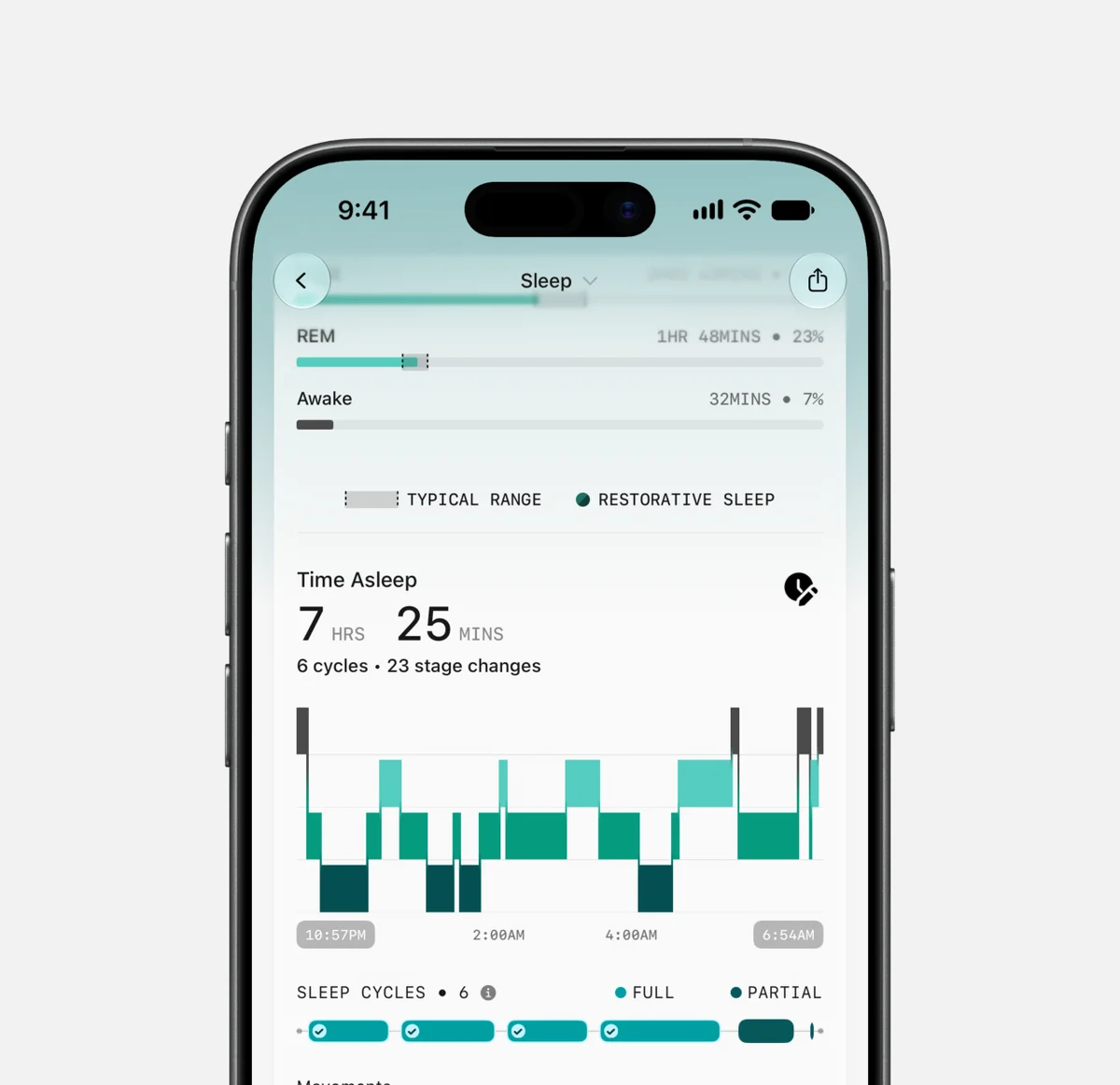
The stages view shows your night as a hypnogram. In this example, the night had 6 sleep cycles, 1 hour 48 minutes of REM and 32 minutes awake. How the ring tracks sleep stages explains the method.
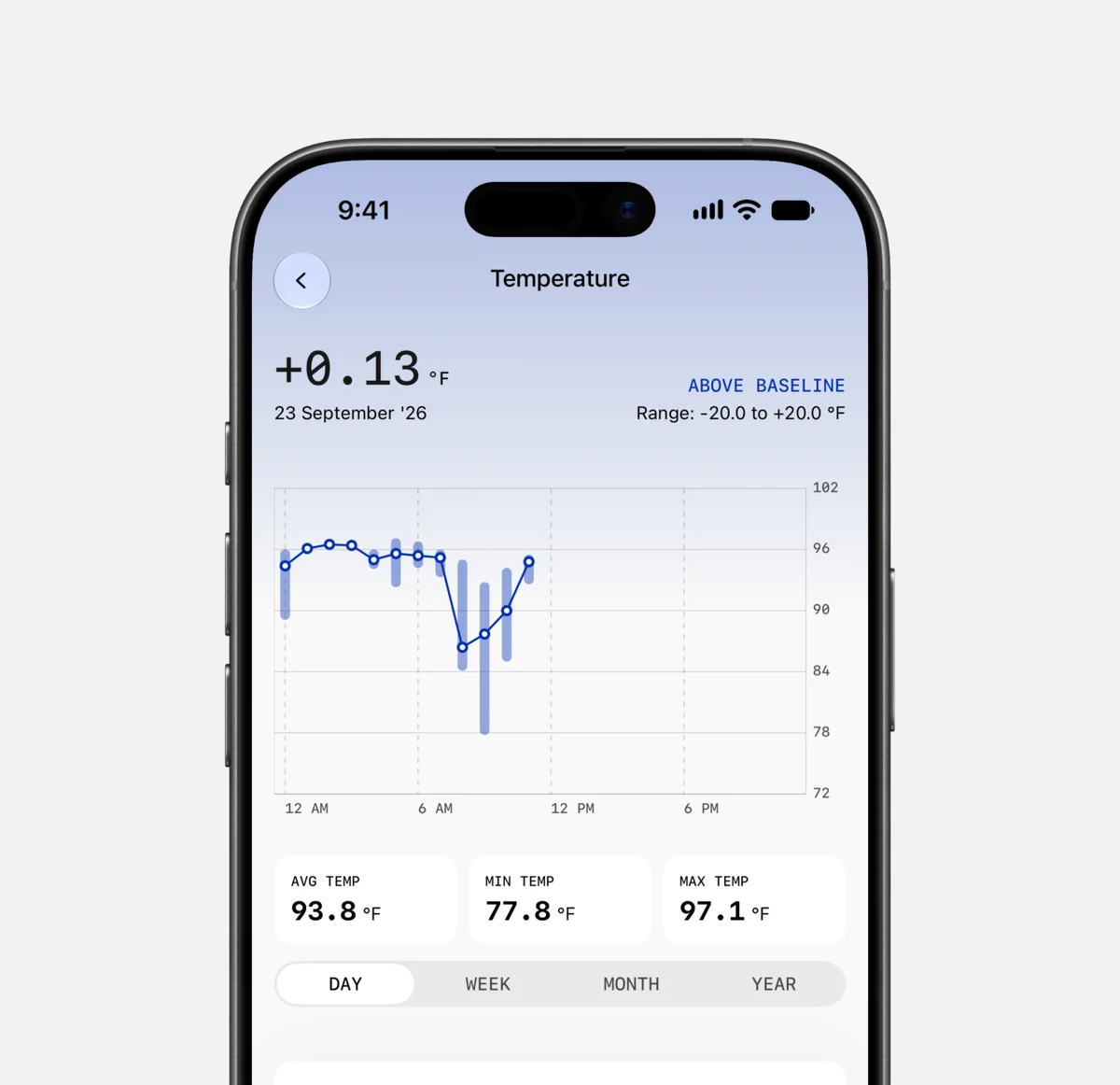
Temperature is shown as a change from your baseline, like the +0.13 °F above, rather than as a single absolute reading.
Our Sleep Algorithm 2.0 was trained on over 125,000 nights of Ring AIR data. It accounts for age, sex and BMI when it scores your night.
How accurate are smart rings for sleep tracking?
Smart rings and other wearables tell sleep from wake more reliably than they tell sleep stages apart. Lean on timing and long-term trends, and read light, deep and REM splits as estimates.
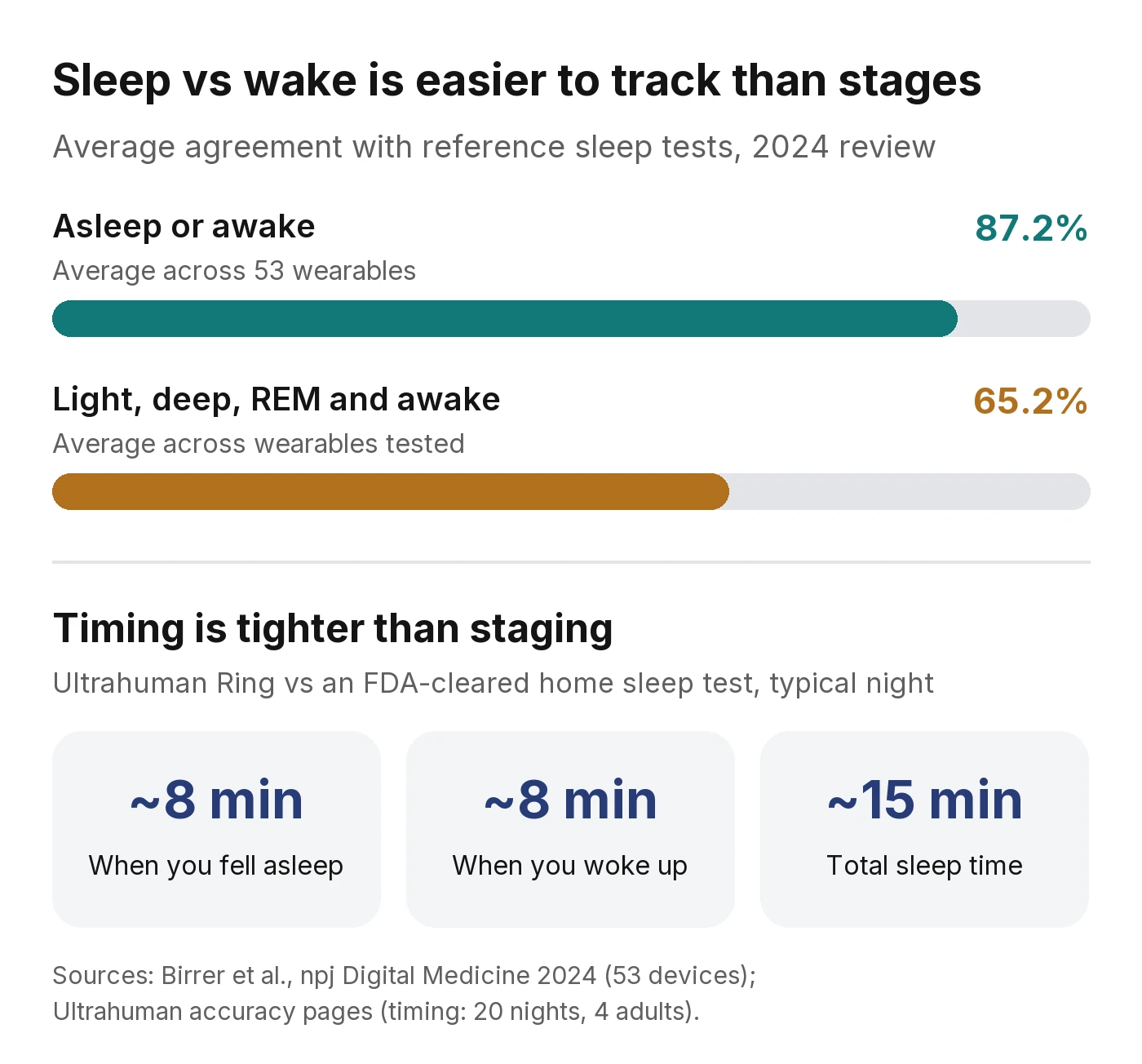
Compared with a lab sleep study (polysomnography), rings track total sleep time well, but their stage estimates are less precise. Treat one night’s stage breakdown as a rough guide.
A 2024 review in npj Digital Medicine found wearables averaged 87.2% accuracy for sleep versus wake across 53 devices. For light, deep, REM and awake, the average fell to 65.2% across 9 devices.
Timing is tighter. In a 20-night test of our ring with 4 people, against an FDA-cleared home sleep test, sleep onset and wake time typically landed within about 8 minutes of the reference test, and total sleep within about 15 minutes.
How to get more useful sleep data from a smart ring
- Wear it every night. Charge it while you’re awake, so it’s on your finger at bedtime.
- Read trends, not one night. Your 7- or 14-night average tells you more than this morning’s number.
- Trust how you feel. If your score and your energy disagree, go with how you feel. Getting anxious about your sleep data can itself hurt your sleep, which is called orthosomnia .
- Use your data to change one thing. Try moving caffeine earlier or waking within a wake-up window, then watch the trend.
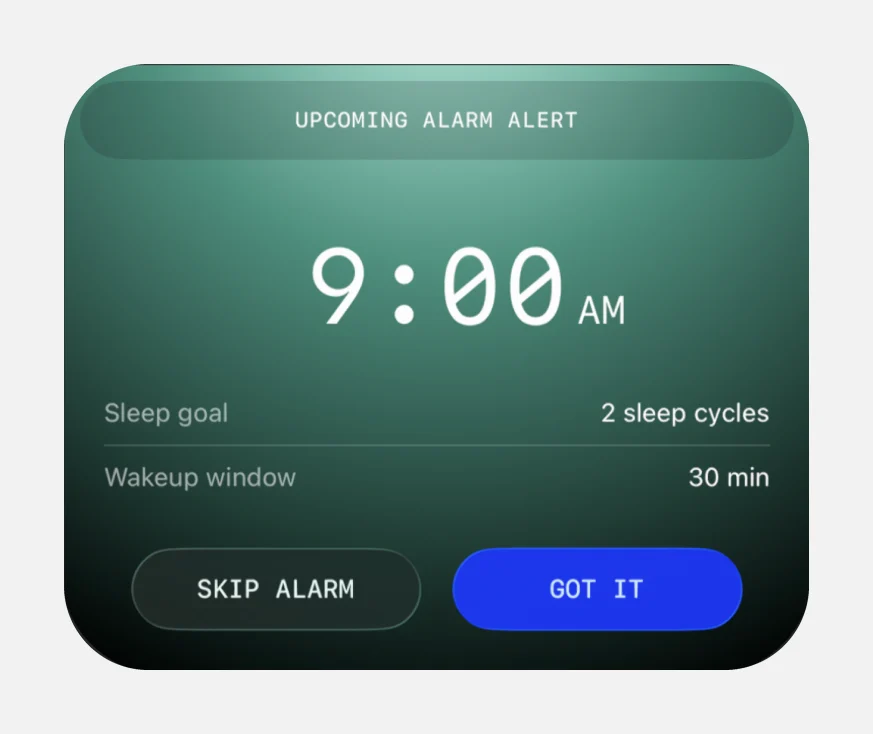
Ring Tip: turn on the free Smart Alarm PowerPlug and set a 30-minute window. It aims to wake you at a lighter moment in that window. Waking from deep sleep can leave you groggy.
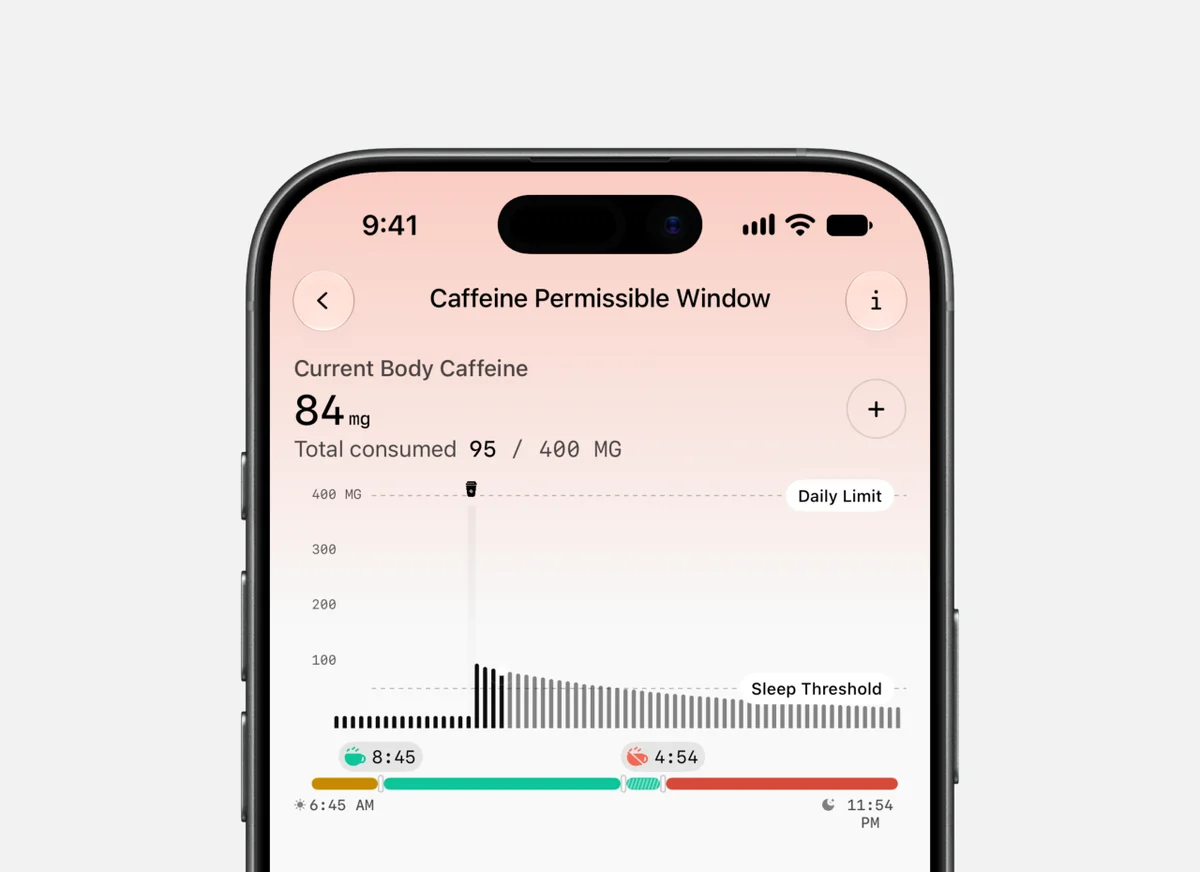
Caffeine has a half-life of about five hours. The Caffeine Window PowerPlug uses your sleep timing to estimate how late you can drink it and still clear it before bed.
FAQ
Can a smart ring detect sleep apnea, and what should I do if it flags something?
It can flag risk, but it can’t diagnose it. Galaxy Ring’s US feature is an FDA-cleared risk check. Loud snoring can be a sign of sleep apnea, and only a sleep study can diagnose it, so ask a doctor whether you need one. Bring your ring’s trend over several nights, not a single reading.
Is a smart ring or a smartwatch better for sleep tracking?
Either can work, so choose the one you’ll wear every night. The rings here have no screen and weigh 2–4.8 g. In our comparison of 106 nights from 56 people, the Ultrahuman Ring’s sleep onset was within half an hour of a consumer smartwatch on 96% of nights.
Do smart rings track naps?
Our Ultrahuman Ring does. When it spots a likely nap, the app asks you to confirm it. Of 555,000 answered nap prompts, wearers confirmed 90% .
Why does my sleep score change so much from night to night?
Normal nights vary. Across 849,971 pairs of consecutive nights from 174,730 members, the score moved an average of 10.2 points. More than a third of back-to-back nights differed by 10 points or more. Watch the weekly trend instead.
Should I worry if my ring says I woke up a lot?
Usually not. In about 13 million nights of our Ultrahuman Ring data, 84% included at least one awakening of five minutes or longer, and the median was two a night. As sleep scientist Dr Sophie Bostock explains , “Many brief awakenings are so short that we don’t remember them.”
Do I need a subscription for sleep tracking on a smart ring?
Not for core sleep tracking on our Ultrahuman rings or on RingConn, and Samsung lists no fee for Galaxy Ring. On our rings, paid extras are optional: Ultrahuman Max costs $99.99 a year, and a few PowerPlugs carry a fee. Smart Alarm and Caffeine Window are free.
Get Ring PRO with a free sizing kit , or compare Ring PRO and Ring AIR .
Sources
- Ultrahuman. Ring PRO product page.
- Ultrahuman. Introducing Chill Mode .
- Ultrahuman. How it works .
- Ultrahuman. PowerPlugs .
- Ultrahuman. Sleep Index explainer .
- Ultrahuman. Sleep stages explainer , restorative sleep and time in bed .
- Ultrahuman. Heart rate variability explainer and sleep consistency explainer .
- Ultrahuman. Accuracy pages: sleep duration , sleep onset , wake time and naps .
- Ultrahuman. Orthosomnia explained and Waking at 3 am .
- Ultrahuman. How to use the Ultrahuman Ring sizing kit .
- Samsung. Galaxy Ring and Sleep Apnea feature on Galaxy Ring, 3 Nov 2026 .
- RingConn. Gen 2 and Gen 2 Air .
- Circular. Circular Ring 2 , product specifications and sizing .
- WHOOP. WHOOP One and memberships .
- Birrer V, et al. Evaluating reliability in wearable devices for sleep staging . npj Digital Medicine, 2024.
THE AUTHOR