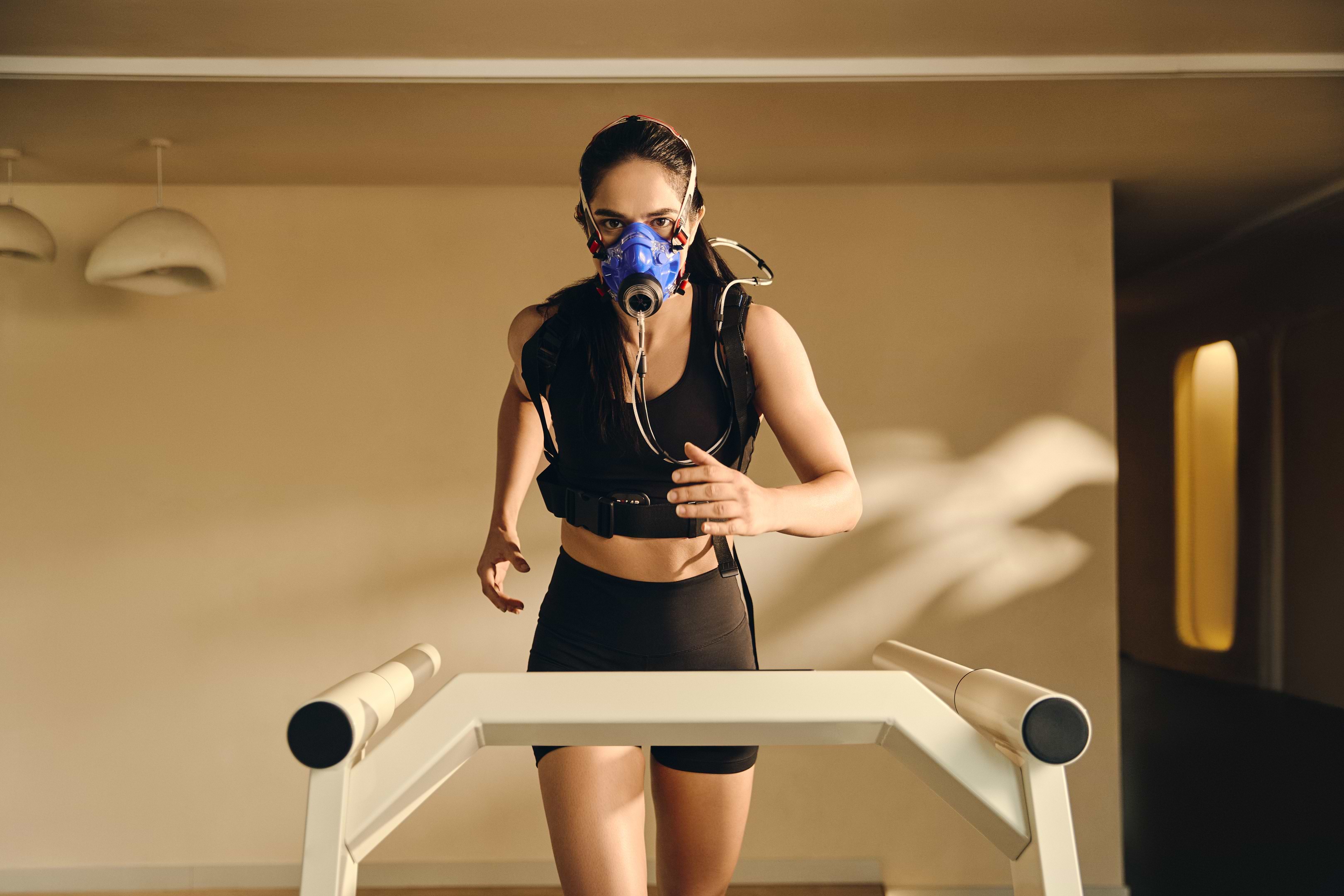
VO2 Max is the highest rate at which your body can take in, transport, and use oxygen during hard exercise, measured in millilitres of oxygen per kilogram of body weight per minute (mL/kg/min).
In this guide, we explain what VO2 max actually measures, why it matters, and what determines your own number.
Why VO2 max matters
An American Heart Association scientific statement called cardiorespiratory fitness a stronger predictor of long-term mortality than smoking, high blood pressure, or high cholesterol, and argued it should be checked as routinely as any other vital sign.
VO2 max earns that status because it’s the combined output of the heart, lungs, blood and muscles working together – a single number that summarises how well several systems function at once.
What VO2 max actually measures
Getting oxygen from the air into a working muscle takes several steps: the lungs pull it into the blood, the heart pumps that blood out to the body, and the muscles pull the oxygen out of the blood to use it.
VO2 max is the ceiling on how fast that whole chain can work, all at once, under maximum demand.
How it’s traditionally measured
The lab gold standard is cardiopulmonary exercise testing (CPET): pushing to exhaustion on a treadmill or bike while a mask measures the oxygen you breathe in and out.
It’s precise, but it requires lab equipment, trained staff, and a genuinely maximal effort – which is exactly why almost nobody gets it tested this way in ordinary life.
What determines your VO2 max
- Genetics. A twin-study meta-analysis put the heritability of VO2 max at roughly 60 to 70%.
- Age. Aerobic capacity declines through adulthood, gradually at first and then faster after 70.
- Sex. VO2 max runs higher in men than women on average, largely due to differences in heart size, haemoglobin levels and muscle mass relative to body weight.
- Training status. This is the one real lever. Consistent aerobic conditioning raises VO2 max by improving how much blood the heart moves per beat and how efficiently muscles extract oxygen from it.
How the Ultrahuman Ring estimates VO2 Max
The Ultrahuman Ring estimates VO2 Max passively, from data it already collects overnight, so members get a read on this metric without a lab visit.
The model is calibrated directly against real cardiopulmonary exercise testing rather than treated as a fixed formula, from a study of 101 participants in the Ultrahuman Performance Lab in Bengaluru.
Read our full guide to the overhauled Ultrahuman Ring VO2 Max algorithm here .
THE AUTHOR