Bedroom CO₂ and humidity trim deep sleep, and temperature drift dents sleep score, across 121,598 nights; everyday noise does not
Across 121,598 paired Home-and-Ring nights, members’ stuffiest, most humid, and most temperature-variable nights tracked slightly lower deep sleep and sleep score, the direction sealed-room trials predict, at a fraction of the size.
Chamber experiments settled long ago that a sealed room’s air and temperature move sleep, but they run on a handful of people in conditions no real bedroom reaches. The canonical bedroom-air randomised trial paired roughly 660 ppm of carbon dioxide against roughly 2,585 ppm in student dorm rooms and found better sleep and next-day cognition at the lower level (Strøm-Tejsen et al., 2016). A thermal-environment review reports that humid heat shortens deep and REM sleep, and that what registers is drift from a person’s preferred temperature, not the absolute degree (Okamoto-Mizuno and Mizuno, 2012). A World Health Organization meta-analysis of 74 sleep-lab studies put the odds of a confirmed awakening up about 35 percent per 10 decibel rise, anchored to transport noise of 45 to 65 decibels (Basner and McGuire, 2018). None addresses whether those directions survive in ordinary homes.
We paired bedroom readings from the Ultrahuman Home device with the same night’s Ring sleep summary across 121,598 nights from 1,242 members, between January 2024 and April 2026. For each member and each factor we ranked that member’s own nights into quartiles, compared the highest-exposure quartile against the lowest, and pooled across the cohort; members with fewer than 14 paired nights were left out so the quartiles stayed stable. Because every member is their own comparison, age, fitness, Ring fit and baseline physiology drop out automatically.
Three of the four things the Home device tracks shift sleep in the direction sealed-room trials report, though the moves are small and these are nightly associations rather than the controlled contrasts a chamber RCT delivers; noise, the fourth, does not move at ordinary levels. Deep sleep was 0.37 percentage points lower on members’ highest carbon-dioxide nights (95 percent confidence interval, the range the true effect plausibly occupies, −0.55 to −0.20) and 0.32 percentage points on their most humid nights (95 percent CI −0.48 to −0.15); sleep score dropped 0.36 points when bedroom temperature drifted 4.5 degrees Fahrenheit from a member’s own median (95 percent CI −0.66 to −0.07).
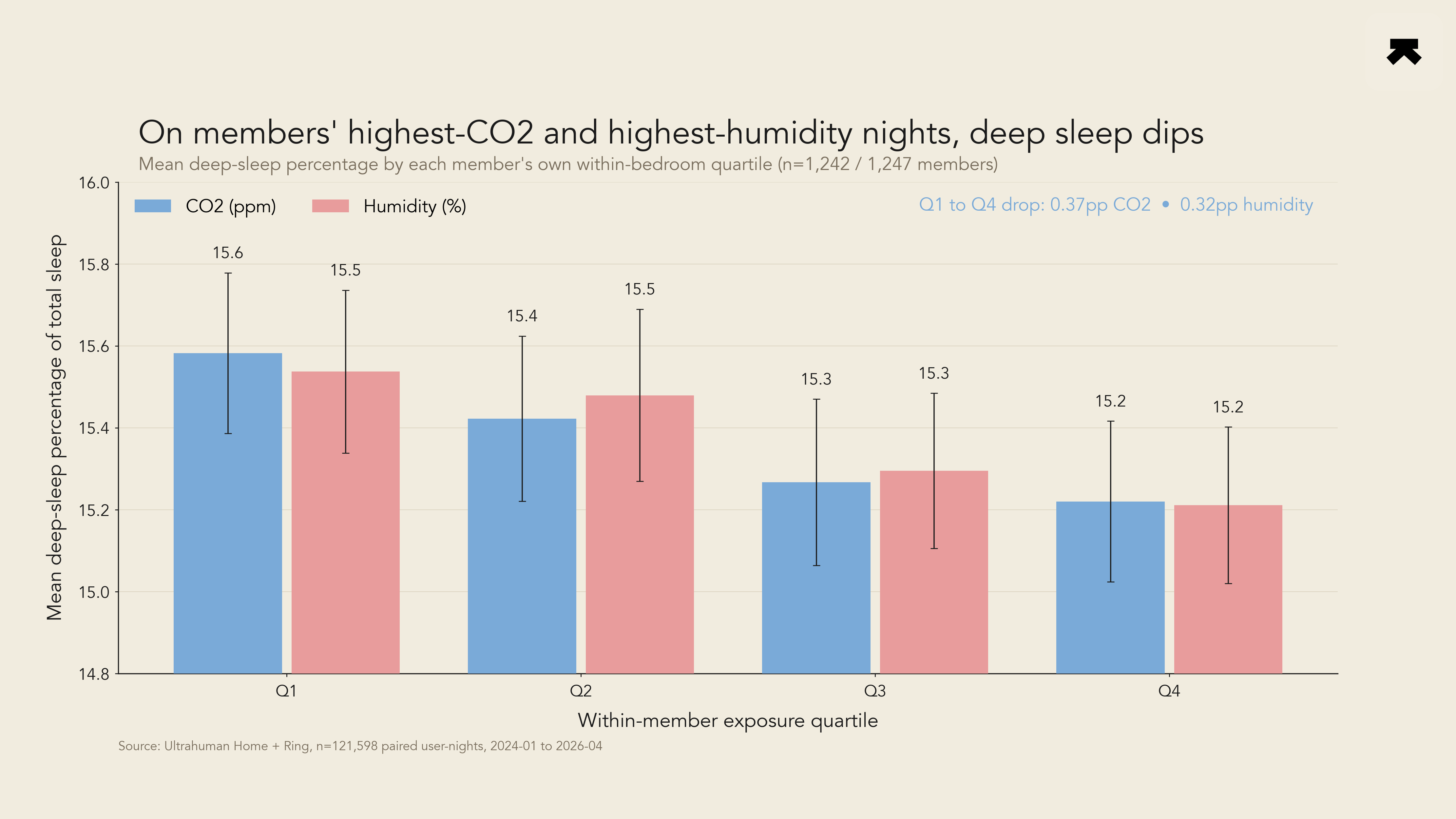
Figure 1. Mean deep-sleep percentage by within-member exposure quartile for two ambient factors (bedroom carbon dioxide and humidity), across 1,242 to 1,247 Ultrahuman Home and Ring members and 121,598 paired nights between January 2024 and April 2026. Q1 to Q4 are within-member quartiles of each member’s own exposure distribution, shown as the across-member pooled mean. The Q1-to-Q4 deep-sleep drop is 0.37 percentage points for carbon dioxide and 0.32 percentage points for humidity.
The within-person contrasts land where the chamber work predicts, at a fraction of the size. Carbon dioxide sat at 509 ppm on members’ cleanest nights and 897 ppm on their highest, where deep sleep ran 0.37 percentage points lower. Its sleep score moved the other way, but those nights also carried 13.9 more minutes in bed, and the score rewards time asleep, so the duration-immune deep-sleep figure is the honest one. Humidity moved deep sleep the same way across a 40-to-54 percent swing, and temperature through drift, not absolute degree. Noise was the exception: between a 35 and a 41 decibel quartile, sleep architecture held steady, with small shifts in heart-rate variability (HRV, +0.41 ms) and lowest heart rate (−0.20 bpm). That null reads as range: ordinary bedrooms sit below the transport-noise band the awakening curve was measured on. Age, sex and country are the next pass.
On members’ stuffiest or most humid nights, deep sleep runs a little lower, and on nights temperature drifts, sleep score dips a touch, the same directions sealed-room trials found, at a fraction of the size and across a cohort an order of magnitude larger. These are within-member nightly associations, not the isolated cause a chamber RCT pins down, so other things that travel with a stuffy or humid night may carry some of the effect. Everyday bedroom noise, at the levels members actually live with, is not the lever.
- Strøm-Tejsen P, et al. The effects of bedroom air quality on sleep and next-day performance. Indoor Air, 2016. PMID: 26452168.
- Okamoto-Mizuno K, Mizuno K. Effects of thermal environment on sleep and circadian rhythm. Journal of Physiological Anthropology, 2012. PMID: 22738673.
- Basner M, McGuire S. WHO environmental noise guidelines for the European region: a systematic review on environmental noise and effects on sleep. International Journal of Environmental Research and Public Health, 2018. PMID: 29538344.
More bytes
Keep exploring
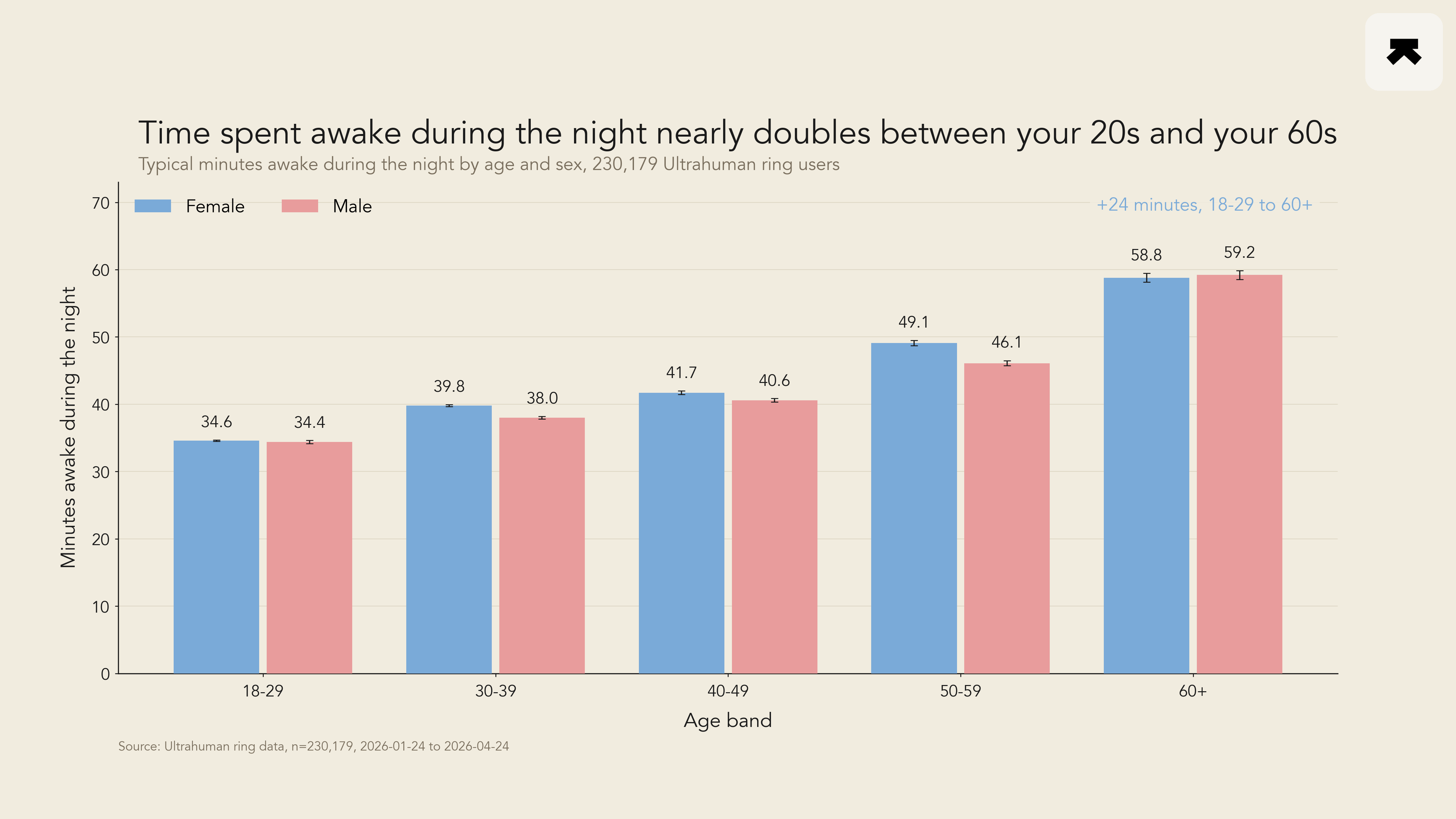
Across 230,179 Ring members, the dominant age change in sleep is more time awake at night, not less deep sleep
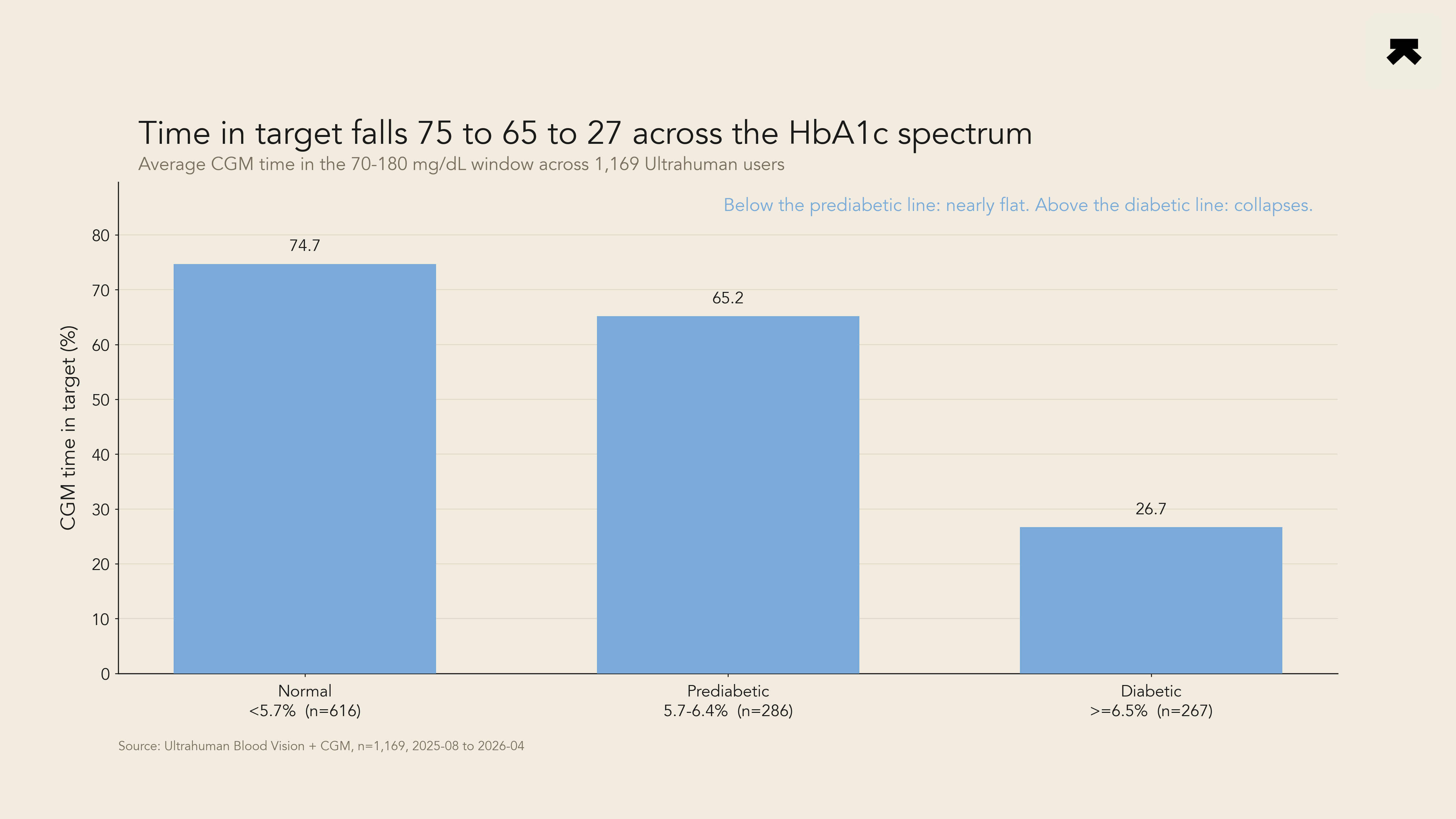
Time in target holds until the diabetic line, then collapses, across 1,169 members