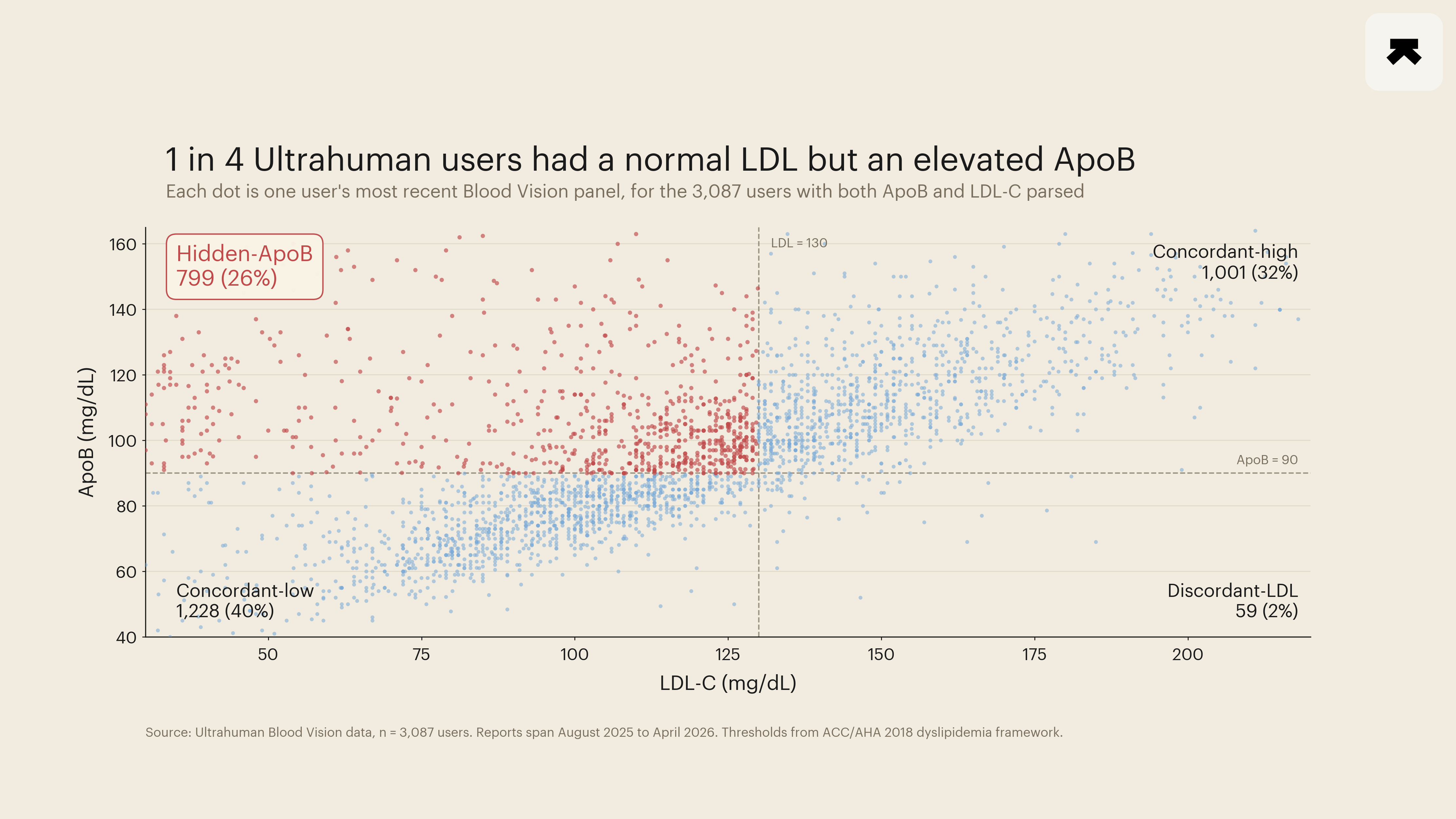
Sauna nights lift sleep score and lower overnight heart rate but trim deep sleep, across 180 Ring members
Across 180 members and a year of paired Ring nights between June 2025 and May 2026, sauna nights raised sleep efficiency 0.88 percentage points and sleep score 1.48 points and lowered resting heart rate 0.66 bpm against each member’s own baseline, while deep sleep fell 3.58 minutes.
Warm-bath research mapped the mechanism that links heat to sleep: a 2019 meta-analysis of seventeen trials found shorter sleep onset and higher efficiency when bathing fell one to two hours before bed, the cooling phase afterward acting as the cue that consolidates slow-wave sleep (Haghayegh et al., 2019). The dry-heat literature is thinner and tracks autonomic outcomes more closely than sleep stages. A randomised trial of post-exercise sauna over eight weeks (Lee et al., 38 sedentary adults at cardiovascular risk) found that fifteen minutes of sauna added no heart-rate-variability (HRV) benefit beyond the exercise itself (Lee et al., 2025). A 2025 meta-analysis of twenty passive-heating trials over two to fifteen weeks found no pooled chronic HRV effect, only a 4.1 mmHg drop in systolic blood pressure (Hamaya et al., 2025). A single-session crossover in trained athletes found overnight HRV unchanged the night of a twenty-minute infrared session (Ahokas et al., 2023). None measured how sleep stages shift on the night of a sauna, the question a year of paired Ring data can reach.
We took every member who tagged a sauna or infrared-sauna session at least three times in the Ultrahuman app between June 2025 and May 2026 and had valid Ring sleep on those nights. 180 cleared that bar. For each member we compared their sauna nights against the average of every other valid sleep night for that same person, typically 200 to 360 nights, so each member acts as their own control.
Five small, consistent shifts on sauna nights, all surviving Holm correction across the seven secondary outcomes. Sleep efficiency rose 0.88 percentage points (95% CI +0.50 to +1.25, Cohen’s d 0.34, a standardised effect size where 0.2 counts as small); sleep score rose 1.48 points (95% CI +0.76 to +2.21); overnight resting heart rate fell 0.66 bpm (95% CI −1.03 to −0.28); deep sleep fell 3.58 minutes (95% CI −5.76 to −1.40) and 0.92 percentage points of the night. Overnight HRV (0.41 ms), total sleep duration (4.07 min), and body-temperature deviation (0.02 °C) did not move.
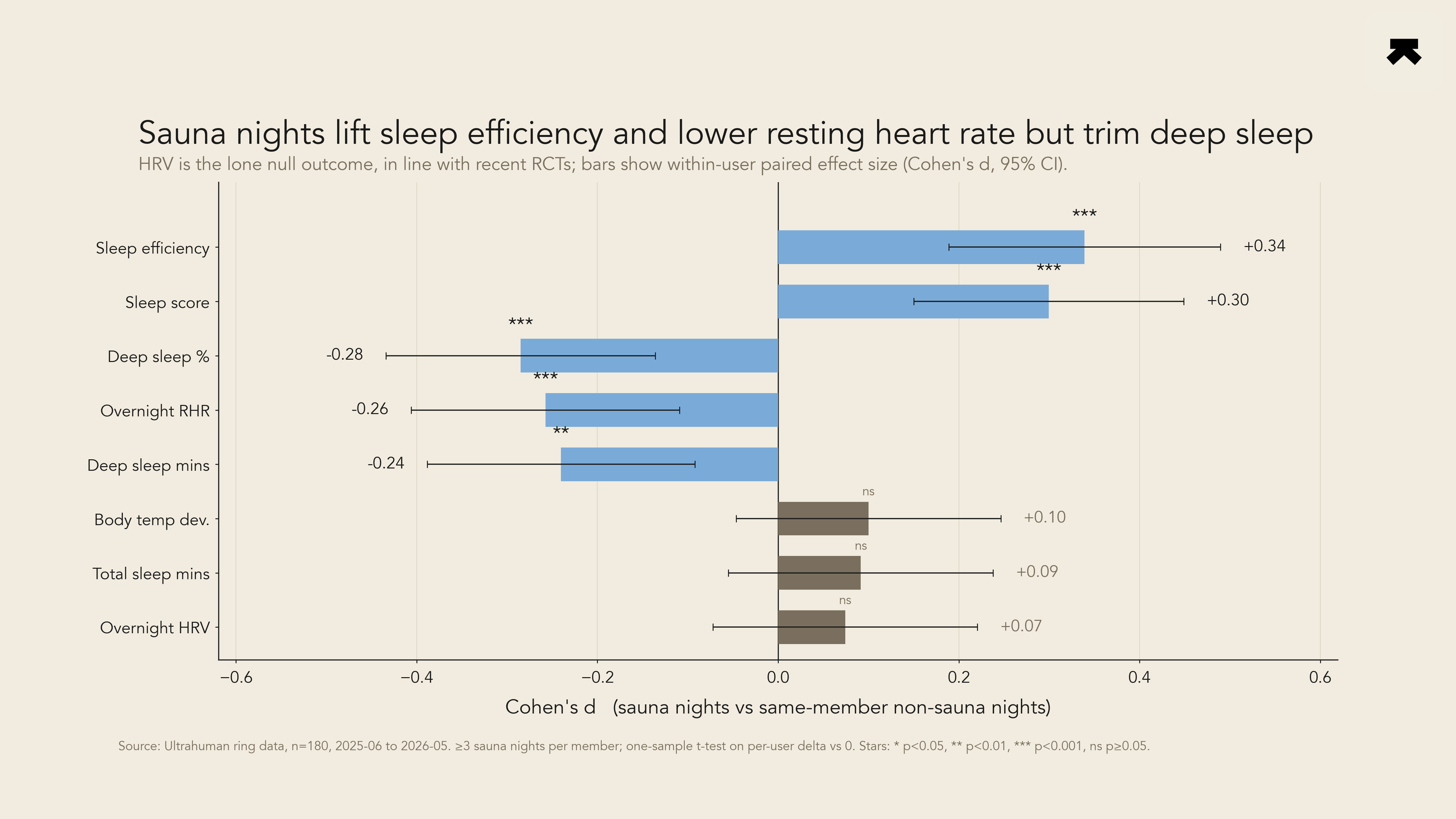
The HRV null aligns exactly with the trials: Lee found no sub-chronic gain, Hamaya none across two to fifteen weeks, Ahokas none on the night itself, and the member-level Ring response joins them. The deep-sleep drop is the one result those trials never measured. The most parsimonious read is timing: a session well before bed leaves room for the cooling phase, while one close to bedtime carries residual core warmth into the night and trims slow-wave sleep. A date-only tag mixes both, so the cohort average lands slightly negative. The within-user paired design controls for age, sex, Ring model, and baseline fitness automatically, so the timing split and the heat-acclimation hint among frequent users sit downstream as the next questions to test.
Members lose a few minutes of deep sleep on the nights they sauna, the reverse of the popular framing, while sleep efficiency, sleep score, and resting heart rate all nudge the right way. The Ring catches the HRV null three independent trials already reached, and surfaces a deep-sleep timing question those trials never measured.
More bytes
Keep exploring
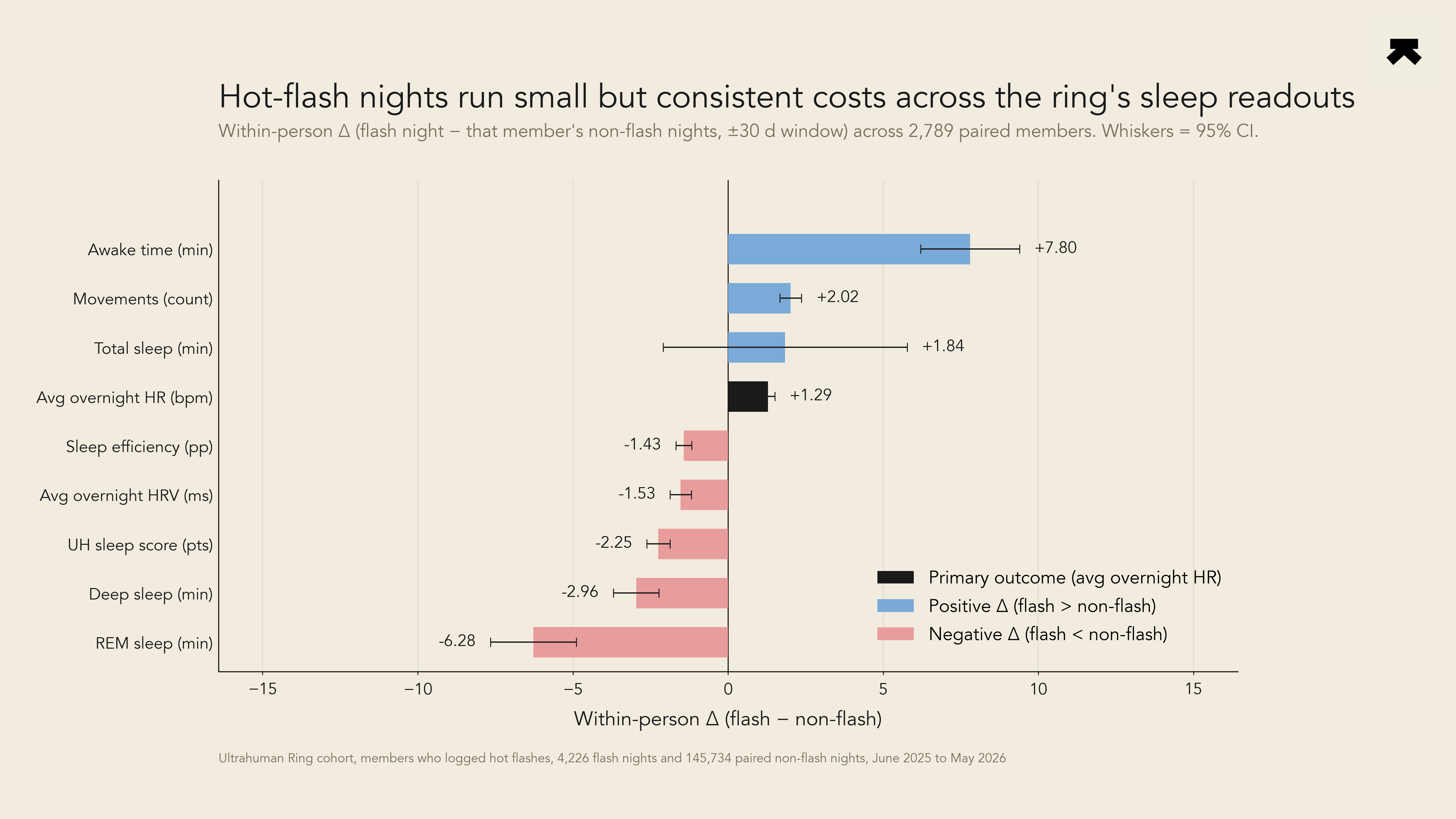
Hot flashes shift sleep toward lighter stages and raise overnight heart rate, across 2,789 Ring members
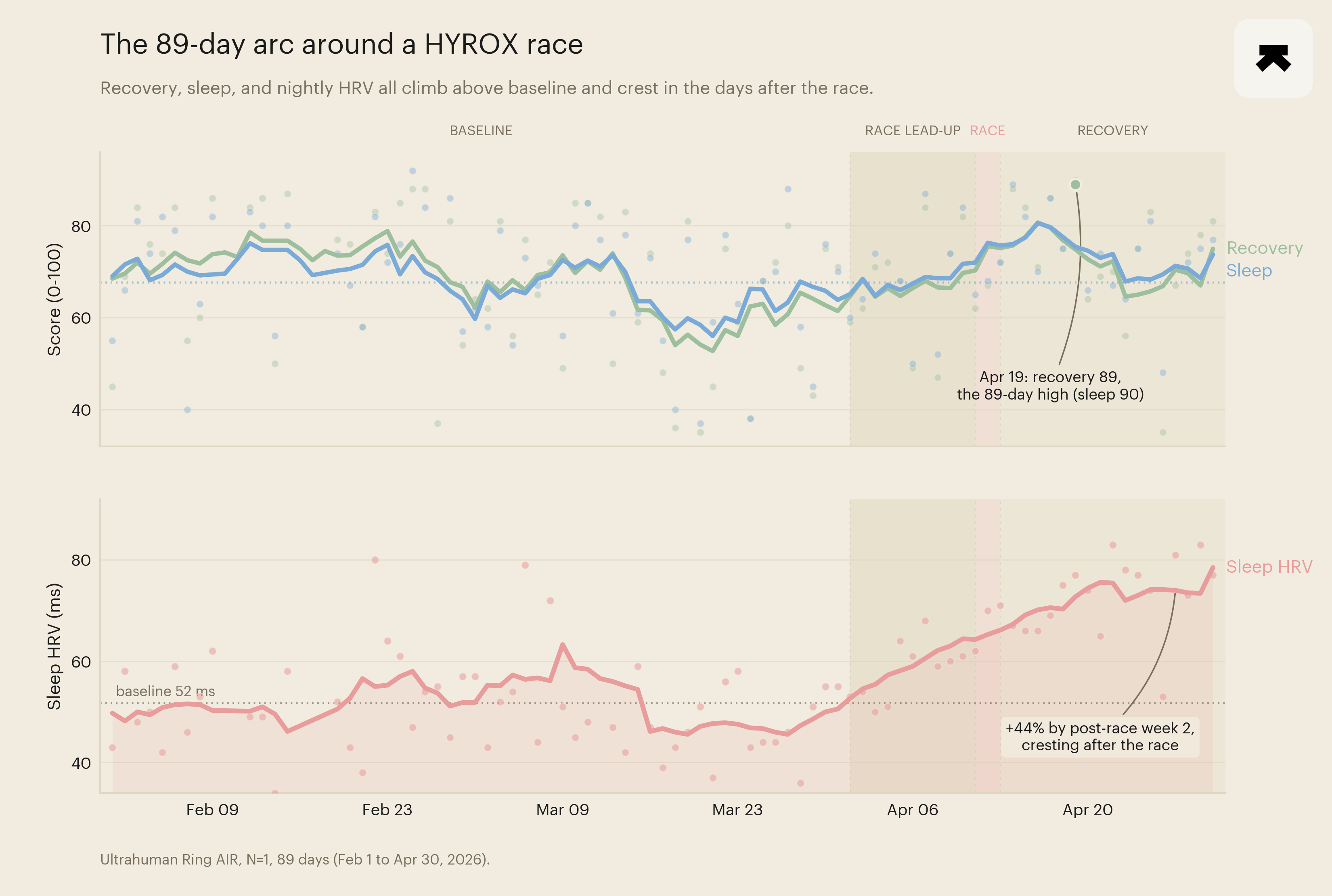
Across 89 days around a HYROX race, one athlete's recovery overshot baseline by 19% and sleep HRV by 44%