The World Cup Sleep Report: What 30 match nights cost 33,513 members' sleep
Hrithik Basu Roy, Aditi Shanmugam, Nihav Dhawale, Debasrija Mondal, Kanika Gupta, Ankit Agarwal, Vinayak Narasimhan
Ultrahuman Healthcare Pvt. Ltd.
Summary
Objective: A World Cup fixes its kick-off times once, so for much of the audience a match lands after midnight or before breakfast rather than in the evening. We quantify what a match night costs on the night itself, whether the cost depends on when the sleep was lost rather than how much, and how quickly it clears.
Methods: We analysed 61,990 confirmed match-night tags from 33,513 Ultrahuman Ring members across the 30 fixture nights of the 2026 tournament (15 June – 19 July 2026), comparing every member against their own 28-night, same-day-type baseline. The Ring raises the two tags from sleep timing alone, so night resting heart rate is the one headline measure the tag does not read and every comparison between the two tags rests on it.
Results:
1. A late kick-off is paid for the same night: recovery score fell 9.2 points out of 100 (95% CI -9.4 to -9.0), night resting heart rate rose 1.8 bpm (1.7 to 1.9), members slept 63 minutes less and carried 56 minutes of added sleep debt. 2. When the sleep is lost matters more than how much is lost. With sleep loss held level, a late-night match raised night resting heart rate 1.0 bpm more than an early-morning one (95% CI 0.9 to 1.1, 52,799 events), and 0.8 bpm within the same member (0.7 to 1.0, 5,933 members). 3. The cost was gone by the next night: one night after an isolated late-night match, 98% of the recovery drop and 91% of the heart-rate rise had cleared. 4. Members chose their nights, and the nights grew more costly. Late-night tags doubled on Friday and Saturday evenings, 1,532 against 761 on a weeknight, while added sleep debt rose from about 52 minutes to 81 minutes in the closing week.
Conclusion: One self-chosen late kick-off costs about an hour of sleep and a measurable overnight cardiac load, and clears by the following night. The gap between the two kinds of night tracks when the sleep was lost rather than how much of it went missing, which makes this a finding about the body clock that a football calendar made visible. The tag is the member's own call and records no match, team or kick-off time, so this measures self-declared tournament sleep disruption rather than verified viewing, and nothing here is a clinical measure.
Introduction
A World Cup reschedules the evenings of a large part of the world. FIFA reports that around five billion people engaged with the 2022 tournament [1], and that 1.42 billion watched the final [2]. The fixture list is set once and the world watches it on local clocks, so for much of that audience the match never lands in the evening at all, but after midnight or before breakfast.
That makes a World Cup a natural experiment in sleep timing. Controlled work shows that a short night raises heart rate [3] and lowers heart-rate variability [3,4], and that several short nights in a row build a cost [5]. It also shows that timing matters on its own account. When volunteers sleep and eat 12 hours out of phase with their body clock under laboratory control, blood pressure rises and the daily cortisol rhythm reverses [6]. A late kick-off is a small, voluntary version of the same shift [7].
Tournaments have been studied before, but through hospital admissions. On the days the host nation played in 2006, acute cardiac emergencies around Munich were 2.66 times as common as normal, and 3.26 times as common in men [8]. England's penalty-shootout defeat in 1998 was followed by a 25% rise in heart-attack admissions over that day and the two after [9]. Those studies see only the people who reach a hospital. A ring worn every night measures the ordinary case instead, each person against their own normal, which matters when one person's resting heart rate can sit 70 bpm away from another's [10].
Methods
Who and when
33,513 Ultrahuman Ring members confirmed 61,990 match-night tags: 29,764 late-night and 32,226 early-morning, and every estimate runs on all of them. Four tags elsewhere in the record were entered by hand on nights before the tags went live; they fall outside this window and outside every estimate. Dates in this paper refer to the calendar evening the sleep began, not the morning after. The cohort's median age is 31, and 69% of members with a recorded sex are female.
What the tag is
This paper counts two Ring tags: Late night match and Early morning match. The Ring generates both from sleep timing alone. Late night match appears when sleep starts at least 120 minutes later than that member's own recent normal. Early morning match appears when they wake at least 60 minutes earlier.
The Ring offers its ordinary Up late and Early morning tags alongside the match pair, and the two sets are separate. A member who was up late for reasons unrelated to football can dismiss the match tag and confirm the ordinary one instead, so confirming a match tag means choosing the football label over the non-football label beside it. No rule in the tag takes any football input, and no tag records a match, a kick-off time or a team. That member's choice is the only football-related information in the data, and only confirmed tags are counted.
Which nights
The tournament ran from 11 June to 19 July 2026. Five nights inside it, 8, 12, 13, 16 and 17 July, were scheduled rest days with no match anywhere. The tags read sleep timing only, so they fire on a rest night too. Those five nights are excluded, which leaves every night in this paper carrying at least one fixture. The tags went live on the night of 14 June, three nights after the opening match. That first night carries only 189 confirmed tags, below the 300-event minimum this analysis requires of a night, so every estimate runs on the 30 fixture nights from 15 June to 19 July.
How it is measured
Every number compares a member to themselves. The baseline is that member's own average over the previous 28 nights of the same day type, with tagged nights left out. A weekend night means a Friday or Saturday evening, and every other night counts as a weeknight.
The unit of analysis is one member on one night on one tag. Every interval printed on an effect is a 95% confidence interval, clustered on the member. The nightly tag counts use intervals across nights instead, because a night's count is the complete record for that night rather than a sample of it.
The tag fires on sleep timing, so bedtime and sleep duration are part of what triggers it, and so is added sleep debt, which is calculated from them. Night resting heart rate is not. That makes it the one measure that can compare the two tags against each other, and every comparison between them in this paper rests on it. Recovery score takes sleep timing among its inputs, so it is reported for each tag against that member's own normal and is never used to compare the two tags.
What the measures mean
Total sleep time is time actually asleep, the combined time in light, REM and deep stages, and excludes time spent awake in bed. Added sleep debt is how far that night's sleep fell short of the member's own recent sleep need. Recovery score is the Ring's 0 to 100 morning readiness score. Where a comparison needs a control group, it uses members who confirmed no match tag on the same dates.
Selection in the tag, and the HRV caveat
Only 12.2% of the match tags shown across the window were confirmed, and confirming picks out the worse night. Within the same member, a confirmed late night runs about 8 minutes shorter than one they were shown and ignored. Heart-rate variability shifts with the season [11] and moves too much with the choice of baseline window to carry a claim on its own, so wherever an own-baseline value appears, the control-adjusted value is printed beside it.
Results
A late kick-off is paid for on the same night
On the night of a late-night match, recovery score fell 9.2 points (95% CI -9.4 to -9.0) and night resting heart rate rose 1.8 bpm (1.7 to 1.9). Members slept 63 minutes less than usual, leaving 56 minutes of added sleep debt.
An early-morning match removed almost the same sleep: 61 minutes against 63, or 97% as much. It cost far less everywhere else. Recovery fell 2.4 points (-2.6 to -2.2) and resting heart rate rose 0.7 bpm (0.6 to 0.8). On heart rate, the measure that can carry the comparison, the late night cost two and a half times as much (Figure 1).
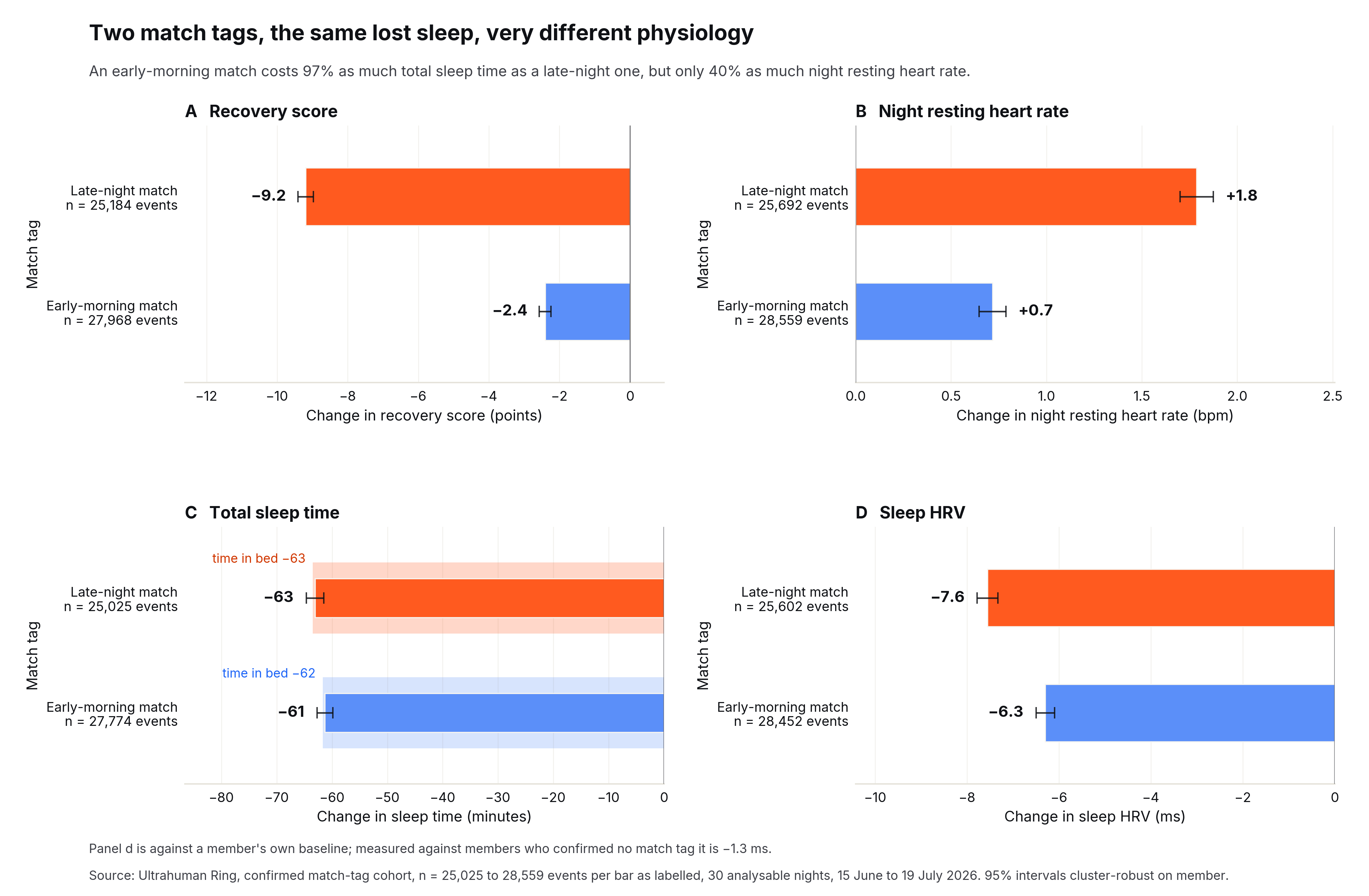
Figure 1. Both match nights remove about an hour of sleep, and the late night costs two and a half times the heart rate. Change from each member's own baseline on the two match tags, per event, with 95% confidence intervals clustered on member. A) Recovery score. B) Night resting heart rate, where the two arms separate at 1.8 bpm against 0.7. C) Total sleep time; both arms lose close to an hour. D) Sleep HRV, which falls 7.6 ms against a member's own baseline but 1.3 ms against members who confirmed no tag.
The hour the sleep is lost in matters more than the amount lost
When two nights remove the same amount of sleep but cost different amounts, the difference lies in the shape of the night. This section tests that three ways: by matching nights on the sleep they lost, by looking at nights that lost no sleep at all, and by holding sleep fixed statistically. All three agree.
Start with the shape. A late-night match pushes both ends of the night later, but unevenly. Bedtime moves 1 h 40 min later and wake time only 35 min, so the night starts after midnight and runs about 1 h 04 min shorter. An early-morning match shifts the whole night earlier instead. The tagged night is the one before an early kick-off, and on it members went to bed 30 min earlier than usual, then woke 1 h 33 min early, for a night also about 1 h 04 min shorter (Figure 2). The earlier bedtime reads as members going to bed ahead of an early alarm.
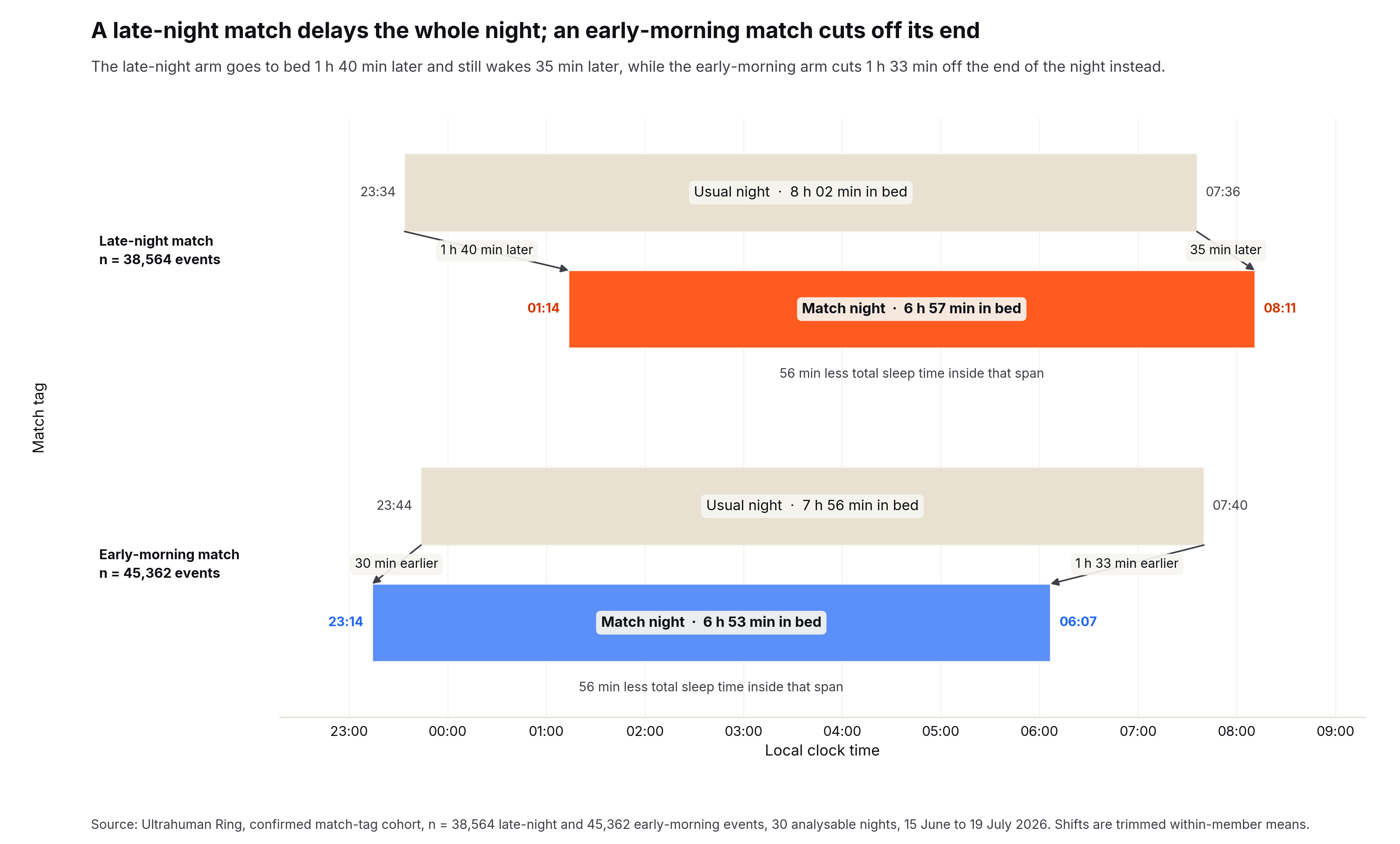
Figure 2. The two tagged nights are reshaped at opposite ends of the night. Each pair of bars places one group's usual night above the same group's tagged night on a local clock axis. A late-night match delays both ends, 23:34 to 01:14 and 07:36 to 08:11; an early-morning match moves both ends earlier, 23:44 to 23:14 and 07:40 to 06:07. This panel needs a bedtime and a wake time on the same night, which more nights can supply than the headline figures require, so sleep lost reads 56 minutes here against the 63 and 61 in the Results.
The first approach matches the nights on sleep lost. Comparing the two tags only across nights that lost the same amount of total sleep time, to within 15 minutes, a late-night match still raised night resting heart rate 1.0 bpm more than an early-morning one (95% CI 0.9 to 1.1), across 52,799 events (Figure 3). Among the 5,933 members who had both kinds of night, so the comparison sits inside one person, the gap is 0.8 bpm (0.7 to 1.0).
The second approach looks only at nights that lost no sleep at all. A late-night match that cost no sleep still raised night resting heart rate 0.8 bpm (0.6 to 1.0). An early-morning match that cost no sleep appeared to raise it 0.1 bpm, marginally but not significantly above zero. Where nothing was lost, only the late night still carried a cost, and the two arms sit 0.7 bpm apart. These are not rare nights. On 22% of late-night matches the member slept more than usual, and on 31% they slept at least as much as usual.
The third approach uses a statistical control, holding that night's sleep at the member's own baseline. It runs on a wider set of nights than the headline figures, where the unadjusted values are a 1.7 bpm rise and 52 minutes of added debt against the 1.8 bpm and 56 minutes in Results 1. Read within that set, 54% of the heart-rate rise survives. The effect is therefore more than a restatement of the short night. Added sleep debt behaves the other way round. Hold sleep fixed and nothing is left of its 52 minutes, which is expected, since the debt is calculated from the night's sleep.
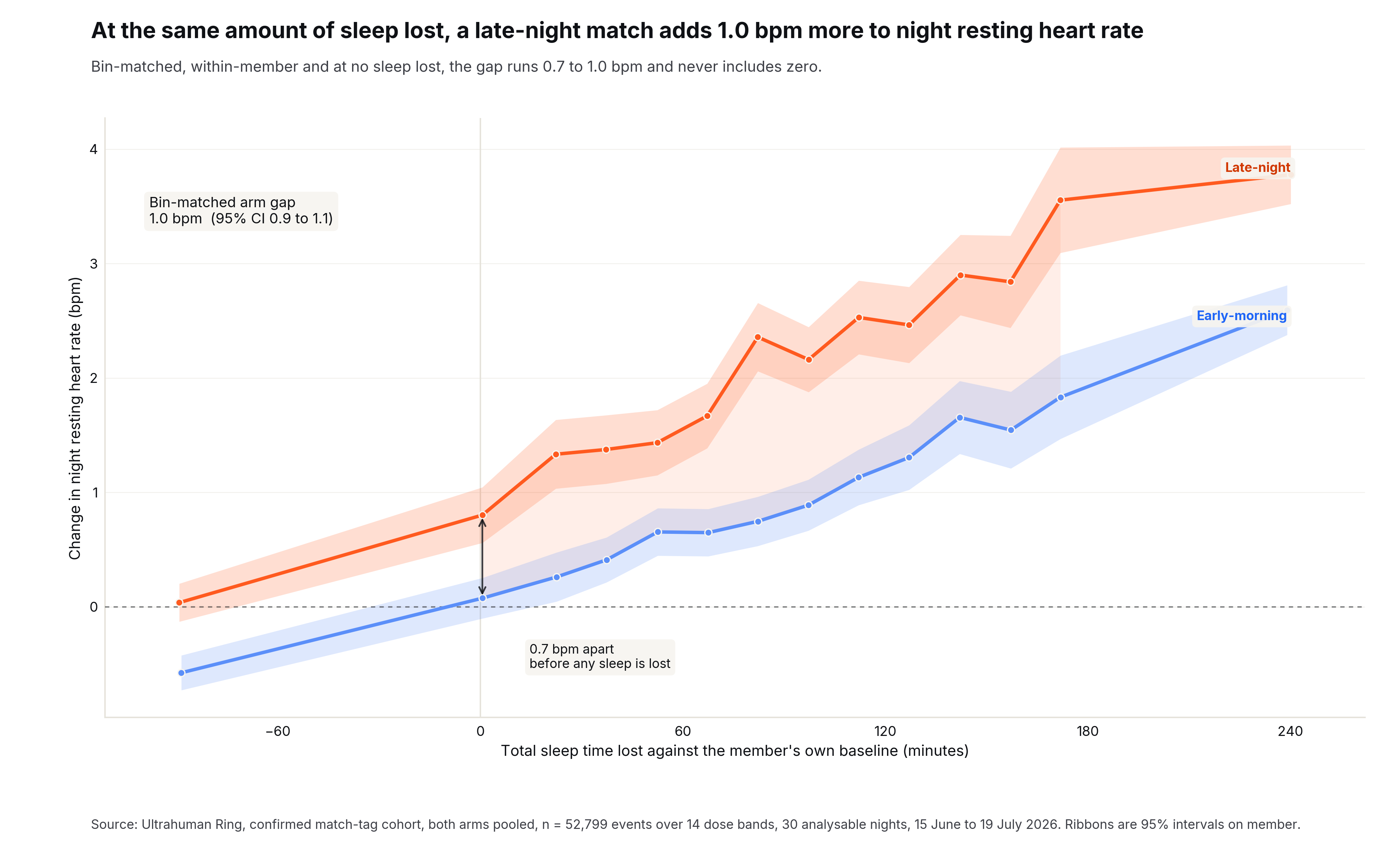
Figure 3. At every level of sleep lost, the late night costs more heart rate than the early one. Night resting heart rate against total sleep time lost, one line per tag. Matched in 15-minute bins the gap is 1.0 bpm (95% CI 0.9 to 1.1), across about 52,800 events from about 28,300 members. Where no sleep at all was lost the lines are 0.7 bpm apart.
The cost clears by the following night and does not accumulate
The cost did not carry into the following days. Using only isolated match nights, those with no other tagged night in the week either side, measured against members who confirmed no match tag on the same dates, an isolated late-night match cost 9.9 recovery points and 1.7 bpm. One night later both were back to normal, with 98% of the recovery change and 91% of the heart-rate rise cleared (Figure 4). Heart rate is the cleaner of the two, because part of the recovery figure is the score's own sleep-timing term, which is present on the match night and gone the next by construction.
Little accumulated across the tournament either. 59% of members confirmed exactly one tagged night in the whole tournament, and among those who confirmed more, the size of the hit did not deepen with each earlier tagged night.
An earlier Ultrahuman analysis asked how long it takes to recover from one bad night of sleep and found that most sleep metrics took around 72 hours to return to their pre-deprivation level [12]. The two results measure different things. That analysis began from a night scoring below 50 on sleep quality, whatever the cause, and followed sleep score, duration, wakeful episodes and HRV across the following week. This one begins from a night whose timing shifted, and follows morning recovery and night resting heart rate, neither of which that analysis tracked. Together they suggest that sleep itself can take a few days to settle after a genuinely bad night, while the cardiac cost of one self-chosen late night is gone by the following night. These nights are also the milder case, mostly a single late night rather than a night scored below 50.
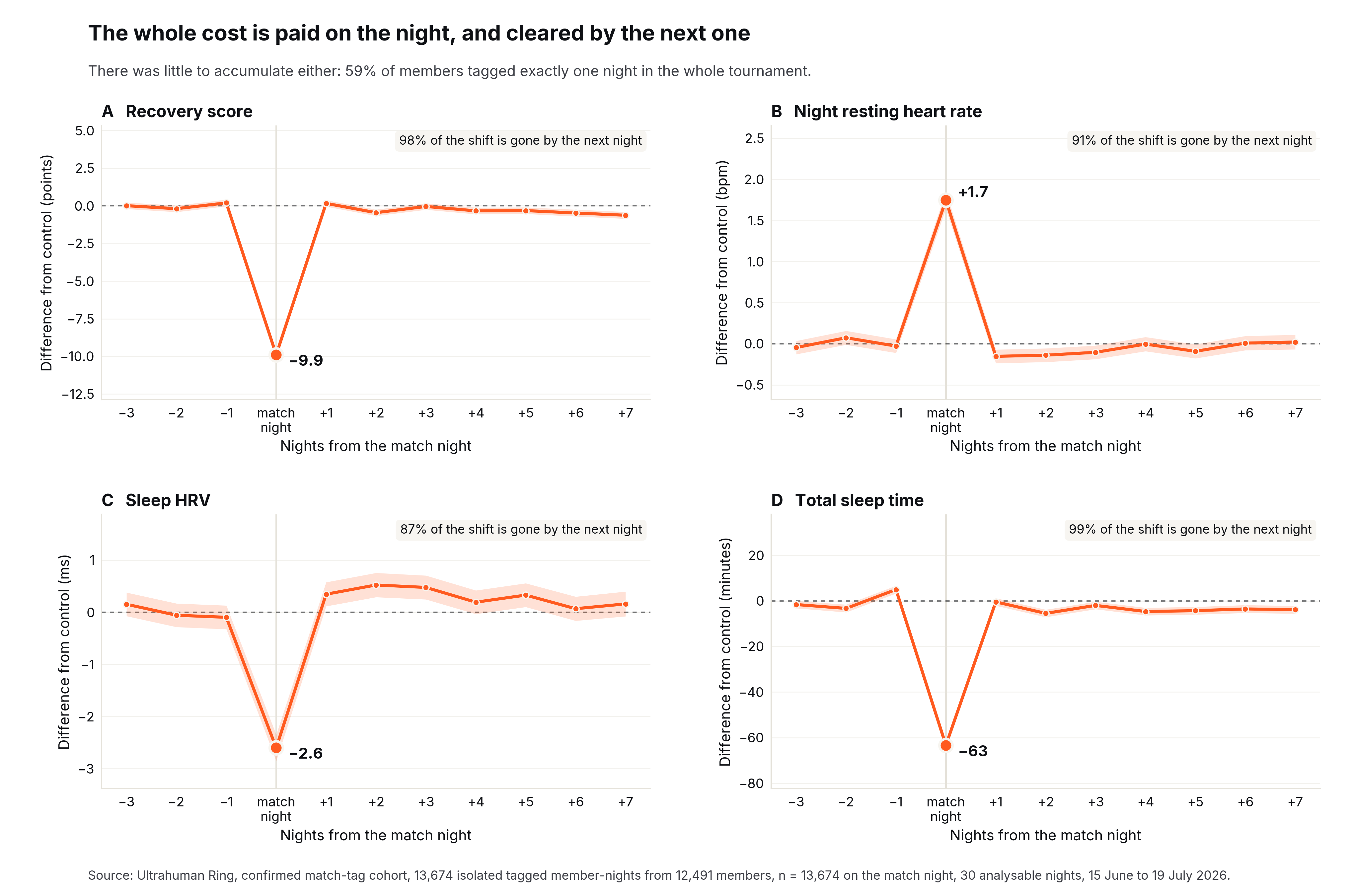
Figure 4. Every measure is back at baseline one night after an isolated match night. Each panel tracks one measure from three nights before an isolated late-night match to seven nights after, against members who confirmed no tag on the same dates. A) Recovery score, down 9.9 points on the match night. B) Night resting heart rate, up 1.7 bpm. C) Sleep HRV, down 2.6 ms. D) Total sleep time, down 63 minutes. One night later all four sit back at baseline, having cleared 98%, 91%, 87% and 99% of the match-night shift.
Tag volume follows a weekly rhythm and the nights grow more costly
Two further patterns are descriptive rather than findings. They describe who confirmed a tag and when, not what a match night costs.
The tournament kept a weekly beat. Late-night tags averaged 1,532 a night on a Friday or Saturday evening against 761 on a weeknight, a 2.01x difference (95% CI 1.64 to 2.43), peaking on Saturdays at 1,688 and bottoming on Mondays at 660. Early-morning tags ran the opposite week, peaking on Wednesday nights at 1,206 and bottoming on Saturday at 860, the pattern expected when an early kick-off falls on a day the alarm was already set for work. The busiest single night was Saturday 20 June, with 3,097 tags across both kinds. The fixture calendar does not explain the weekend spike. Weekend nights carried 3.22 matches on average against 3.00 on a weeknight, and the gap survives holding the night's match count and its place in the tournament fixed (Figure 5).
The nights also got more expensive (Figure 6). Added sleep debt on a late-night match held near 52 minutes for three weeks, then climbed 3.08 minutes a night from 6 July to reach 81 minutes in the closing week, while nightly tag volume fell 20%. Members who tagged in both the opening and closing weeks added 19 minutes more debt in the closing one, so this is not a change in who was tagging. Two caveats apply. Putting the tournament's five excluded rest nights back flattens the trend to 2.13 minutes a night and the closing week to 77 minutes. And why the nights got worse cannot be answered here, because the round, the date and accumulated tiredness all move together; only the clock can be ruled out, since local kick-off times moved 89 minutes earlier into the knockout rounds rather than later.
The worst single night was the final, at 105 minutes of added debt and 17.5 recovery points lost, and its record is incomplete. About two thirds of a normal night's tag entries were logged, and the shortfall sits almost entirely in one region. Only 9 confirmed late-night tags survive across that whole region, while those members' 35,248 sleep records are present in normal numbers. The sleep was recorded; the tags were not. The final is therefore read with that region excluded, as is every night it is ranked against, and without it the closing week still stands at 74 minutes.
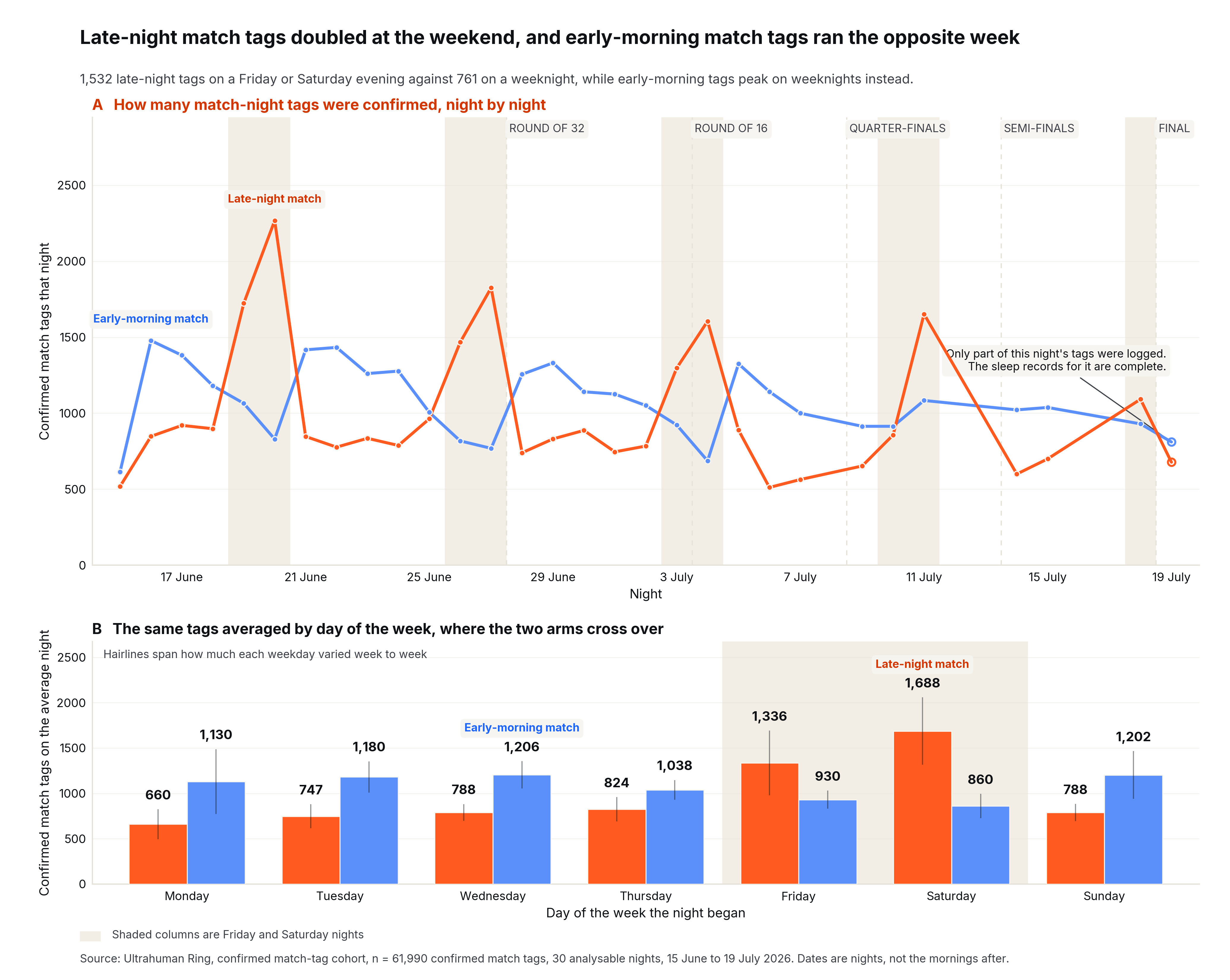
Figure 5. Confirmed tags follow the working week, and the two arms run opposite rhythms. Confirmed match tags across the 30 analysable nights, 15 June to 19 July 2026. A) Counts night by night, with Friday and Saturday evenings shaded. B) The same counts averaged by day of the week, where the two arms cross over. These are counts of confirmed tags. They do not count people awake, and say nothing about how badly anyone slept. Only part of the final night's tag record was logged, so that night's count is a floor.
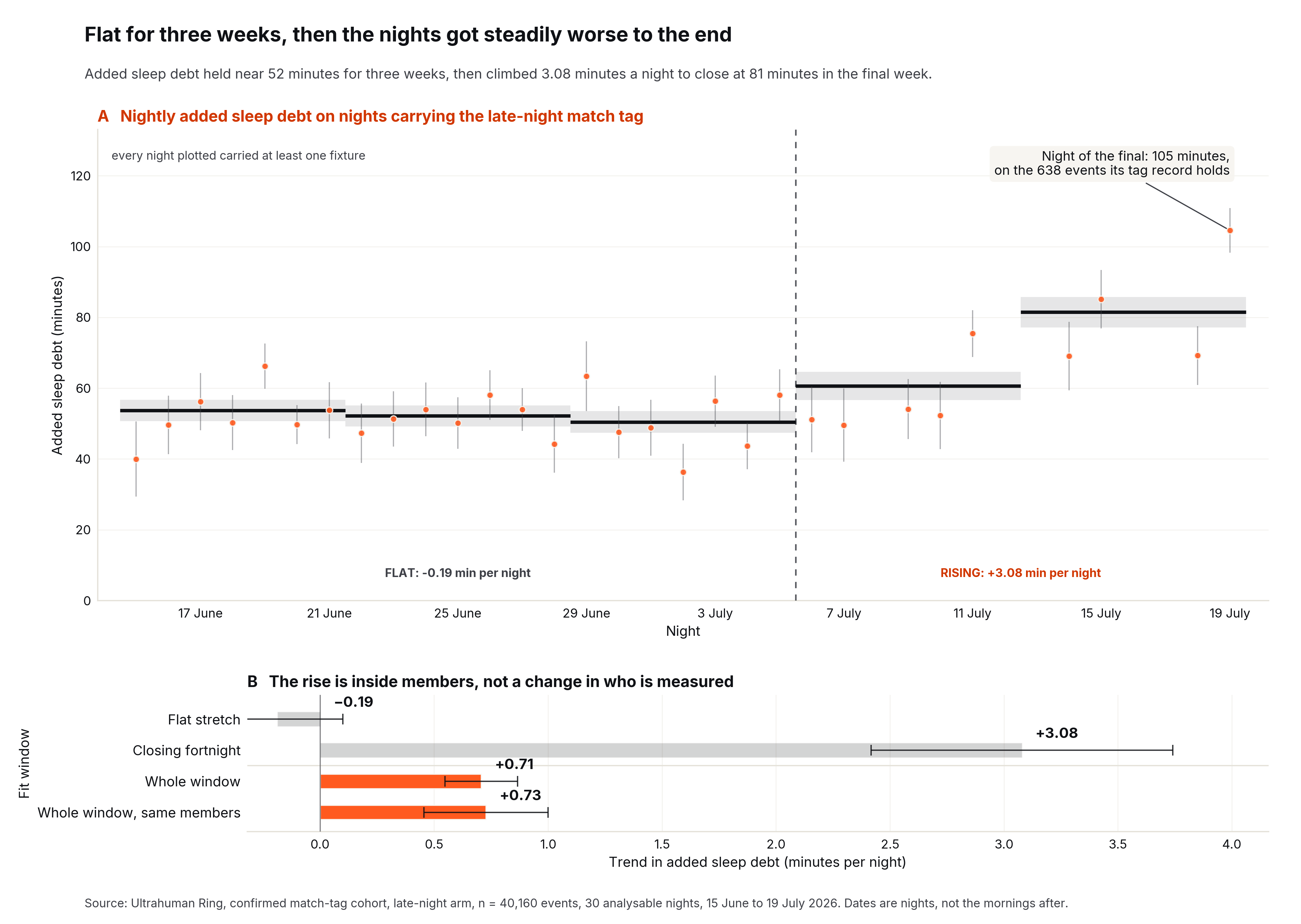
Figure 6. Added sleep debt holds flat for three weeks, then climbs through the knockouts. Added sleep debt on nights carrying the late-night match tag. A) The nightly mean with weekly means marked at 54, 52, 50, 61 and 81 minutes. The series is flat for three weeks, then rises 3.08 minutes a night from 6 July. B) The trend fitted over the flat stretch, the closing fortnight, the whole window, and the whole window within the same members. The final night is read on the members whose tags were logged, so its point is plotted on that basis alone.
Discussion
Across 30 match nights, a late kick-off cost members about an hour of sleep, 9.2 recovery points and 1.8 bpm on the same night. Two nights that removed the same sleep still cost different amounts, about 1 bpm apart depending on when the sleep went missing, and that gap held after matching on sleep lost, inside the same member, and against a control group. The whole cost then cleared by the next night.
The timing result is the one most likely to hold beyond this tournament. What predicted the cost was when members slept, not what they were watching, so this is a result about the body clock, measured during a football tournament. The design is also strongest here, since three independent cuts of the data agree and the measure carrying it is the one the tag does not read.
One late night, chosen freely and slept off once, left no residue. What grew across the tournament was the cost of the nights themselves, with no sign of a build-up inside members, which fits an exposure that intensified rather than a tolerance that eroded. This design cannot fully separate those two.
Several limits shape what these numbers mean. The tag is member-declared and takes no football input, so this measures self-identified tournament sleep disruption rather than verified viewing, and confirming a tag selects the worse night. The controlled studies this work leans on for mechanism ran on small, mostly male samples, against a cohort that is 69% female. This is an observational analysis, so it describes what happened around a declared night and not what caused it, and nothing here is a clinical measure.
Mapping each fixture's kick-off to each member's local clock would turn a declared tag into a measured exposure. Repeating the timing comparison away from football would test how far the timing result holds.
This work is independent and is not affiliated with, endorsed by, or connected to any football governing body, competition organiser or broadcaster. "World Cup" is used descriptively, to date the nights studied.
- FIFA. (2023). FIFA World Cup Qatar 2022 in numbers. FIFA Annual Report 2022. https://publications.fifa.com/en/annual-report-2022/tournaments-and-events/fifa-world-cup-quatar-2022/fifa-world-cup-qatar-2022-in-numbers/
- FIFA. (2024). Reports detail record global audience figures and positive sustainability outcomes from FIFA World Cup Qatar 2022. https://inside.fifa.com/organisation/news/reports-detail-record-global-audience-figures-and-positive-sustainability-outcomes-fifa-world-cup-qatar
- Schlagintweit, J., Laharnar, N., Glos, M., Fietze, I., & Penzel, T. (2023). Effects of sleep fragmentation and partial sleep restriction on heart rate variability during night. Scientific Reports, 13, 6202. https://doi.org/10.1038/s41598-023-33013-5
- Zhang, S., Niu, X., Ma, J., Wang, Y., & Li, H. (2025). Effects of sleep deprivation on heart rate variability: A systematic review and meta-analysis. Frontiers in Neurology, 16, 1556784. https://doi.org/10.3389/fneur.2025.1556784
- Reichenberger, D. A., Ness, K. M., Strayer, S. M., Mathew, G. M., Schade, M. M., Buxton, O. M., & Chang, A.-M. (2023). Recovery sleep after sleep restriction is insufficient to return elevated daytime heart rate and systolic blood pressure to baseline levels. Psychosomatic Medicine, 85(8), 744–751. https://doi.org/10.1097/PSY.0000000000001229
- Scheer, F. A. J. L., Hilton, M. F., Mantzoros, C. S., & Shea, S. A. (2009). Adverse metabolic and cardiovascular consequences of circadian misalignment. Proceedings of the National Academy of Sciences, 106(11), 4453–4458. https://doi.org/10.1073/pnas.0808180106
- Waterhouse, J., Reilly, T., Atkinson, G., & Edwards, B. (2007). Jet lag: Trends and coping strategies. The Lancet, 369(9567), 1117–1129. https://doi.org/10.1016/S0140-6736(07)60529-7
- Wilbert-Lampen, U., Leistner, D., Greven, S., Pohl, T., Sper, S., Völker, C., Güthlin, D., Plasse, A., Knez, A., Küchenhoff, H., & Steinbeck, G. (2008). Cardiovascular events during World Cup soccer. New England Journal of Medicine, 358(5), 475–483. https://doi.org/10.1056/NEJMoa0707427
- Carroll, D., Ebrahim, S., Tilling, K., Macleod, J., & Davey Smith, G. (2002). Admissions for myocardial infarction and World Cup football: Database survey. BMJ, 325(7378), 1439–1442. https://doi.org/10.1136/bmj.325.7378.1439
- Quer, G., Gouda, P., Galarnyk, M., Topol, E. J., & Steinhubl, S. R. (2020). Inter- and intraindividual variability in daily resting heart rate and its associations with age, sex, sleep, BMI, and time of year: Retrospective, longitudinal cohort study of 92,457 adults. PLOS ONE, 15(2), e0227709. https://doi.org/10.1371/journal.pone.0227709
- Kristal-Boneh, E., Froom, P., Harari, G., Malik, M., & Ribak, J. (2000). Summer-winter differences in 24 h variability of heart rate. Journal of Cardiovascular Risk, 7(2), 141–146. https://doi.org/10.1177/204748730000700209
- Asudani, V., Prabhakaran, P., Dalal, S., Srinivasan, B., & Bhattacharya, A. (2024). How long does it take to recover from one bad night of sleep? Ultrahuman Science. https://ultrahuman.com/science/studies/how-long-does-it-take-to-recover-from-one-bad-night-of-sleep