







Blood Age explained: how 18 blood markers are turned into a biological age
Medically reviewed by Mukul Mittal, MD
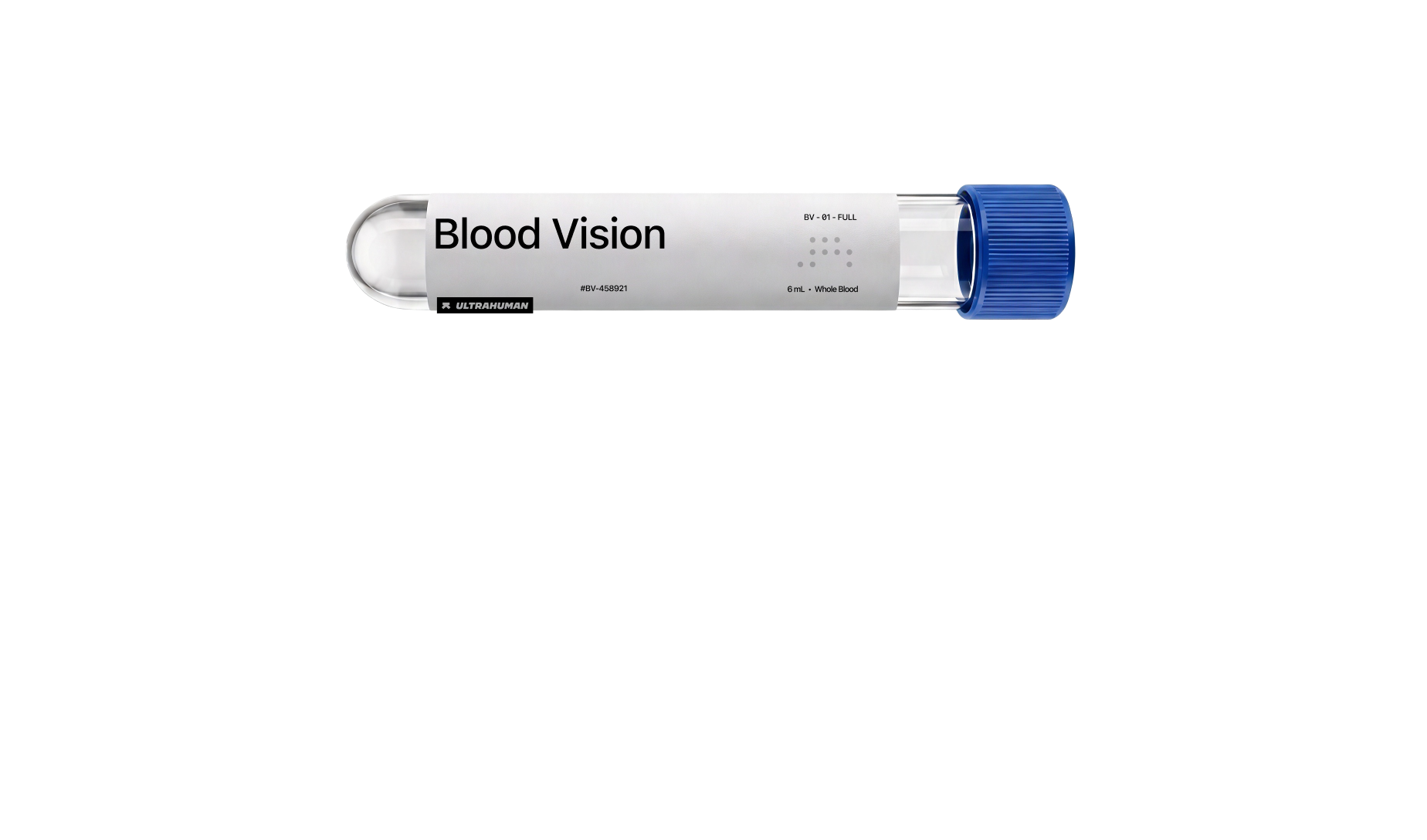
Blood Age is an estimate, in years, of how old your blood markers look, worked out from a single blood test.
A blood test usually comes back as a list, one marker at a time, each checked against its own reference range. Blood Age combines 18 routine markers into one number you can follow from one test to the next.
In this guide, we explain which markers Blood Age uses and why we chose them, what the difference from your actual age means, and how to read your Blood Age.
Key takeaways
Blood Age combines 18 routine markers from one blood draw, chosen to cover blood sugar, inflammation, blood cells, the kidneys, the liver, blood fats and the thyroid.
If your Blood Age sits above your actual age, your markers looked older than you on the day you were tested. It is not a diagnosis, and it does not forecast how long you will live.
Compare each new Blood Age with your own earlier ones. You learn more from two or more tests than from one.
In our study of 20,858 Ultrahuman members, those whose Blood Age sat further above their actual age tended to have a higher resting heart rate at night, and to sleep less. That study is a preprint, shared before peer review.
What is Blood Age?
Blood Age answers one question about your blood test: does it look like the blood of someone your age?
It combines 18 routine markers from a single draw into a figure in years. If you are 45 and it comes back 49, your markers resemble those of someone four years older, by our model.
Test again in six months and you can get a different figure, because the markers themselves move.
How Blood Age is estimated
Everything comes from one blood draw. The markers fall into seven groups, by what they measure.
Blood sugar: HbA1c, which reflects your average blood sugar across the previous two to three months
Inflammation and immune cells: C-reactive protein, made by the liver in response to inflammation, plus white blood cell count and lymphocyte percentage, the share of white cells that are lymphocytes
Red blood cells: hemoglobin, the protein that carries oxygen, plus mean corpuscular volume (the cells' average size) and red cell distribution width (how much their size varies)
Kidneys: creatinine, a waste product that builds up in the blood when the kidneys aren't working well, and estimated glomerular filtration rate (eGFR), a calculation used to estimate how well your kidneys filter
Liver: albumin (a protein the liver makes), plus alkaline phosphatase, ALT and AST (enzymes found in the liver)
Blood fats: total cholesterol, LDL cholesterol, HDL cholesterol and triglycerides
Thyroid: TSH, or thyroid-stimulating hormone
We built Blood Age on published research. Your Ring plays no part in it, and every new blood panel can give you a new figure.
Why these 18 markers
All of them are routine lab tests, so a standard panel usually covers them.
We chose them to span the body's main systems, because the body does not age evenly. Among UK adults in one study, different organ systems aged at different paces, and people with a disease in one organ often had older biological ages in several others.
How to read your Blood Age
Start with the difference between your Blood Age and your actual age. Then open the results underneath it and read them one by one, as the app lists them. If one sits outside its reference range, that stands on its own, whatever your Blood Age is.
Illness moves it. An infection can push up your C-reactive protein and your white cell count for a week or two. So get tested when you are well, and prepare the same way every time, including any fasting your test asks for.
Compare yourself with yourself. Different methods of estimating biological age often disagree, so your own previous Blood Age is a better comparison than a biological age from a different kind of test. You learn more from two or more tests than from one, though illness and laboratory variation can move the figure too.
What the research says
People with more diseases tend to have an older biological age, judged from routine lab results. That comes from a study of more than 11,000 US adults.
Among more than 400,000 UK adults, the more unhealthy habits someone had, the further their blood-based estimate ran ahead of their actual age. The study counted smoking, alcohol-related habits and too little exercise.
Sleep showed up too, but faintly. About 364,000 UK adults with healthier sleep habits had younger-looking estimates, by roughly five to six weeks of biological age for each point on a sleep scale scored from 0 to 6. That is under a year across the whole scale.
Cutting calories slowed two of these measures in a two-year trial of 220 adults without obesity. People randomly assigned to eat less aged more slowly, according to both biological-age measures, than people who carried on as usual, and the difference remained after accounting for weight loss. It does not follow that slowing these measures extends life.
The methods also disagree with each other. Among 964 middle-aged adults in New Zealand, estimates of biological age built in different ways matched one another poorly.
None of these studies tested Blood Age itself. Each used a different estimate of biological age.
What Ultrahuman's data shows
We looked at 20,858 members. Those whose Blood Age sat further above their actual age tended to have a higher resting heart rate at night, and to sleep less. That is reported in a preprint, shared before peer review.
Of five Ring measures, night-time resting heart rate came closest to the Blood Age difference, and even that was a loose connection once we accounted for age and sex, a correlation of 0.22.
Figure 1
Resting heart rate at night moved most closely with the Blood Age gap
20,858 Ultrahuman members, how closely each Ring measure moved with the Blood Age gap after allowing for age and sex, where 0 means no link
Blood Age explained: how 18 blood markers are turned into a biological age
Source: Ultrahuman Science, medRxiv preprint, 2026, 20,858 Ultrahuman members
Blood Age explained: how 18 blood markers are turned into a biological age
These are associations in observational data. Sleeping more or lowering your heart rate would not necessarily change your Blood Age, and the members we studied may not look like the wider population.
Read the original research
All Studies →This explainer is based on original research by the Ultrahuman Science team. Explore the full Studies repository.
Frequently asked questions
Is my Blood Age more important than my individual results?
No. Blood Age sums up 18 results in one number, and each result still has its own reference range. Read your Blood Age and your individual results together.
Does a Blood Age above my age mean I'm aging faster?
No. A Blood Age above your age shows that on the day of one test, your markers looked older than you are. Repeated tests alone would not establish your true aging speed.
Does the Ring feed into my Blood Age?
No. Blood Age is worked out from a blood test, and your Ring readings play no part in the calculation.
Can my Blood Age change?
Yes. The markers Blood Age reads can shift with diet, activity and illness, and every blood test can give a new estimate.
Does a younger Blood Age mean I'll live longer?
No. Blood Age reads your markers on one day, and no single blood test can tell you how long you'll live.
When should I talk to a doctor about my Blood Age?
Talk to a doctor when a result sits outside its reference range, or if you are concerned about a persistently higher Blood Age. Bring the full set of results with you.
References
- Tian YE, Cropley V, Maier AB, et al. Heterogeneous aging across multiple organ systems and prediction of chronic disease and mortality. Nature Medicine. 2023;29(5):1221-1231. PMID 37024597
- Liu Z, Kuo PL, Horvath S, et al. A new aging measure captures morbidity and mortality risk across diverse subpopulations from NHANES IV: A cohort study. PLoS Medicine. 2018;15(12):e1002718. PMID 30596641
- Li X, Cao X, Zhang J, et al. Accelerated aging mediates the associations of unhealthy lifestyles with cardiovascular disease, cancer, and mortality. Journal of the American Geriatrics Society. 2024;72(1):181-193. PMID 37789775
- Gao X, Huang N, Guo X, Huang T. Role of sleep quality in the acceleration of biological aging and its potential for preventive interaction on air pollution insults: Findings from the UK Biobank cohort. Aging Cell. 2022;21(5):e13610. PMID 35421261
- Belsky DW, Huffman KM, Pieper CF, Shalev I, Kraus WE. Change in the Rate of Biological Aging in Response to Caloric Restriction: CALERIE Biobank Analysis. The Journals of Gerontology: Series A. 2017;73(1):4-10. PMID 28531269
- Belsky DW, Moffitt TE, Cohen AA, et al. Eleven Telomere, Epigenetic Clock, and Biomarker-Composite Quantifications of Biological Aging: Do They Measure the Same Thing? American Journal of Epidemiology. 2018;187(6):1220-1230. PMID 29149257
- Ultrahuman Science. Blood Age: a biological-age clock associated with modifiable wearable physiology in 20,858 adults. medRxiv. 2026. 10.64898/2026.08.12.26360277
Blood Age describes associations in blood test data rather than causes. It isn't a medical diagnosis. If a result sits outside its reference range or keeps changing between tests, take it to your physician.
Related explainers


Your cart is empty
Looks like you haven't added anything yet. Explore our products to get started.