




Cardio Age explained: How Ultrahuman Ring estimates your fitness
Ultrahuman's Cardio Age estimates the fitness of your heart and lungs, expressed as an age.
If you're 45 and your Cardio Age reads 38, your cardiovascular fitness is running seven years behind your chronological age. But if it reads 52, that can be a wake-up call to start taking action.
In this guide, we explain how the Ring estimates Cardio Age, the science behind the number, and the difference in behaviors between those with the biggest variations in aging.
Key takeaways
Cardio Age turns your estimated VO2 max into an age, so you can read it against your own years instead of an unfamiliar unit.
The Ring estimates it passively from your overnight resting heart rate, heart rate variability and daily steps, plus your age, sex, height and weight. No exercise test needed.
Ultrahuman built its own VO2 max model and tested it against cardiopulmonary exercise testing, the laboratory gold standard.
In a study of 442 members, those who improved consistently over a year lowered their Cardio Age by an average of 3.24 years.
What is Cardio Age?
Fitness declines with age, so the same VO2 max means very different things for a 25-year-old and a 55-year-old.
Cardio Age handles that comparison for you. It places your estimated fitness against population norms for your sex, then reports the age at which it would be average.
The number worth watching is the Cardio Age gap: your Cardio Age minus your real age. A negative gap means your fitness is ahead of your years. A positive gap means there's room to improve.
How Ultrahuman Ring estimates Cardio Age
Almost nobody takes the gold-standard VO2 Max test, where you push to exhaustion while a mask measures the oxygen you breathe. But the ingredients of a good estimate are things a ring worn every night already records.
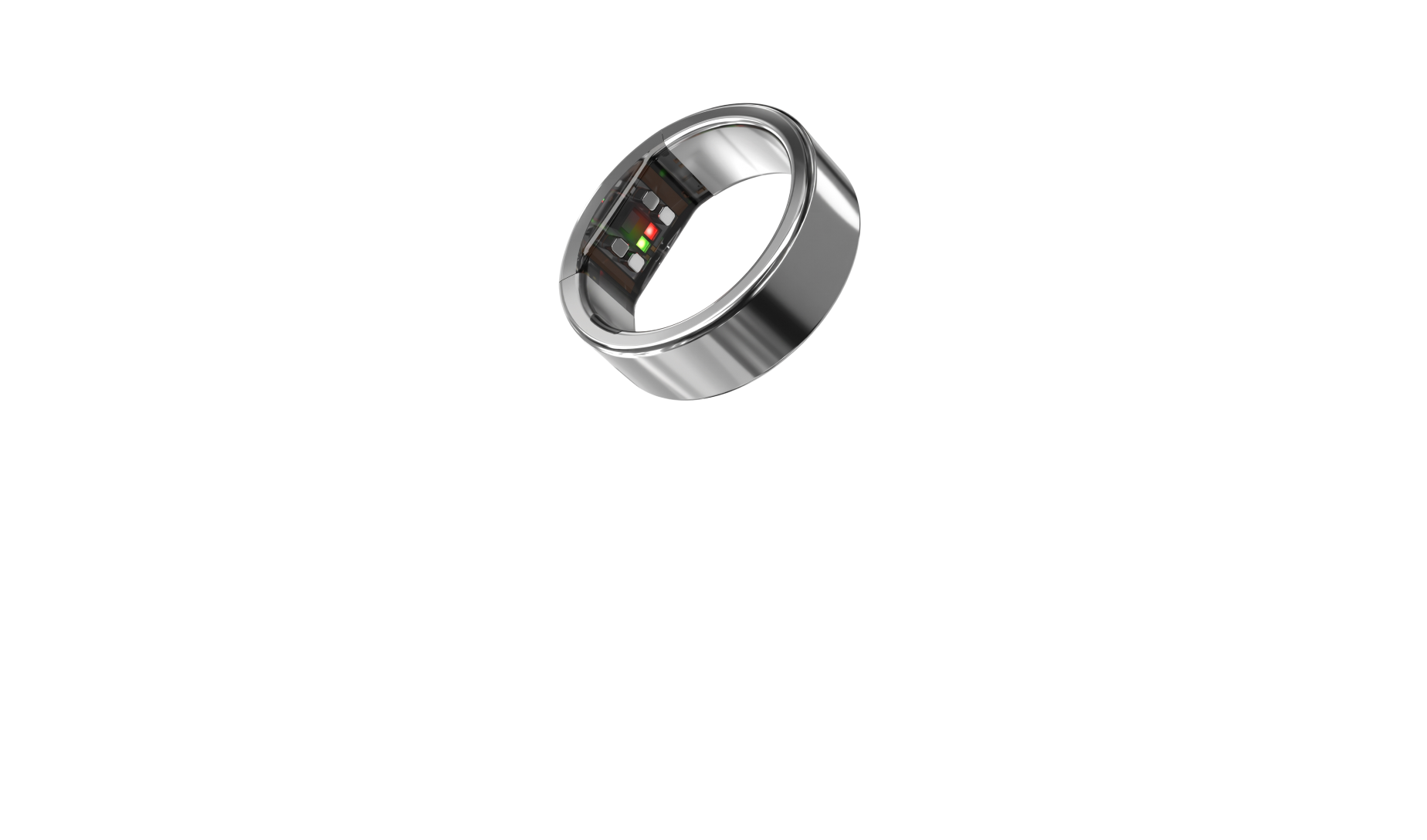
An optical sensor reads your pulse across the night, giving your overnight resting heart rate and your heart rate variability. The motion sensor counts your daily steps. Those, with your age, sex, height and weight, feed an Ultrahuman model that produces a VO2 max estimate, which becomes your Cardio Age.
This is Ultrahuman's own model. It was tested directly against cardiopulmonary exercise testing, comparing the Ring's number against the laboratory measurement and against several published prediction equations.
How to read Cardio Age in the app
Your Cardio Age appears alongside the VO2 max estimate it comes from, on the same card.
Because the inputs are captured every night, it updates continuously as your resting heart rate, HRV and step patterns shift. A sustained drop in resting heart rate over several weeks, from more consistent training or better sleep, moves your Cardio Age younger.
The main lever is aerobic conditioning. The blog covers how to train your aerobic capacity across the different intensity zones.
A gap that concerns you, or one that won't move despite consistent training and better sleep, is worth raising with a physician.
What the research says about fitness and aging
Aerobic capacity falls by roughly 3 to 6% per decade in your twenties and thirties, then more than 20% per decade after 70, according to the Baltimore Longitudinal Study of Aging.
A large registry of laboratory fitness tests across thousands of adults puts the average decline at roughly 10% per decade, and maps what typical fitness looks like at each age and sex. Those norms are what the Ring compares your estimate against.
Regular activity slows the clock, which is why holding your Cardio Age level as the years pass is itself a result. The American Heart Association Scientific Statement called cardiorespiratory fitness a stronger predictor of long-term mortality than smoking, high blood pressure, or high cholesterol, and argued it should be assessed as routinely as any clinical vital sign.
What Ultrahuman's data shows
In a study of 442 Ring members, 82.6% had a Cardio Age younger than their real age, with a mean gap of 1.84 years.
Members who improved consistently across 12 months lowered their Cardio Age by an average of 3.24 years, alongside a fall in resting heart rate.
Better sleep efficiency, more REM sleep, longer total sleep and more daily steps were each independently linked to a younger Cardio Age gap, beyond the model's own inputs.
Figure 1
Estimated VO2 max declines with age and runs higher in men
Median overnight VO2 max estimate across Ultrahuman Ring members by age band and sex
Estimated VO2 max declines with age and runs higher in men
Source: Ultrahuman Ring data, n=1,809, May-Jun 2026
Read the original research
All Studies →This explainer is based on original research by the Ultrahuman Science team. Read the source studies:
Frequently asked questions
What does Cardio Age mean on the Ring?
The age at which your estimated cardiovascular fitness would be typical for your sex. Lower than your real age means your fitness sits above average for your years. Higher means below.
What is VO2 max, and how is it different from Cardio Age?
VO2 max is the highest rate at which your body can use oxygen during hard exercise. Cardio Age takes that same estimate and expresses it as an age instead, because your own age is a number you already understand.
Is the Ring's Cardio Age accurate?
It's a model estimate rather than a laboratory test. Ultrahuman developed and tested the Ring's VO2 max estimate against cardiopulmonary exercise testing. Any estimate from a finger sensor carries some uncertainty, so read it as a trend over months rather than a single exact figure.
Why does Cardio Age differ between men and women?
Estimated fitness runs higher in men on average, because of larger heart size, higher hemoglobin and more muscle relative to body weight. The norms the Ring uses are specific to your sex, so the same fitness estimate maps to a different Cardio Age for a man and a woman. That's a group-level pattern; individual fitness varies widely.
What can I do to improve my Cardio Age?
Consistent aerobic training, good sleep and lower chronic stress all lower resting heart rate and lift HRV over time, and more daily movement feeds the model directly. In the 12-month study, members who improved consistently lowered their Cardio Age by an average of 3.24 years.
How often does Cardio Age update?
The Ring re-estimates each night from your latest overnight readings. It's smoothed into a trend rather than jumping after a single hard workout or short night, so the weekly or monthly direction is what to read.
References
- Ultrahuman Science. Accuracy of a smart-ring VO2max estimate and five published prediction equations against cardiopulmonary exercise testing: development and validation study with population-scale analysis. medRxiv 2026. DOI 10.64898/2026.07.16.26358226
- Shanmugam A, Gupta K, Dhawale N, et al. Wearable-derived cardiovascular fitness age and its lifestyle correlates in 442 adults. Frontiers in Digital Health 2026. DOI 10.3389/fdgth.2026.1842633
- Ross R, Blair SN, Arena R, et al. Importance of assessing cardiorespiratory fitness in clinical practice: a case for fitness as a clinical vital sign. A scientific statement from the American Heart Association. Circulation 2016. PMID 27881567
- Peterman JE, Arena R, Myers J, et al. Development of global reference standards for directly measured cardiorespiratory fitness: a report from the Fitness Registry and Importance of Exercise National Database (FRIEND). Mayo Clinic Proceedings 2019. PMID 31883698
- Fleg JL, Morrell CH, Bos AG, et al. Accelerated longitudinal decline of aerobic capacity in healthy older adults. Circulation 2005. PMID 16043637
This article is for education only. Cardio Age and the underlying VO2 max estimate are modeled outputs from the Ring, not laboratory measurements or clinical assessments. The patterns described here reflect population associations, not individual cause and effect. If anything in your readings surprises or concerns you, bring it to a physician.