




How the Ultrahuman Ring tracks HRV – and what the data shows
Medically reviewed by Mukul Mittal, MD
Heart rate variability (HRV) is the variation in time between one heartbeat and the next, measured in milliseconds. A rested heart doesn't tick like a metronome: the gaps stretch and shrink slightly, and HRV puts a number on how much.
The Ultrahuman Ring reads it overnight from your finger and scores each night against your own normal. A higher number usually reflects better rest and recovery, but the comparison that means anything is with yourself, not with anyone else.
In this guide, we explain what HRV actually measures, how the Ring reads it, and why your own baseline is the only useful reference point.
Key takeaways
The Ring reads your HRV overnight from your finger, then judges each night against your own baseline.
HRV is measured in milliseconds, and healthy people sit at very different levels. There's no universal good number.
Dips in HRV are linked to stress, alcohol, illness, poor sleep and overtraining. Falls in HRV over a few weeks can act as an early warning system.
HRV falls with age. Across more than 500,000 Ring wearers, the median drops from 47 ms in the twenties to 34 ms in the sixties.
What is heart rate variability?
A heart beating 60 times a minute doesn't leave exactly one second between beats. One gap might run 1,050 milliseconds and the next 920. HRV is the size of that scatter.
The scatter isn't a flaw. Your heart speeds up slightly as you breathe in and slows as you breathe out.
When you're rested, that push and pull has room to move, and the gaps vary more. When your body is busy with something (such as a virus, a deadline, last night's drinks), the timing tightens, and variability falls.
Read our blog on HRV explained and what's normal
How the Ring measures HRV
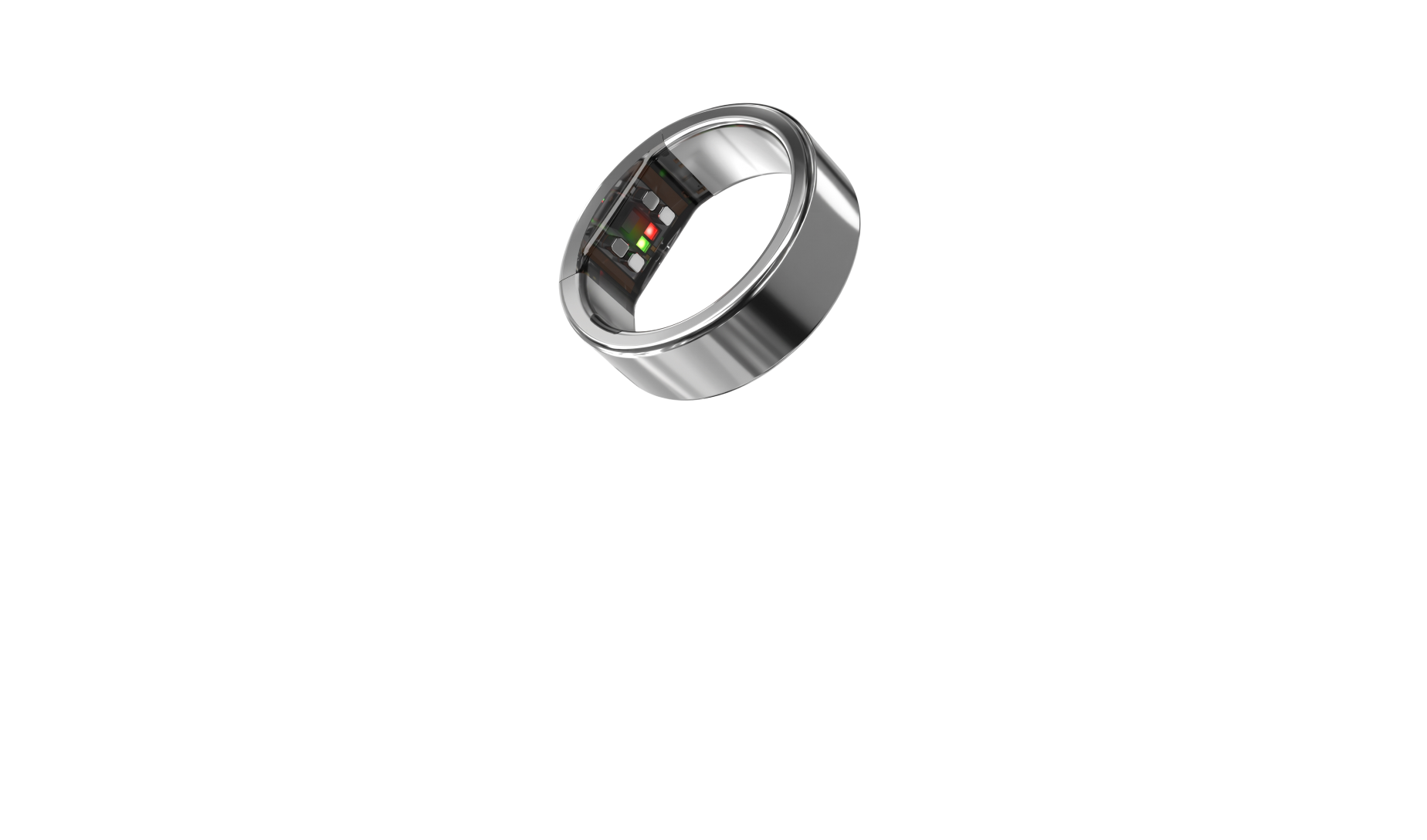
An optical sensor shines light into the tissue of your finger and reads the pulse of blood passing underneath.
Each pulse marks the timing of a beat, and the Ring times the gaps between them, reporting the typical difference between one gap and the next in milliseconds. An accelerometer tells it when your hand is still enough for that timing to be trusted.
The beat timing is measured directly. The number you see is a summary of it: an average across the long, quiet stretches of your sleep rather than a single moment.
Over your first weeks of wear, the Ring also builds your own overnight range, so the app can say whether last night sits inside it.
Why the Ring reads HRV overnight
HRV is only comparable when the conditions are comparable, and it follows a daily rhythm of its own. In 166 healthy adults aged 20 to 70, the calming side of HRV peaked at night and sat on a lower plateau through the day, while overall measures ran the other way.
Daytime readings also move with posture, caffeine, meals, talking, and stress. Compare one morning's spot reading with the next, and you're partly comparing the mornings.
Sleep is the most repeatable condition you have. You're lying down, mostly still, at roughly the same hour, doing roughly the same thing. Reading there collects hours of beats instead of two minutes of them, and it costs you nothing because you're asleep.
Why your own baseline is the reference
Looking at 528,935 Ultrahuman Ring wearers across 79 million nights, there are clear HRV trends.
HRV falls with age. The median HRV drops in each decade after the twenties, from 47 ms down to 34 ms in the sixties.
| Age band | Median overnight HRV | Middle half of wearers |
|---|---|---|
| 20 to 29 | 47 ms | 37 to 59 ms |
| 30 to 39 | 42 ms | 33 to 53 ms |
| 40 to 49 | 38 ms | 30 to 48 ms |
| 50 to 59 | 35 ms | 27 to 45 ms |
| 60 to 69 | 34 ms | 26 to 45 ms |
But the spread of HRV across each age bracket is wide. The middle half of people in their twenties ran from 37 to 59 ms.
So while HRV does naturally decline, there’s no single good number for age.
Comparing to your established HRV baseline is the only useful way of understanding trends in heart rate variability, which makes wearables such as the Ultrahuman Ring AIR/PRO so useful.
What moves HRV over time
Training does help push HRV the other way. A review pooling 16 randomized trials in healthy adults found exercise training was associated with higher HRV than in no-training controls, across the 348 participants behind its main estimate.
A review of 37 studies of people under psychological stress found HRV shifted.
Night to night, sleep, alcohol, illness, and hard training move it most. That's covered in what a low HRV reading means.
How HRV shows up in the app
Your overnight HRV lands each morning and feeds your Dynamic Recovery Score. A night below your own range pulls that score down. A run of nights inside it holds the score up.
Resting heart rate feeds the same score, so the two usually tell a consistent story: when one turns, the other tends to turn with it.
Higher isn't automatically better. HRV varies so widely between healthy people that a bigger number is a different number, not a better one. Read it weekly, and let single nights go.
Read the original research
All Studies →This explainer is based on original research by the Ultrahuman Science team. Explore the full Studies repository.
Frequently asked questions
What is a good HRV number?
There's no single good number. Healthy adults of the same age routinely sit tens of milliseconds apart, and the age bands overlap heavily. A good HRV is one that's normal for you.
How long before the Ring knows my baseline?
Give it a few weeks of consistent nightly wear. The range needs enough ordinary nights, good and bad, before "inside your range" means anything. Early on, read the raw milliseconds rather than the verdict.
Is HRV the same thing as resting heart rate?
No. Resting heart rate counts how many times your heart beats each minute. HRV measures how evenly spaced those beats are. They often move together overnight, but they answer different questions and the Ring reports both.
Can I raise my HRV?
Somewhat. Trials of exercise training in healthy adults suggest HRV rises with the training, and sleep and alcohol move it night to night. Age moves it the other way, which is why your own trend beats a chart.
Does illness show up in my HRV?
Often. A fever or infection tends to push overnight heart rate up and HRV down. The Ring can't tell you what the illness is, only that the night looked unlike your normal ones.
References
- Bonnemeier H, Richardt G, Potratz J, et al. Circadian profile of cardiac autonomic nervous modulation in healthy subjects: differing effects of aging and gender on heart rate variability. Journal of Cardiovascular Electrophysiology 2003. PMID 12890036
- Umetani K, Singer DH, McCraty R, Atkinson M. Twenty-four hour time domain heart rate variability and heart rate: relations to age and gender over nine decades. Journal of the American College of Cardiology 1998. PMID 9502641
- Amekran Y, El Hangouche AJ. Effects of exercise training on heart rate variability in healthy adults: a systematic review and meta-analysis of randomized controlled trials. Cureus 2024. PMID 39015867
- Kim HG, Cheon EJ, Bai DS, Lee YH, Koo BH. Stress and heart rate variability: a meta-analysis and review of the literature. Psychiatry Investigation 2018. PMID 29486547
This explainer describes associations in physiological data, not cause and effect. HRV is a wellness signal, not a medical diagnosis. If your readings change in a way that concerns you, bring the pattern to your physician.
