



Resting heart rate when sick: why your number rises
Medically reviewed by Mukul Mittal, MD
Resting heart rate when sick is your overnight beats per minute while your body fights an infection, and it almost always runs above your usual number. The Ultrahuman Ring reads it from your finger each night and scores it against your own recent nights. Fighting an infection costs energy, and the heart beats more often to pay for it. The rise is a prompt to rest, not a diagnosis.
Key takeaways
The Ultrahuman Ring reads resting heart rate from your finger overnight and compares tonight to your own baseline, not to a population average.
Illness usually pushes the number up. Fever pushes it up hardest, because a warmer body needs more blood moving.
The rise can start before you feel anything, so an unexplained jump is worth noticing.
A rise that lingers after symptoms clear suggests your body is still working.
A high reading tells you something changed. It does not tell you what changed.
What happens to your resting heart rate when you are sick?
It goes up, usually by a few beats and sometimes by a lot more. Your immune system runs hot while it clears an infection. Your temperature rises, vessels near the skin open to shed heat, and fluid leaves through sweat and faster breathing. Each of those asks the heart to beat more often to move the same blood.
Fever is the strongest single driver, which is why the rise scales. The hotter you run, the faster your heart works. Plenty of other things move the number too, and the resting heart rate overview covers them.
How does the Ring measure resting heart rate overnight?
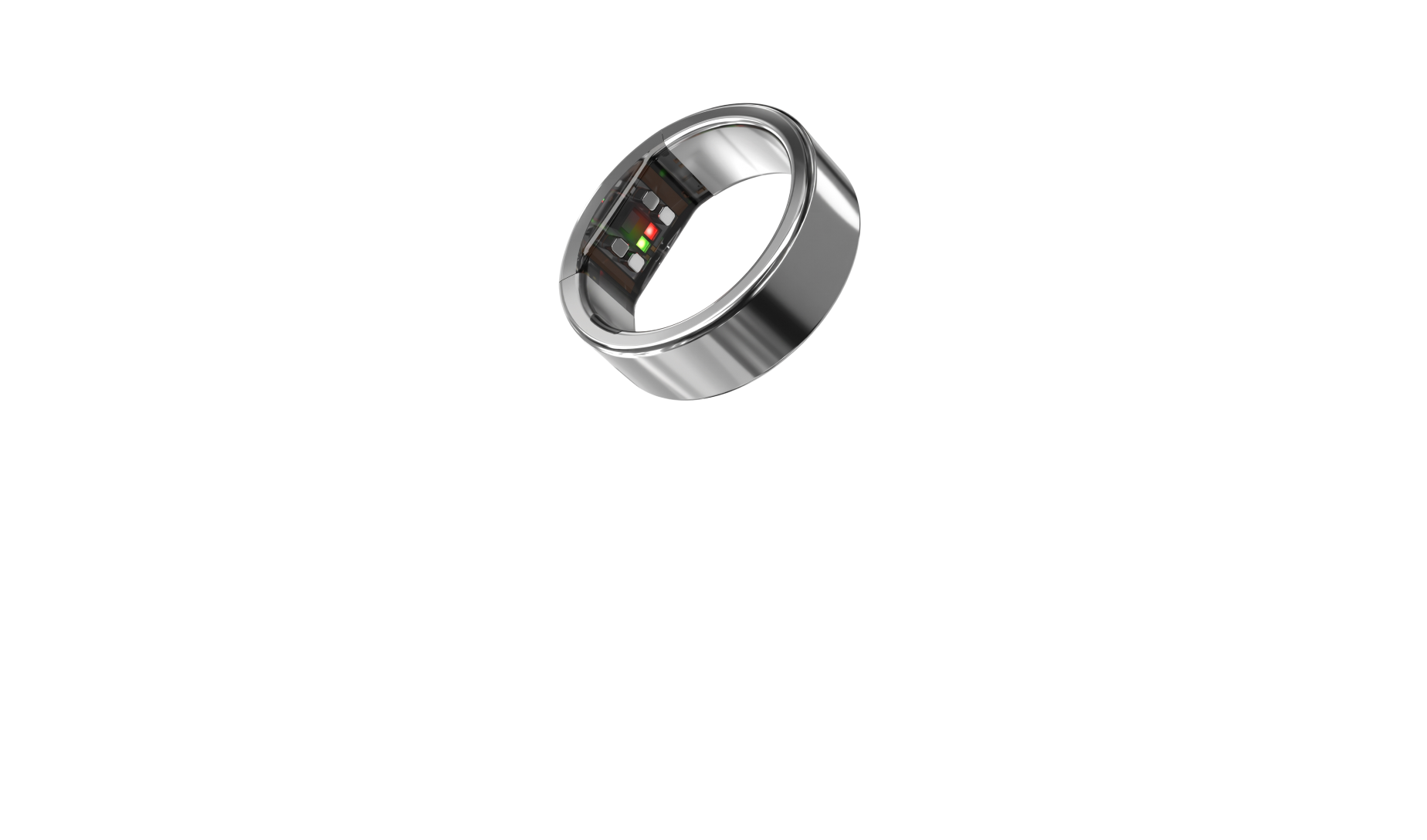
The Ring reads your pulse with light. Sensors against the inside of your finger shine light into the skin and read how much comes back as blood moves through. A movement sensor tells the algorithm when you are actually still. Your resting heart rate comes from the quietest sustained stretch of the night, not from one reading.
Night is the useful window. In daylight hours, movement, caffeine, meals and stress swing your heart rate harder than a mild infection does. Asleep, most of that stops, and the illness signal is what remains.
Why does the Ring judge your number against your own baseline?
Because a healthy resting heart rate covers a wide range, and yours sits at one place inside it. A trained 25-year-old may sleep at 46 beats per minute. Someone else sits at 68. Both are ordinary. Against a population average, neither says anything about tonight. Against your own history, a sudden jump is loud.
So the Ring learns your normal from your own nights and reports the departure. The same logic runs through the nightly skin temperature read and heart rate variability.
What does the research say about heart rate and infection?
Research is consistent on the direction: infection raises resting heart rate, and the rise is often visible before symptoms are. Fever sets the scale. Researchers recorded 24-hour heart traces in 27 young men while they had a fever, then again after they recovered. Mean heart rate ran 84.0 beats per minute with the fever and 66.5 after it. Across those recordings, every 1 degree Celsius added 8.5 beats per minute.
The pattern holds at population scale. Among 2,745 people with a confirmed COVID-19 infection, heart rate and breathing rate rose while heart rate variability fell, all measured on wearables. Fever was reported by just over half of them, 52% of women and 59% of men.
Reading it the same way every night is what makes the timing visible. Researchers followed nearly 5,300 people and found 32 with a confirmed COVID-19 infection. Twenty-six of the 32 showed changes in heart rate, step count or time asleep. Of the 25 with symptom dates, 22 showed the change at or before symptoms began. Run as a live warning system watching each person's own baseline, the same data would have caught 63% before symptoms.
Controlled exposure studies show the signal is real. Volunteers were deliberately given a virus and tracked with a wrist-worn sensor. Models told infected from uninfected with up to 92% accuracy for influenza H1N1 and 88% for rhinovirus, across 31 and 18 analyzed participants.
That sets the size of change a wearable has to resolve. In six volunteers across 36 sleep sessions, the Ring's overnight heart rate matched a clinical reference device to a mean error of 2.4 beats per minute. One degree of fever moves the number by roughly 8.5 beats, so the error sits well inside the effect. That is a claim about measurement, not diagnosis. The Ring does not detect infection.
What does Ultrahuman data show about being ill?
Members can tag a night as sick in the app, so we can compare their sick nights against their own well nights.
Across 5,590 members who logged feeling ill, overnight resting heart rate ran a median 1.9 beats per minute above their own baseline, and 68% of members showed a rise. Control nights here are nights the same member tagged something else, so the comparison is not measuring who bothers to open the app.
Fever is the sharper signal, as the research predicts. On nights members specifically logged a fever, the gap widened to a median 5.4 beats per minute, with 80% showing a rise. Their heart rate variability fell and their overnight skin temperature climbed on the same nights.
The timing is the interesting part:
| Night, relative to the day you feel ill | Resting heart rate vs your own baseline |
|---|---|
| 3 days before | almost nothing, about 0.2 bpm |
| 1 day before | about 1 bpm above |
| The day you log it | about 3.4 bpm above, the peak |
| 1 day after | about 2.5 bpm above |
| 5 days after | back to normal |
So the number starts drifting up a couple of days before you feel anything, peaks on the day you notice, and settles within about five days.
Read that as a description of what those nights look like, not as a detector. These are self-reported tags, people who feel unwell also sleep and eat differently, and a rise of a beat or two is inside the ordinary week-to-week noise.
How does resting heart rate show up in the Ultrahuman app?
It appears each morning on your sleep card, plotted against your recent nights so you see the shape of the change. It also feeds the Dynamic Recovery Score alongside heart rate variability. That is why your recovery number often drops on the night your body starts fighting something, before you know why.
When you are ill, read the trend rather than the digit. The number is asking for rest.
Read the original research
All Studies →This explainer is based on original research by the Ultrahuman Science team. Read the source studies:
Frequently asked questions
How much does resting heart rate go up when you are sick?
It depends on how hard your body is working, and fever is the clearest driver. In one study of young men with a fever, each 1 degree Celsius added about 8.5 beats per minute. A mild cold may move you a beat or two, or barely at all.
Can the Ring tell me I am getting sick before I feel it?
Sometimes it hints. Research shows resting heart rate can rise a day or more ahead of symptoms. The Ring does not detect infection and does not diagnose anything. Treat an unexplained rise as a reason to rest, not a result.
How long does resting heart rate stay high after an illness?
Usually until the work is finished, which can be days after your last symptom. Feeling better and being recovered are not the same night. If your number sits well above your normal weeks later, bring the pattern to a doctor.
Should I train when my resting heart rate is elevated?
That is a judgment call rather than something a number decides. A raised resting heart rate means your body is already spending on something. Most people ease off until it settles.
Can something other than illness explain a high reading?
Yes, plenty. Alcohol, a late heavy meal, a hard session, a hot room, short sleep and stress all lift overnight resting heart rate. That is why the trend across nights beats any single night.
Is a lower resting heart rate always better?
No. A low number usually reflects fitness, and it is worth reading what a low resting heart rate does and does not mean. A very low or falling rate with dizziness, fainting, breathlessness or unusual fatigue is worth a doctor's look.
References
- Karjalainen J, Viitasalo M. Fever and cardiac rhythm. Arch Intern Med 1986. PMID: 2424378.
- Natarajan A, Su HW, Heneghan C. Assessment of physiological signs associated with COVID-19 measured using wearable devices. NPJ Digit Med 2020. PMID: 33299095.
- Mishra T, Wang M, Metwally AA, Bogu GK, Brooks AW, Bahmani A, et al. Pre-symptomatic detection of COVID-19 from smartwatch data. Nat Biomed Eng 2020. PMID: 33208926.
- Grzesiak E, Bent B, McClain MT, Woods CW, Tsalik EL, Nicholson BP, et al. Assessment of the Feasibility of Using Noninvasive Wearable Biometric Monitoring Sensors to Detect Influenza and the Common Cold Before Symptom Onset. JAMA Netw Open 2021. PMID: 34586364.
This page describes associations in physiological data, not cause and effect. It is not a medical diagnosis and the Ring does not detect infection. If a change in your readings concerns you, bring it to your physician.
Related explainers
Heart & RecoveryHow the Ultrahuman Ring tracks HRV – and what the data showsHeart & RecoveryLow resting heart rate: What's normal?Heart & RecoveryUltrahuman Dynamic Recovery Score explainedHeart & RecoveryResting heart rate explainedSleep & CircadianHow Ultrahuman measures skin temperature overnight


