



How Ultrahuman measures skin temperature overnight
Medically reviewed by Mukul Mittal, MD
Skin temperature is one of the signals the Ultrahuman Ring records continuously through the night, and it feeds several of the Ring's other metrics. How it is used as a signal is covered in the sleep and cycle and ovulation tracking explainers.
This explainer stays with the measurement itself: what skin temperature is, how it relates to core body temperature, and how the Ring captures it overnight on the Ring AIR and Ring PRO.
It also explains why the Ring reports a deviation from your personal baseline rather than absolute degrees, and what that deviation means.
Key takeaways
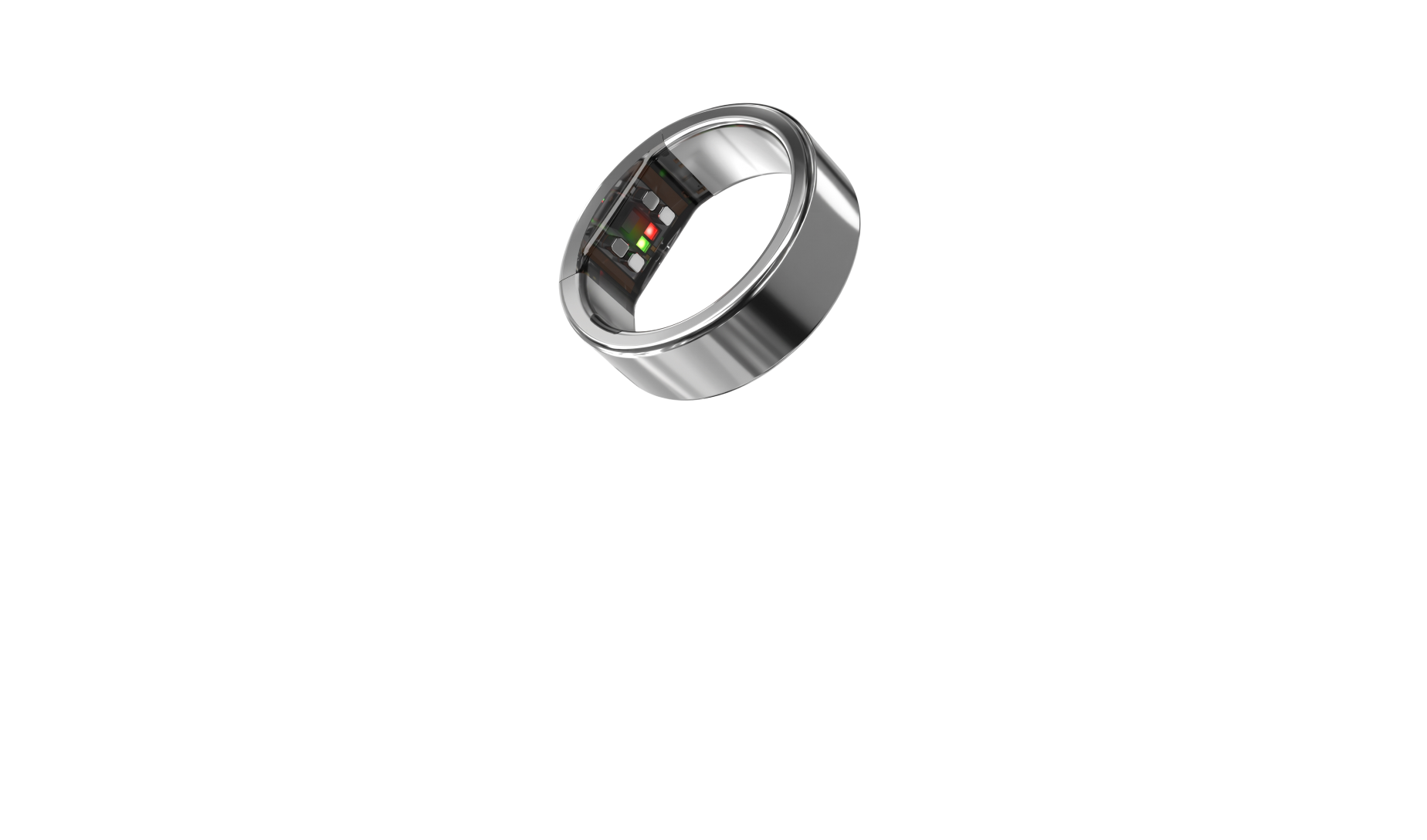
The Ultrahuman Ring measures finger skin temperature continuously overnight using a contact NTC thermistor pressed against the inner surface of the ring.
Temperature Deviation is reported relative to your personal rolling baseline.
Deviation above or below your baseline can reflect physiological changes, including illness, menstrual phase shifts, alcohol, or recovery stress, and the Ultrahuman app surfaces these shifts as contributors to your Readiness score.
What is skin temperature, and why does it change overnight?
Skin temperature is the temperature at the surface of the skin, measured at a specific body site.
It is not the same as core body temperature, which is the deep internal temperature of the trunk and organs.
However, skin temperature at “distal” skin locations, such as the hands and feet, tells an important story and gives smart rings such as the Ultrahuman Ring vital information about sleep onset and the body’s circadian rhythm and ovulatory cycles.
As you approach sleep, your body shunts blood toward the hands and feet through peripheral vasodilation, releasing stored heat into the environment.
Distal skin sites such as the hands and feet rise roughly 1°C near sleep onset as this heat-dissipation process ramps up, while core temperature falls. This distal-to-proximal skin temperature gradient is part of the body's circadian thermoregulatory program.
How does Ultrahuman measure skin temperature overnight?
The Ultrahuman Ring contains a contact NTC (negative temperature coefficient) thermistor on its inner surface.
The sensor runs throughout the sleep window, capturing the full overnight temperature arc rather than single-spot measurements.
Each night, the Ring processes those continuous sensor readings into a per-night skin temperature summary. That summary is then compared to a rolling multi-night personal baseline stored in your profile to produce the Temperature Deviation value.
The Ring's thermistor was compared against a reference thermistor during overnight wear (7 people), so the deviation it reports reflects a real change at your finger.
That validation was run in two conditions, and the difference between them matters. Off the body, in a controlled bath, the Ring tracked the reference almost exactly (R²=0.987). Worn on the finger through a real night, with movement and shifting skin contact, the agreement was still close but looser (R²=0.975), and the Ring sat about 0.4°C away from the reference on average. That standing offset is one more reason the Ring reports a deviation from your own baseline rather than an absolute temperature: a constant offset cancels out when each night is compared to your own typical night.
Why does Ultrahuman report deviation rather than absolute degrees?
Absolute finger temperature swings widely for non-physiological reasons: a warmer room, a different blanket, a tighter ring fit, or reduced blood flow after an evening run can all move the raw number by a wide margin. Reporting an absolute reading would make the metric noisy and hard to interpret.
The solution is to compute the deviation from each member's own rolling baseline. That baseline captures your typical overnight finger temperature under your typical conditions. Deviations from it reflect genuine physiological shifts rather than environmental noise.
What does the research say about distal skin temperature and sleep?
The circadian and sleep-physiology literature has studied distal skin temperature for decades. The convergent finding is that the finger and wrist temperature rhythm is a reliable readout of the body's internal clock and its sleep-preparation state.
Haghayegh and colleagues showed in a proof-of-concept RCT of 11 healthy young men that warming the hands and feet to boost their blood flow widened the hand-to-core temperature gap and helped people fall asleep markedly faster, by roughly 49 minutes in a small controlled trial. The mechanism: increased peripheral blood flow accelerates core body heat loss, and that fall in core temperature drives the transition to sleep.
Lok et al., in a forced-desynchrony light protocol in eight healthy men, found that the hands and feet warmed during sleep while core temperature fell, and that this push-pull pattern is set by the circadian clock rather than by sleep pressure alone.
Sarabia and colleagues, tracking 99 university students with wrist iButton sensors, showed this distal-skin temperature rhythm runs about 60 minutes ahead of core temperature, rising at bedtime and dropping after waking, a reliable readout of the circadian clock. The finger carries the same distal signal, which makes it a practical, continuous index of circadian timing outside the lab.
Beyond sleep onset, temperature deviation from a personal baseline also carries information about immune activation. In a study of 1,179 vaccinated participants (using a wearable ring device), temperature deviation from baseline was the strongest independent predictor of antibody response to COVID-19 vaccination, stronger than resting heart rate, HRV, or sleep changes.
What Ultrahuman data shows
The same pattern appears in Ultrahuman's own data. We took a group of members with consistently high sleep quality, lined each night up by the moment the member fell asleep, and measured how their finger skin temperature changed from its level just before sleep.
The shape is clear and consistent. Before sleep, finger temperature is flat. At sleep onset it climbs steeply. Within about an hour it settles roughly 3°C above its pre-sleep level, and it holds there for the rest of the night. As the member wakes, it falls back toward where it started. This is the distal warming the laboratory studies describe, measured here across hundreds of ordinary nights rather than in a sleep lab.
The rise is larger than the roughly 1°C usually reported for the wrist, and the reason is the measurement site. The finger is the most distal point on the body, and the more distal the site, the more its temperature swings. The comparison matters too: the baseline here is the waking evening, when the hand runs cool, so the warming that follows sleep onset looks large against it. The direction and the timing match the literature; only the size differs.
Figure 1
Skin temperature rises sharply at sleep onset and holds through the night
Finger temperature change from each member's pre-sleep baseline, aligned to their own onset
Skin temperature rises sharply at sleep onset and holds through the night
Source: Ultrahuman Ring data, n=181 members; sleep onset from daily sleep index, Jan 2025
These members were chosen for steady, high-quality sleep. That makes their sleep onset sharp and consistent from night to night, which is part of why the curve is so clean. Across a broader population, with more varied sleep hygiene, the same warming would still appear, but it would be spread over a wider window and less sharply defined.
How skin temperature tracking shows up in the Ultrahuman app
Temperature Deviation appears in the Sleep card in the Ultrahuman app each morning as a signed value (°C or °F, matching your units): positive means warmer than your personal baseline that night; negative means cooler. It also feeds the Readiness score as a contributor via the body index, where sustained positive deviation is counted as a physiological load signal.
The app surfaces the metric in two ways.
In the Sleep section, members see the nightly deviation alongside other contributors such as total sleep time, heart rate during sleep, and restfulness.
In the Recovery view, the temperature deviation contributor is one of the inputs that determines your Dynamic Recovery score.
For the practical side, our blog covers practical tips to optimize your sleep environment temperature so you can act on what the Ring measures.
Read the original research
All Studies →This explainer is based on original research by the Ultrahuman Science team. Read the source studies:
Frequently asked questions
What is temperature deviation on the Ultrahuman app?
Temperature deviation is the difference between your nightly finger skin temperature and your personal rolling baseline, expressed in °C or °F, matching your app's units. A value near zero means your temperature that night was typical for you. A notably positive value means your finger ran warmer than usual, and a notably negative value means it ran cooler. The Ultrahuman Ring measures this with a contact thermistor on the inner ring surface overnight.
Why does the Ring report deviation and not actual degrees?
Absolute finger skin temperature shifts with room temperature, clothing, and blood flow state, making it hard to interpret night-to-night. Deviation from your personal baseline removes those sources of noise and surfaces only the physiologically meaningful shifts, such as those caused by illness, heavy exercise, alcohol, or hormonal changes.
How accurate is the Ring skin temperature sensor?
The Ring's thermistor was compared against a reference thermistor during real-world overnight wear (7 people). Worn on the finger overnight it tracked the reference closely (R²=0.975), with a mean offset of about 0.4°C; off the body on a bench the agreement was tighter (R²=0.987). The overnight figure is the one that describes real use, because that is when the sensor is exposed to movement and changing skin contact. The full accuracy figures are published in Ultrahuman's validation study.
Is this the same as core body temperature?
No. The Ring measures finger skin temperature, which is a peripheral (distal) measurement. Core body temperature is the deep internal temperature of the trunk. The two have an inverse relationship overnight: finger skin temperature rises as the body prepares for sleep and core temperature falls. The Ring measures the peripheral signal, not core temperature.
What does a high temperature deviation mean?
A positive deviation means your finger ran warmer than your personal baseline during that night. Common causes include illness and immune activation, the luteal phase of the menstrual cycle, alcohol consumption before bed, or elevated physiological stress from intensive training. A single night of elevated deviation may not be significant, but sustained elevation over several nights typically reflects a genuine physiological load.
What does a low or negative temperature deviation mean?
A negative deviation means your finger ran cooler than usual overnight. This can occur during very restful nights, in cooler sleeping environments, or during the follicular phase of the menstrual cycle. In isolation, a mild negative deviation is often a positive sign.
Can the Ring detect illness from temperature deviation?
The Ring measures temperature deviation as one physiological signal among several, not as a standalone illness screen. A notable and sustained positive deviation, particularly when accompanied by elevated resting heart rate and reduced heart rate variability, suggests the body is under physiological stress. Members who notice that pattern over several nights alongside symptoms should speak with a physician.
Does the Ring measure temperature if I am not wearing it the full night?
The temperature deviation value is computed from the overnight wear window. If the Ring is off the finger for part of the night, the measurement window is shorter. The Ultrahuman app may flag nights with incomplete sensor data.
References
- Garcia-Molina G, Winger T, Makaram N, et al. Unobtrusive Skin Temperature Estimation on a Smart Bed. Sensors (Basel) 2024;24(15):4882. PMID: 39123929. DOI: 10.3390/s24154882
- Haghayegh S, Khoshnevis S, Smolensky MH, et al. Novel temperature-controlled sleep system to improve sleep: a proof-of-concept study. J Sleep Res 2022;31(6):e13662. PMID: 35852479. DOI: 10.1111/jsr.13662
- Lack LC, Gradisar M, Van Someren EJW, et al. The relationship between insomnia and body temperatures. Sleep Med Rev 2008;12(4):307-17. PMID: 18603220. DOI: 10.1016/j.smrv.2008.02.003
- Lok R, Woelders T, van Koningsveld MJ, et al. Bright Light Decreases Peripheral Skin Temperature in Healthy Men: A Forced Desynchrony Study Under Dim and Bright Light (II). J Biol Rhythms 2022;37(4):417-428. PMID: 35723003. DOI: 10.1177/07487304221096948
- Sarabia JA, Rol MA, Mendiola P, Madrid JA. Circadian rhythm of wrist temperature in normal-living subjects: A candidate of new index of the circadian system. Physiol Behav 2008;95(4):570-80. PMID: 18761026. DOI: 10.1016/j.physbeh.2008.08.005
- Mason AE, Kasl P, Hartogensis W, et al. Metrics from Wearable Devices as Candidate Predictors of Antibody Response Following Vaccination against COVID-19: Data from the Second TemPredict Study. Vaccines (Basel) 2022;10(2):264. PMID: 35214723. DOI: 10.3390/vaccines10020264
The findings described here reflect associations observed in the Ultrahuman member cohort and the published literature. They do not represent cause-and-effect relationships. If you notice unexpected changes in your temperature deviation, bring them to your physician.

