


How Ultrahuman measures sleep duration (total sleep time)
Sleep is the foundation of the Ultrahuman Ring’s health insights, and for good reason. Getting enough sleep is one of the most important things you can do for your health.
That's why total sleep time (TST) sits at the heart of your Sleep and Recovery scores.
In a published comparison with a single-channel EEG home sleep test (4 people, 20 nights), Ring AIR’s total sleep time landed a typical 15 minutes from the reference on a given night (Driller et al. 2026).
In this guide, we explain how the Ring estimates sleep, and how you can use this data to optimize your health.
Key takeaways
TST is time actually asleep, not time in bed. The difference matters: 8 hours in bed can be 6 to 7.5 hours of sleep.
The Ring classifies each epoch using infrared PPG, motion (accelerometer and gyroscope), and skin-temperature signals. TST is the count of sleep-labeled epochs converted to minutes.
In a published comparison with a single-channel EEG home sleep test (Somfit, 4 participants, 20 paired nights), the Ring's total sleep time landed a typical 15 minutes from the reference on a given night (ICC 0.844, Pearson r = 0.889). With only 4 participants, treat this as indicative rather than settled (Driller et al. 2026).
Across 513,543 Ultrahuman Ring members (82.7 million nights), median nightly TST is 7 h 59 min. Eight in ten members average between 7 and 9 hours.
Single-night readings carry a typical error of about 15 minutes, so multi-night trends are more reliable than any one night.
What is total sleep time?
Total sleep time is the number of minutes a person is actually asleep during a given night.
It excludes time lying in bed awake before sleep onset, time awake after waking in the night, and time lying in bed after waking in the morning. A member in bed 8.5 hours who loses 30 minutes falling asleep, 20 minutes to a night waking, and 10 minutes before rising accumulates roughly 7 hours 10 minutes of TST.
TST is the core input into most published sleep-health research. In such studies, "fewer than 7 hours" means TST, not time in bed. Using TIB as a proxy inflates the number and can mislead a member who is a poor sleeper into thinking they are on target.
How does Ultrahuman measure total sleep time?
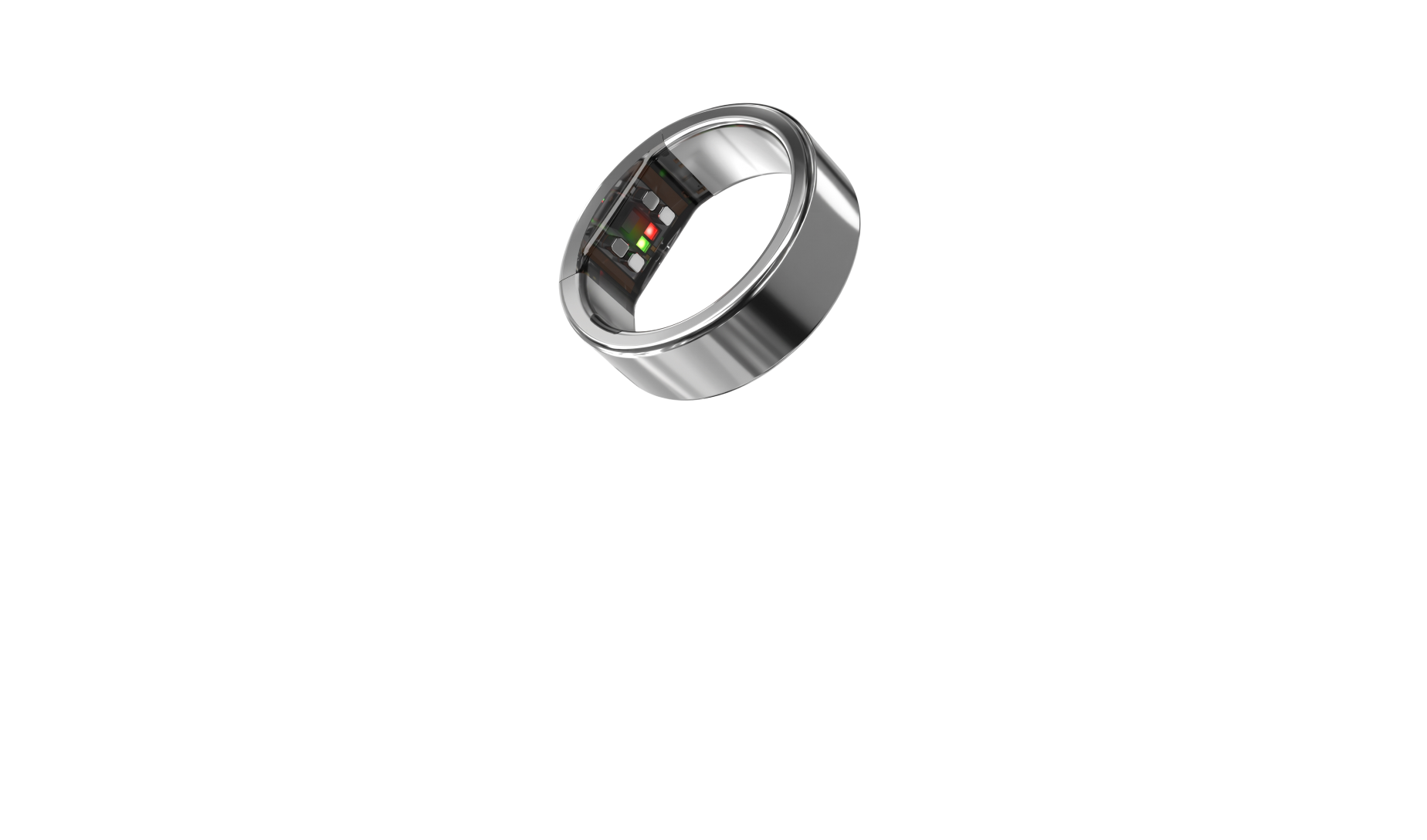
The Ring carries three sensor systems that run continuously throughout the night: an infrared photoplethysmography (PPG) sensor at the finger, a 6-axis motion sensor (3-axis accelerometer + 3-axis gyroscope), and an NTC skin-temperature thermistor.
Infrared PPG detects changes in blood volume at the finger with each heartbeat. From the PPG signal the system derives beat-to-beat heart rate and heart rate variability (HRV).
These cardiovascular signals shift in characteristic ways as the brain cycles through sleep stages: heart rate tends to be lower and more regular in non-REM sleep, HRV tends to be higher in deep sleep, and heart rate tends to be more variable in REM, though these patterns overlap across stages, which is why motion and temperature signals are also used. The signal also contains motion artifacts that the algorithm uses as a secondary movement indicator.
Motion sensor records the ring's movement using a 6-axis motion sensor (accelerometer and gyroscope), providing an actigraphy-style signal. Physical stillness is a prerequisite for any sleep stage; movement indicates wakefulness or stage transitions. The motion signal resolves ambiguous PPG windows where the cardiovascular pattern alone would not cleanly indicate wake vs light sleep.
Skin-temperature thermistor records relative skin temperature at the finger throughout the night. Skin temperature rises at sleep onset, as core temperature falls, and shows a characteristic overnight profile that tracks circadian phase.
Temperature deviation from baseline is a useful signal for detecting sleep boundaries and can help distinguish the later REM-heavy portion of sleep from early deep-sleep-heavy cycles.
The system fuses all three streams to assign a label to each epoch: awake, light sleep, deep sleep, or REM. TST is the summed duration of the sleep-labeled epochs. Sleep boundaries (when sleep starts and ends) are detected from the combined signal rather than set by the member, so the Ring reports the algorithmically estimated sleep interval.
The Ultrahuman app surfaces TST as the "Sleep Duration" figure inside the Sleep card. It also feeds the nightly Sleep Index alongside sleep efficiency (the ratio of TST to time in bed), sleep timing, and the composition of stages.
What does the research say about sleep duration and health?
A dose-response meta-analysis across prospective cohort studies found a U-shaped relationship between sleep duration and all-cause mortality and cardiovascular events.
The lowest risk sat at approximately 7 hours per night, with risk climbing on both sides: it rose modestly for each hour below 7 and more steeply for each hour above. Both short and long sleep were independently linked to higher risk (Yin et al. 2017, Journal of the American Heart Association).
This U-shaped pattern informed the expert recommendations most clinicians cite. An 18-member National Sleep Foundation consensus panel recommended 7 to 9 hours for adults aged 18 to 64 and 7 to 8 hours for adults aged 65 and older, using a structured appropriateness methodology across the full body of sleep-health evidence (Hirshkowitz et al. 2015, Sleep Health).
A detailed review of the sleep-immune crosstalk found that sleep affects the innate and adaptive immune system, and that prolonged sleep deficiency (including habitually short sleep duration and disrupted sleep) is associated with chronic, systemic low-grade inflammation and elevated proinflammatory cytokines (Besedovsky, Lange, and Haack 2019, Physiological Reviews). Sleep also appears to promote inflammatory homeostasis when duration and quality are adequate.
An independent academic study using the Ring found that wearable-derived sleep regularity indices from the Ring showed weak-to-modest agreement with the Sleep Regularity Questionnaire (Driller et al. 2026, Journal of Circadian Rhythms). More device validations and the published evidence base are collected in the Ultrahuman Science studies library.
How much do Ultrahuman Ring members actually sleep?
Across 513,543 Ultrahuman Ring members with at least 7 valid nights on record, median nightly TST is 7 hours 59 minutes (mean 7 hours 57 minutes), based on 82.7 million nights.
Figure 1
Eight in ten members average between 7 and 9 hours of sleep
TST distribution across 513,543 Ultrahuman Ring members (at least 7 valid nights each)
Eight in ten members average between 7 and 9 hours of sleep
Source: Ultrahuman Ring data, n=513,543, Oct 2022 - Jun 2026
The distribution is concentrated in the 7-9 hour range. Members averaging 7 to 8 hours of TST make up 38.9% of the cohort; those averaging 8 to 9 hours account for another 41.7%. Together, that is 80.6% of members in the range most sleep researchers consider optimal for adult health.
At the short end, 9.9% of members average between 6 and 7 hours, and 1.3% average under 6 hours per night. At the long end, 8.2% average more than 9 hours. The spread across the cohort is fairly tight (SD about 48 minutes), but within a single member's own week it can be considerably wider.
These are group averages, not a prescription for any one person. An individual member's single-night TST reading carries a typical error of about 15 minutes against an EEG reference, so trends over multiple nights, tracked by the Ultrahuman app as a rolling average, are more stable than any single night's reading.
How it shows up in the Ultrahuman app
Sleep duration appears in the Ultrahuman app under the Sleep card, labeled "Sleep Duration."
The reading updates each morning after the Ring syncs. Members can view the previous night's reading. The nightly Ultrahuman Sleep Index on the same card weights sleep duration alongside sleep efficiency, sleep timing, and sleep stage estimates.
The Sleep card shows the night's wake and sleep segmentation, sleep onset and offset, and how each night compares to the member's baseline. The Ring tracks this automatically overnight; no sleep diary or manual entry is needed.
Sleep duration is one input to the Sleep Index rather than the only metric, so a night of 7 hours of efficient sleep can score as well as 8 hours of fragmented sleep. Duration and sleep quality affect recovery independently, and the Sleep Index weights them separately. The Ultrahuman blog covers practical ways to get more quality sleep each night and how naps can add to your total sleep time.
Read the original research
All Studies →This explainer is based on original research by the Ultrahuman Science team. Read the source studies:
Frequently asked questions
What is the difference between total sleep time and time in bed?
Time in bed (TIB) is the full interval from when a person gets into bed to when they get out. Total sleep time is the subset of that interval when sleep is actually occurring. The difference equals sleep onset latency (the time to fall asleep) plus any wakefulness after sleep onset (WASO). A member with good sleep efficiency might lose only 20-30 minutes to TIB-TST difference; a member with fragmented sleep might lose 90 minutes or more.
How close is the Ring's sleep duration to an EEG home test?
In a published comparison with a single-channel EEG home sleep test (Somfit), across 20 paired nights in 4 participants, the Ring's total sleep time landed a typical 15 minutes from the reference on a given night, with an ICC of 0.844 and Pearson r = 0.889 (Driller et al. 2026). Averaged over all nights it was 1.0 minute off, so there is almost no systematic over- or under-reading, though with only 4 participants the figures are indicative rather than settled. Individual-night readings are best treated as estimates, and multi-night trends as the more reliable signal.
Why does the app show less sleep than I think I got?
The Ring excludes time in bed while awake. Brief awakenings embedded in the night, and any lying-awake periods before sleep onset or after morning waking, are classified as "awake" rather than sleep. A reading lower than your sense of how long you slept usually reflects awakenings you do not remember or a longer sleep-onset time than you recall.
How much sleep do adults need?
The National Sleep Foundation consensus recommends 7 to 9 hours of sleep per night for adults aged 18 to 64, and 7 to 8 hours for adults aged 65 and over. This recommendation is for typical healthy adults; individual variation exists, and some people function well outside this range. If you consistently feel rested and alert during the day, that is a more useful signal than any fixed target.
Can I use my nightly sleep duration reading to detect a health problem?
The Ring tracks sleep duration as a wellness metric; it is not a clinical screening tool and cannot diagnose sleep disorders or any health condition. Consistently very short or very long sleep duration can reflect many things, including lifestyle, environment, and underlying health. If you have concerns about your sleep health, bringing your Ring's trend data to a clinician provides useful context for a proper evaluation.
Does the Ring need me to set a sleep schedule?
No. The Ring detects sleep onset and offset automatically from the combined sensor signal. You do not need to start a manual sleep session or set bed- and wake-time targets for the measurement to work. The algorithm runs continuously overnight and identifies the sleep window after the fact.
Does wearing the Ring on a specific finger affect the reading?
The Ring works on any finger, and a snug fit keeps the sensors in consistent skin contact overnight. A loose fit that allows the ring to shift significantly can introduce motion artifacts that affect the PPG signal quality and, in turn, sleep classification. The Ultrahuman app surfaces a signal quality indicator to help members confirm a good fit.
References
- Yin J, Jin X, Shan Z, et al. Relationship of Sleep Duration With All-Cause Mortality and Cardiovascular Events: A Systematic Review and Dose-Response Meta-Analysis of Prospective Cohort Studies. Journal of the American Heart Association. 2017;6(9). PMID: 28889101 DOI: 10.1161/JAHA.117.005947
- Hirshkowitz M, Whiton K, Albert SM, et al. National Sleep Foundation's sleep time duration recommendations: methodology and results summary. Sleep Health. 2015;1(1):40-43. PMID: 29073412 DOI: 10.1016/j.sleh.2014.12.010
- Besedovsky L, Lange T, Haack M. The Sleep-Immune Crosstalk in Health and Disease. Physiological Reviews. 2019;99(3):1325-1380. PMID: 30920354 DOI: 10.1152/physrev.00010.2018
- Driller M, Bodner ME, Fenuta A, Stevenson S, Suppiah H. How Does the Sleep Regularity Questionnaire Relate to Wearable- and Diary-Derived Sleep Regularity? Journal of Circadian Rhythms. 2026;24:2. PMID: 42145918 DOI: 10.5334/jcr.265
This article describes associations found in population-level data and published research, not cause-and-effect relationships. Sleep tracking metrics from the Ultrahuman Ring are for general wellness purposes and are not a substitute for clinical evaluation. If you have concerns about your sleep health, speak with a qualified healthcare professional.

