



How the Ultrahuman Ring estimates Restorative Sleep
Not all sleep is created equal. Deep and REM sleep are collectively known as ‘restorative sleep’ due to their links to physical repair and memory consolidation.
Getting enough restorative sleep is essential, not only to feel rested and perform at our best, but also to protect long-term brain health and lifespan.
In this guide, we explain how the Ultrahuman Ring estimates restorative sleep, how much you should get per night, and what the science says.
Key takeaways
Restorative sleep is the sum of deep and REM sleep, the two stages with distinct physiological signatures the Ring reads through the night.
Restorative sleep makes up a larger share of the night in younger adults and declines with age.
Deep sleep is front-loaded into the first half of the night; REM grows longer toward morning, so a cut-short night trims REM the most.
Your own trend over weeks matters far more than any single night's reading.
What is restorative sleep?
Restorative sleep refers to the stages of a night that do the most active biological work: deep sleep (also called slow-wave sleep, or SWS) and REM (rapid eye movement) sleep.
Together they typically represent a little over a third of a healthy adult's night. Light sleep makes up most of the remaining time, and brief periods of wake account for the rest.
The term "restorative" reflects what each stage contributes. During deep sleep, heart rate and movement drop to their overnight low and the autonomic nervous system shifts into strong parasympathetic dominance, as measured by high-frequency heart rate variability peaking in NREM and falling again in REM sleep.
Deep sleep is also when the pituitary releases most of its nightly growth-hormone pulse, a process the research links to tissue repair and the regulation of muscle and bone mass.
During REM sleep, the brain becomes highly active and heart rate variability rises again relative to deep sleep, supporting the redistribution of newly formed memories toward long-term storage and their consolidation in the cortex. Neither stage works in isolation; a healthy night cycles through both.
How does the Ultrahuman Ring estimate restorative sleep?
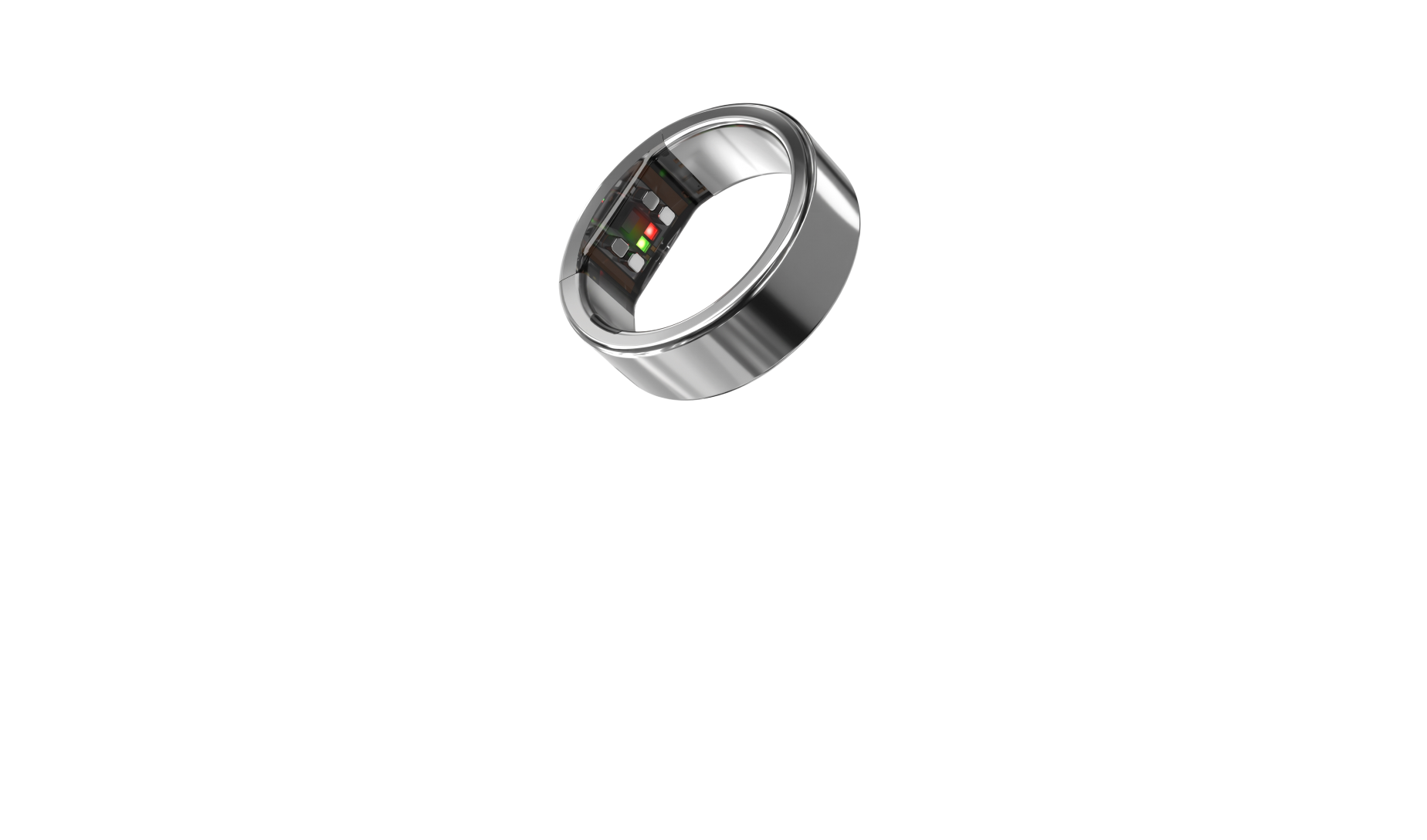
The Ring estimates restorative sleep from two signals it reads all night: pulse, captured by photoplethysmography (PPG), and movement, captured by a 6-axis motion sensor (3-axis accelerometer plus 3-axis gyroscope).
The optical sensors on the band's underside read blood-volume changes at the finger with each heartbeat, giving both a continuous heart rate and the beat-to-beat timing that underlies overnight heart rate variability. The motion sensor tracks how still or restless you are.
From these inputs, an on-device machine-learning model classifies successive epochs of the night into one of four states: Wake, Light, Deep, or REM. The classification uses the way heart rate, heart rate variability, and motion shift together through the night.
Deep sleep stages have the lowest heart rate of the night, very low movement, and the highest parasympathetic HRV signal.
REM sleep stages show low movement sustained across the period but a shift to a more variable, mixed autonomic profile, with irregular beat-to-beat timing distinct from the stable high-parasympathetic pattern of deep sleep, and occasional brief motion.
The app then adds up the deep and REM epochs and reports the total as a share of your total sleep time. That is your restorative sleep percentage.
As a review of how consumer sleep wearables work explains, devices like this read secondary physiological signals and infer the stage from the pattern. They do not record brain activity directly. The Ring estimate is a wellness measure meant to be read as a trend, not a clinical sleep study.
Why does the app report one restorative share instead of four stages?
The app shows restorative sleep as a single combined number rather than separate deep and REM percentages. That choice reflects what the sensor can and cannot reliably tell apart.
Deep and REM are the hardest pair to separate from the finger. Both show low heart rate and low motion compared with being awake, so their signatures overlap when you only have pulse and motion to work with. Reporting them separately per epoch would imply a precision the hardware does not support.
The combined share is the more stable signal. It answers "did I get enough deep and REM together?" more reliably than it answers a precise deep-versus-REM split. Even so, read it as a wellness estimate and a trend, not a clinical measurement.
This is not specific to rings. Research on multi-sensor consumer wearables has found that overall sleep duration is captured well, while stage-level estimates carry more uncertainty, especially for the stages whose physiological fingerprints sit closest together.
What does the research say about deep and REM sleep?
The published research establishes both the physiology of these stages and the age-related shape of how much of each a healthy adult experiences.
The most detailed map of normative sleep architecture across the lifespan comes from a meta-analysis of 65 studies covering 3,577 healthy people aged 5 to 102, which found that both slow-wave sleep percentage and REM percentage decline with age in adults, while lighter stages and time awake after falling asleep increase. That age gradient starts in adolescence, where older teenagers show less N3 sleep and lower slow-wave brain activity than younger adolescents.
On the physiology side, the autonomic shift across NREM and REM sleep stages is now well characterized.
A study measuring heart rate variability across NREM and REM sleep stages in daytime naps found that parasympathetic activity, measured by high-frequency HRV, peaks in NREM sleep and falls again in REM, which shows a more mixed autonomic profile.
This is why the Ring's pulse signal carries information about which stage a member is in: the autonomic pattern is different enough to be readable from the fingertip.
A separate line of research links deep sleep specifically to growth-hormone secretion and the regulation of muscle and bone mass, strengthening the case that slow-wave sleep is when much of the body's physical repair happens. And the memory work of sleep has been traced to both stages: slow-wave sleep supports the redistribution of newly formed memories from the hippocampus to the cortex, while REM sleep supports their later consolidation.
Together, this gives deep and REM a clear biological rationale as the restorative portion of the night, distinct from light sleep.
What does restorative sleep look like across Ultrahuman Ring members?
Across 279,432 external Ultrahuman Ring members, the combined restorative share of the night falls from roughly 40% in the youngest members to roughly 34% in those aged 60 and over, driven by parallel declines in both deep and REM sleep.
Deep and REM averaged about 17.0% and 23.3% of total sleep time (about 40% combined) in the 18 to 29 band, and about 14.2% and 19.5% (about 34% combined) in the 60 and over band, with the middle bands falling in between. Light sleep, which is the remainder, grows to fill the difference as age rises.
These figures come from a cohort of external members only (Ultrahuman staff excluded), counting nights where the Ring recorded a valid sleep summary, requiring at least seven such nights per member, and reporting no group with fewer than 100 members.
Figure 1
Deep and REM sleep both shrink gradually with age
Both stages decline across the lifespan, trimming the restorative share from ~40% to ~34%
Deep and REM sleep both shrink gradually with age
Source: Ultrahuman Ring data, n=279,432, Mar-Jun 2026
Within this cohort, women averaged modestly more REM sleep than men, roughly 1.5 to 2.6 percentage points across age bands. Total sleep time stayed close to eight hours across all age bands.
These are typical ranges across a large group, not a target to hit. Sitting below these averages is common and expected for plenty of people, and restorative sleep share varies widely between people of the same age. Your own trend over weeks matters far more than any comparison to a group average.
How does restorative sleep show up in the Ultrahuman app?
The Ultrahuman app surfaces restorative sleep on the Sleep card in your morning dashboard.
After each night, the card shows your restorative sleep percentage alongside the breakdown of deep, REM, and light sleep.
Tapping through reveals the stage timeline across the night, where you can see how the Ring classifies light, deep, and REM sleep and how the deep-front-loaded and REM-back-loaded structure of a healthy night actually appeared in your own recording.
Restorative sleep feeds the overnight Sleep Index, the app's 0 to 100 overnight score that also accounts for total sleep duration, timing, and continuity. A night cut short enough to trim the final REM windows lowers both the restorative share and the Sleep Index.
Members who want to go deeper on the link between sleep and recovery can pair the restorative sleep metric with overnight resting heart rate and heart rate variability, both of which the Ring records alongside stages.
The lowest overnight heart rate and the highest overnight HRV readings typically occur during the deep sleep windows, so the three metrics often tell a consistent story. For the underlying validation work, see Ultrahuman's published studies, including our study of naps and non-sleep deep rest.
How to increase restorative sleep?
To protect restorative sleep, keep a full, consistent sleep window and limit alcohol and large meals in the hours before bed. Because REM sleep concentrates in the final hours of the night, cutting sleep short trims REM the most.
Deep sleep concentrates in the first hours, so fragmented or delayed sleep onset affects it first; on the blog we cover practical ways to increase your deep sleep.
The Ring tracks both every night, turning the trend over weeks into a signal you can act on.
Read the original research
All Studies →This explainer is based on original research by the Ultrahuman Science team. Read the source studies:
Frequently asked questions
Does the Ring also track light sleep and wake time?
Yes. The Ring classifies successive epochs of the night into one of four states: Wake, Light, Deep, or REM. The restorative share shown in the app is the sum of the Deep and REM portions. Light sleep and time awake are also recorded and visible in the stage timeline when you tap through the Sleep card.
Why does the app show one restorative sleep number instead of separate deep and REM percentages?
Deep and REM are the hardest pair of stages for a ring sensor to separate at the per-epoch level because both show low heart rate and low motion relative to wakefulness, so the app reports them as one combined restorative share, a more reliable signal than two separate per-stage estimates.
How much restorative sleep is typical?
Across 279,432 Ultrahuman Ring members, the combined deep and REM share of the night averaged about 40% in members aged 18 to 29 and about 34% in those aged 60 and over. These are population-level ranges; individual variation is wide, and your own trend over weeks matters more than a comparison to an average.
Why does restorative sleep decline with age?
Sleep architecture shifts gradually across the lifespan, with both deep and REM percentages falling and lighter sleep rising. This is a well-documented, normal pattern seen in large clinical cohorts and in the Ultrahuman member data. It reflects ordinary changes in how the sleeping brain regulates its stages, not a condition to diagnose.
Is a Ring sleep estimate the same as a clinical sleep study?
No. A Ring sleep summary is a nightly estimate of sleep architecture from pulse and motion, meant to be read as a trend over time. A clinical polysomnography study records brain activity directly via EEG alongside many other signals in a supervised setting. The Ring estimate is a wellness tool; a clinical study is a diagnostic tool.
Why does deep sleep come early in the night and REM come late?
Sleep cycles rotate through light, deep, and REM sleep in roughly 90-minute blocks. The mix inside each cycle changes as the night progresses: deep sleep dominates the first two cycles, while REM windows lengthen with each successive cycle and the longest REM periods arrive in the final hours before waking. This front-loaded deep, back-loaded REM pattern is consistent across healthy adults.
What can I do to protect restorative sleep?
The most reliable approaches are those that protect a full sleep window and consistent timing. Cutting sleep short trims REM the most, because REM concentrates in the final hours. Alcohol and large meals before bed commonly suppress deep sleep. Regular wake times anchor the circadian clock that regulates stage timing. These are population-level patterns; individual responses vary, and the Ring lets you see your own.
References
- Ohayon MM, Carskadon MA, Guilleminault C, Vitiello MV. Meta-analysis of quantitative sleep parameters from childhood to old age in healthy individuals: developing normative sleep values across the human lifespan. Sleep 2004. PMID: 15586779
- Baker FC, et al. Age-Related Differences in Sleep Architecture and Electroencephalogram in Adolescents in the National Consortium on Alcohol and Neurodevelopment in Adolescence Sample. Sleep 2016. PMID: 27253763
- Kanady JC, et al. Validation of sleep measurement in a multisensor consumer grade wearable device in healthy young adults. Journal of Clinical Sleep Medicine 2020. PMID: 32048595
- Rentz LE, Ulman HK, Galster SM. Deconstructing Commercial Wearable Technology: Contributions toward Accurate and Free-Living Monitoring of Sleep. Sensors (Basel) 2021. PMID: 34372308
- Diekelmann S, Born J. The memory function of sleep. Nature Reviews Neuroscience 2010. PMID: 20046194
- AlQatari AA, et al. Changes in Heart Rate Variability and Baroreflex Sensitivity During Daytime Naps. Nature and Science of Sleep 2020. PMID: 33061723
- Stich FM, Huwiler S, D'Hulst G, Lustenberger C. The Potential Role of Sleep in Promoting a Healthy Body Composition: Underlying Mechanisms Determining Muscle, Fat, and Bone Mass and Their Association with Sleep. Neuroendocrinology 2021. PMID: 34348331
This article is for education only. The patterns described here reflect associations, not cause-and-effect. Sleep stages are estimated from your heart rate, movement and skin temperature. They are not a clinical sleep study and can't diagnose sleep disorders. If anything in your readings surprises or concerns you, bring it to a physician.

