


Menstrual cycle tracking: How the Ultrahuman Ring reads your cycle
Medically reviewed by Kate Davies, RN, BSc (Hons)
Menstrual cycle tracking follows the body signals that shift across your cycle, so you know which phase you're in and what to expect next.
The Ultrahuman Ring tracks your cycle through the Cycle and Ovulation PowerPlugs, which read skin temperature, resting heart rate, and heart rate variability. Which features you see depends on your plan and region.
In this guide, we explain how the Ultrahuman Ring reads those three signals, why that works better than counting days, and what the research says about each one.
Key takeaways
The Ultrahuman Cycle and Ovulation PowerPlugs read your cycle using skin temperature, resting heart rate, and heart rate variability.
Your temperature isn't flat across the month. It sits low in the first half, steps up after ovulation as progesterone rises, then falls back with your period.
Ovulation shows up as a cluster of changes rather than one number: temperature rising, resting heart rate ticking up, heart rate variability dipping.
Each night is scored against your own baseline for that part of your cycle. Normal means normal for you.
In an Ultrahuman pilot study, the Ring's combined read landed a median of one day from the measured hormone surge. The calendar method landed two days off.
What is menstrual cycle tracking?
Menstrual cycle tracking is any method that follows your cycle's rise and fall. The traditional approaches are counting days on a calendar, or taking your basal body temperature each morning.
A normal cycle runs from 21 to 35 days. The hormones behind it do more than govern bleeding. Estrogen climbs through the first half of the cycle. After ovulation, progesterone takes over.
Both leave marks you can measure: in your temperature, in your resting heart rate, and in how much your heart rate varies from beat to beat. A calendar sees none of that, and a single waking temperature catches only a sliver of it.
How the Ring tracks your menstrual cycle
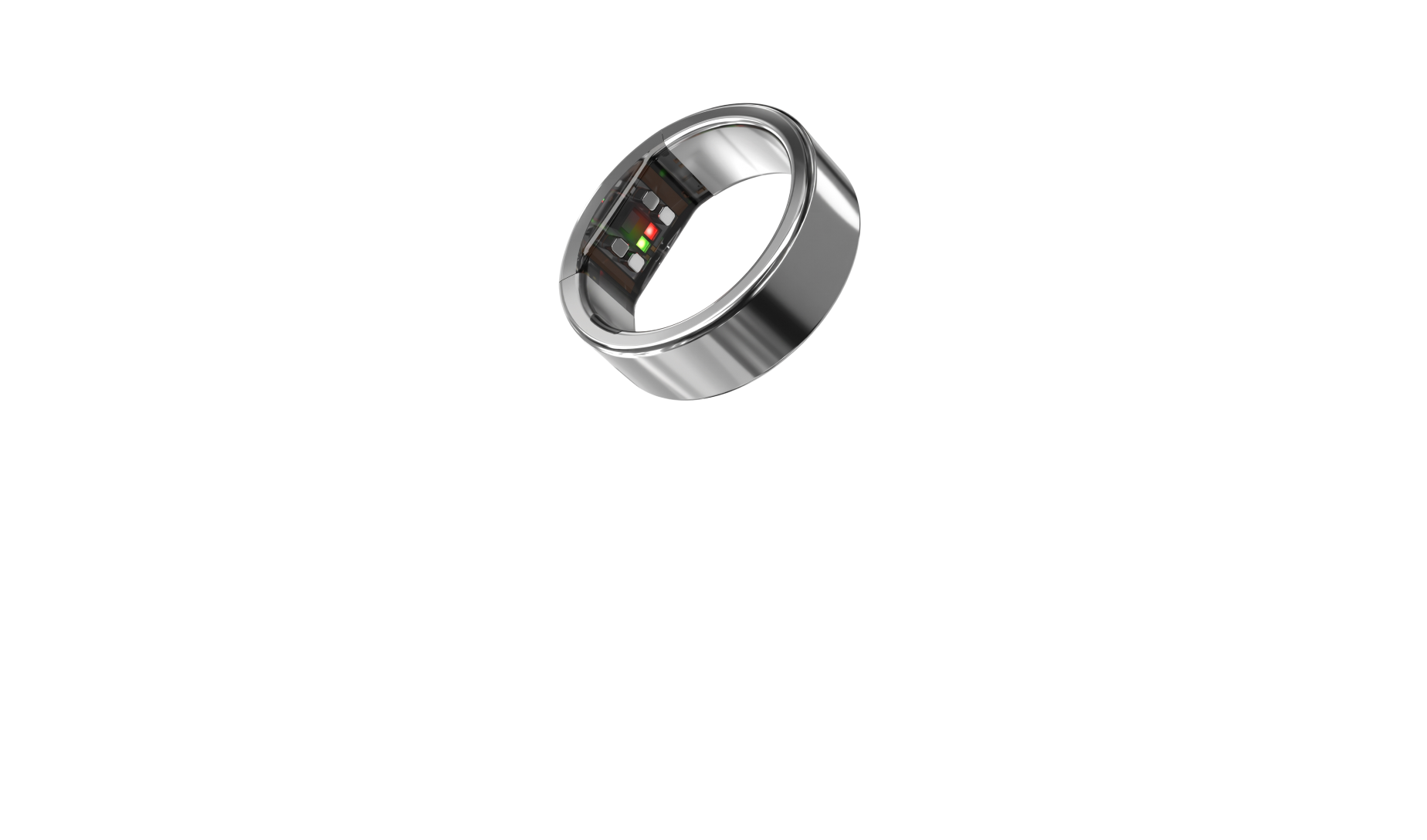
The Ultrahuman Ring tracks your cycle overnight, comparing tonight against your own pattern. A temperature sensor reads skin temperature, while the optical PPG heart rate sensor reads your pulse with light, which gives resting heart rate and heart rate variability.
During the day, movement, meals and stress swing your temperature and heart rate far more than your cycle does, so its smaller signal is lost in the noise. Asleep, most of that stops.
The Cycle & Ovulation PowerPlug learns your temperature over a 30-day baseline. What it shows depends on the goal you choose at setup:
- Cycle Tracking segments the cycle and predicts your period, reporting cycle length, period length, and regularity.
- Conception adds the fertile window: the five days before ovulation, the day itself, and the day after.
The Ring's ovulation read is powered by OvuSense™ technology, which Ultrahuman acquired with viO HealthTech and adapted to the Ring's overnight skin signal.
It predicts your period and your ovulation, confirms ovulation after the fact, and works for women with non-textbook cycles. Cycle Flags™ add further context to your cycle.
Why the Ring reads three signals rather than one morning temperature
Counting days only works while your cycles stay regular. And one temperature, taken once a day, is a thin read of a signal that moves slowly.
| Where you are | Skin temperature | Resting heart rate | Heart rate variability |
|---|---|---|---|
| First half, before ovulation | Low and steady | Lower | Higher |
| Around ovulation | Starts to rise | Ticks up | Dips |
| After ovulation, before your period | Elevated | Elevated | Lower |
Temperature-based tracking vs calendar method
In a pilot study conducted by Ultrahuman of 22 women across 48 complete cycles, temperature-based cycle tracking was more accurate than the calendar method.
The combined temperature, heart rate, and heart rate variability read landed a median of one day from the peak hormone surge, measured by a home urine test.
The calendar method landed two days off, and for women with irregular cycles and older women, the calendar's gap widened to about five days.
What the research says about cycle phase biomarkers
There is a wealth of evidence that links cycle phases to temperature changes.
In a study of 237 women wearing a wearable nightly, temperature, heart rate and breathing rate all shifted with the cycle, and a model combining them detected the fertile window with 90% accuracy.
A review of temperature regulation in women describes core body temperature running 0.3°C to 0.7°C higher after ovulation.
Skin temperature follows the same arc. Across 136 women and 437 cycles, nightly skin temperature ran about 0.3°C higher after ovulation than before it.
Figure 1
Skin temperature steps up after ovulation, and holds
The pattern the Ring reads: a cooler first half, then a sustained warmer second half
Skin temperature steps up after ovulation, and holds
Ultrahuman · idealized schematic of the published pattern, not member data
In a study of 91 women and 274 ovulatory cycles, pulse rate during sleep ran 3.8 beats per minute higher in the middle of the cycle's second half than during menstruation.
Read the original research
All Studies →This explainer is based on original research by the Ultrahuman Science team. Explore the full Studies repository.
Frequently asked questions
How long before the Ring can track my cycle?
About 30 days to learn your baselines, and a cycle or two more before predictions settle. Early predictions lean on your logged dates. Later ones lean on your physiology.
Can the Ring tell me the exact day I ovulate?
It confirms ovulation after the fact, agreeing with a home urine hormone test 92.9% of the time in a study of 22 women, and predicts a fertile window ahead of time. Confirmation is backward-looking by nature, because the temperature rise it reads follows ovulation rather than announcing it.
Can I use cycle tracking on the Ring as contraception?
No. Cycle & Ovulation is a wellness feature, not intended for contraception, conception planning or medical diagnosis. If you're choosing or changing a contraceptive method, that's a conversation with your doctor.
Does an irregular cycle break the tracking?
No, though it changes what to expect. Reading physiology holds up better than counting days when cycles are irregular, which is where date-based prediction drifts furthest. Ultrahuman's cycle research includes women with irregular cycles and self-reported polyendocrine metabolic ovarian syndrome (PMOS), until recently called PCOS.
Can the Ring tell me if I'm starting perimenopause?
No. The PowerPlug reads your cycle as it is now. It doesn't place you at a stage of a reproductive transition, and no wearable signal does that on its own. If your cycles are changing in a way that concerns you, bring the pattern to a clinician.
Will being ill throw the reading off?
It can. Infection and fever move skin temperature and resting heart rate for reasons unrelated to your cycle, and the algorithm reads the same sensors. A cycle with a week of illness in it is one to read loosely.
References
- Baker FC, Siboza F, Fuller A. Temperature regulation in women: effects of the menstrual cycle. Temperature (Austin) 2020. PMID 33123618
- Shilaih M et al. Modern fertility awareness methods: wrist wearables capture the changes in temperature associated with the menstrual cycle. Bioscience Reports 2018. PMID 29175999
- Shilaih M et al. Pulse rate measurement during sleep using wearable sensors, and its correlation with the menstrual cycle phases: a prospective observational study. Scientific Reports 2017. PMID 28465583
- Schmalenberger KM et al. A systematic review and meta-analysis of within-person changes in cardiac vagal activity across the menstrual cycle. Journal of Clinical Medicine 2019. PMID 31726666
- Goodale BM et al. Wearable sensors reveal menses-driven changes in physiology and enable prediction of the fertile window: observational study. Journal of Medical Internet Research 2019. PMID 30998226
Cycle & Ovulation describes associations in physiological data, not cause and effect. It is not a medical diagnosis, a fertility guarantee or a contraceptive method. If your cycle changes in a way that concerns you, bring it to your physician.