

How the Ultrahuman Ring detects and confirms ovulation
Medically reviewed by Kate Davies, RN, BSc (Hons)
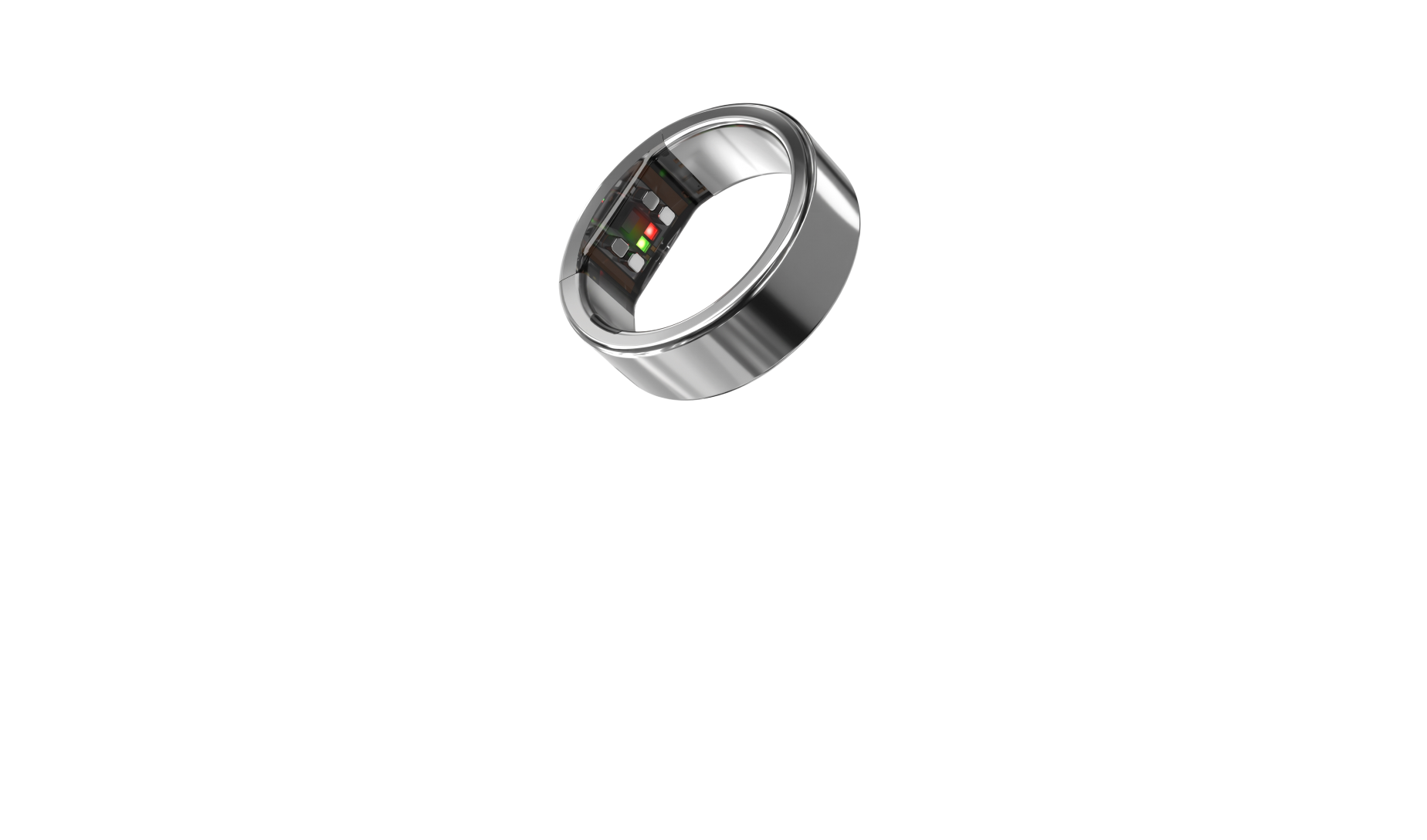
Your cycle has a temperature signature, which the Ultrahuman Ring reads while you sleep.
In this guide, we explain how Ultrahuman Ring AIR and Ring PRO spot ovulation, using your biomarkers.
We also outline what the app shows for ovulation tracking.
Key takeaways
The Ultrahuman Ring confirms ovulation from overnight skin temperature, comparing each night against your own baseline.
The Ring looks for the body’s natural rise in temperature following the release of an egg at ovulation.
Some cycles are anovulatory and never show a confirmed rise. These are marked as an anovulatory Cycle Flag™.
How it works
Cycle & Ovulation reads ovulation from the Ring's overnight skin temperature, combined with resting heart rate and HRV. What the app does with that signal varies by plan and region.
Temperature-based tracking places you in your current cycle phase and predicts your next period. If you choose the Conception goal at setup, the app adds a seven-day fertile window: the five days before ovulation, the day itself, and the day after.
Where it is included, OvuSense™ algorithms layer on top of the same overnight read for more accurate tracking, especially for non-textbook cycles. OvuSense is the technology Ultrahuman acquired with viO HealthTech. Its proprietary Cycle Flags offer added analysis and information about your cycle.
How the Ring reads your cycle overnight
When you ovulate, progesterone causes your body temperature to step up. That rise stays elevated through the second half of your cycle and drops again when your period arrives.
The Ring reads that shift from your finger while you sleep. A temperature sensor on the Ring samples skin temperature through the night.
An optical sensor reads your pulse, giving resting heart rate and HRV. Each night is scored against your own baseline.
When a run of nights settles above baseline, the PowerPlug marks the ovulation day, and predicts your next one.
How temperature moves through the cycle
Temperature tells a different story at each phase of your cycle.
| State | Overnight temperature |
|---|---|
| Your period | Falling back toward your low |
| Before ovulation, as estrogen climbs | Low and steady |
| Ovulation, when the egg is released | Rises sharply |
| After ovulation, as progesterone rises | Held higher until your period, when it returns to baseline |
Why overnight, and not a morning temperature?
Basal body temperature tracking has been around for decades. Take a manual reading before you move each morning and chart the rise.
But it’s a fragile process. A late alarm, a bad night's sleep, a glass of water or getting out of bed before you remember: any of it skews the reading.
The Ring samples multiple temperature readings while you sleep, which is a great time to take a steady, consistent reading.
For Cycle and Ovulation PRO users, Ultrahuman tested this approach directly. In a pilot study of 22 women and 48 complete cycles, the Ring's ovulation call landed a median of one day from the peak hormone surge, measured by a home urine test. Checked against a home urine test tracking four hormone metabolites (22 women), it agreed 92.9% of the time.
There is an honest trade here. A sensor worn internally reads core temperature and is the more precise instrument. Ultrahuman chose the less precise signal deliberately: a ring you already wear every night collects the data without you having to do anything, and its ovulation call still agreed with a home urine hormone test 92.9% of the time, in 22 women.
What the research says
The science behind temperature-based ovulation tracking is solid. The question has always been whether a skin sensor, rather than an internal one, can pick up the signal clearly enough to be useful.
It can. Across 136 women and 437 cycles, nightly skin temperature ran about 0.3 °C higher after ovulation than before it. Measured against a multi-metabolite hormone test, the Ring confirmed ovulation with 100% sensitivity and a 91.7% positive predictive value: when it flagged an ovulation, it was right 91.7% of the time.
A study of 57 women across 193 cycles put continuous skin temperature head-to-head against basal body temperature charting. Skin temperature detected ovulation with a sensitivity of 0.62; the chart managed 0.23. Put simply, the chart misses about three ovulations in four.
The toughest test is in cycles that are hardest to read. A study of 80 women with ovulatory dysfunction across 205 cycles found OvuSense's own skin-worn sensor was 66% accurate on a composite measure: the ovulation day within one day either side, or correctly flagging its absence. Against an internal core-temperature sensor, it reached 90% accuracy for the fertile window, defined in that study as the ovulation day plus or minus three days. The authors noted the skin sensor could not pin the exact day of ovulation with precision.
Cycles with no confirmed rise
A cycle without a confirmed ovulation day is more common than most people realize. In an Ultrahuman dataset of 1,297 cycles from 1,163 women aged 20 to 50, a missing temperature rise was the strongest single marker of an irregular cycle across every age group, running roughly three to four times more common in irregular cycles than regular ones. The dataset included women with polyendocrine metabolic ovarian syndrome (PMOS, until recently called PCOS).
If your Ring doesn't call a rise this month, it could mean no egg was released, or the temperature step was too subtle to confirm. In some plans and regions this is recorded as an anovulatory cycle. Illness, travel, and disrupted sleep all impact on ovulation and cycle patterns.
How it looks in the app
Cycle & Ovulation shows your cycle as a calendar, with the confirmed ovulation day marked once the Ring has seen enough consecutive nights to be confident. The Cycle Tracking page carries the temperature graph, with Temp, HRV and RHR tabs.
When your temperature pattern departs from your own normal in an unusual way, the app can raise a Cycle Flag: a rise that stalls early, or one that starts high and falls back before your period.
A flag is worth noting, not worrying about. If you consistently notice cycle flags, discuss this with your clinician. Depending on your plan and region, you can export your Cycle Report, covering your last six cycles, as a PDF to take to a doctor's appointment.
Read the original research
All Studies →This explainer is based on original research by the Ultrahuman Science team. Read the source studies:
Frequently asked questions
How long before the Ring can confirm ovulation?
About 30 days to build your baselines, and a cycle or two more before the pattern settles. Until then, it uses the dates you log.
Can the Ring predict the fertile window before ovulation?
Yes, as a prediction, not a confirmation. With the Conception goal selected at setup, the app puts a seven-day window ahead of you based on your baselines and logged dates. The confirmation of ovulation that follows shows you how accurately it landed.
Why didn't my Ring confirm ovulation this month?
Either no egg was released, or the temperature step was too small to call with confidence. A disrupted night, illness, or travel can all interfere with the read.
Is skin temperature the same as basal body temperature?
No. Basal body temperature is one oral reading taken before you've moved or eaten in the morning. Skin temperature is read at your finger across the whole night. Both track the same hormonal arc; the overnight read just draws on the whole night rather than a single morning reading.
Can I use this to avoid pregnancy?
No. Cycle & Ovulation is a wellness feature, not a contraceptive method. It isn't designed for conception planning or medical diagnosis either. If you're choosing contraception, that's a conversation for your doctor.
References
- Shilaih M, Goodale BM, Falco L, Kübler F, De Clerck V, Leeners B. Modern fertility awareness methods: wrist wearables capture the changes in temperature associated with the menstrual cycle. Bioscience Reports 2018. PMID 29175999
- Zhu TY, Rothenbuhler M, Hamvas G, et al. The Accuracy of Wrist Skin Temperature in Detecting Ovulation Compared to Basal Body Temperature. Journal of Medical Internet Research 2021. PMID 34100763
- Hurst BS, Davies K, Milnes RC, et al. Novel Technique for Confirmation of the Day of Ovulation Using a Skin-Worn Sensor in a Population With Ovulatory Dysfunction. Frontiers in Bioengineering and Biotechnology 2022. PMID 35309997
Cycle & Ovulation describes associations in physiological data. It is not a medical diagnosis, a fertility guarantee, or a contraceptive method. If your cycle changes in a way that concerns you, speak to your physician.