


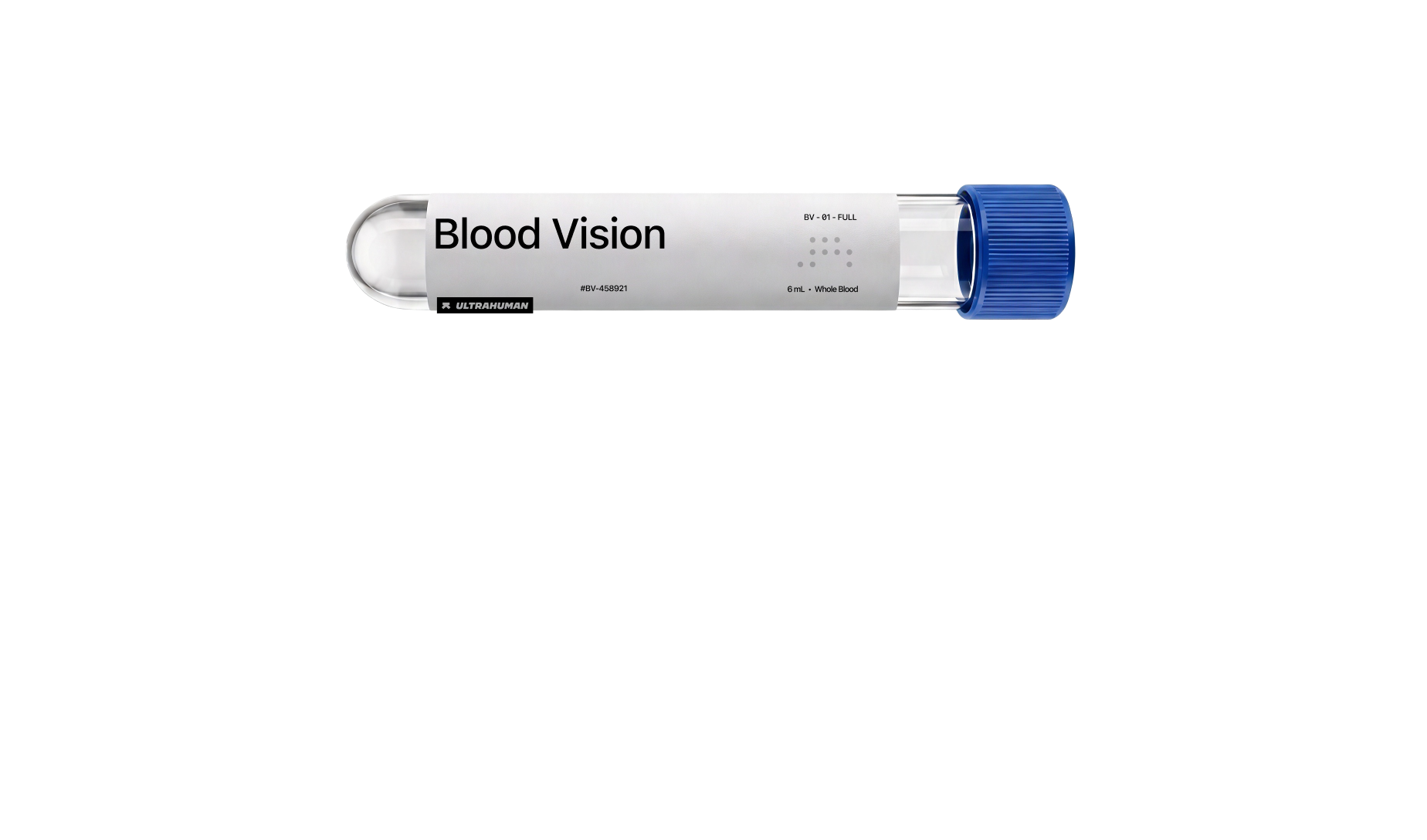




Blood Vision Vitamin and Mineral Panel explained
Medically reviewed by Mukul Mittal, MD
The Blood Vision Vitamin and Mineral Panel measures the micronutrients behind your energy, sleep, and well-being.
It's one of the most directly useful tests you can take: low levels are common, they're a frequent cause of unexplained fatigue, and a low result usually tells you what to do next.
Blood Vision turns the result into a clear next step. Most low markers come back with a supplement suggestion and a dose. A few come back as a reason to ask your doctor why the level is low, which is just as useful an answer.
In this guide, we explain which markers are measured, why one number on its own can mislead you, and how to act on your results.
Key takeaways
The panel covers what your body needs in small amounts and mostly can't make: vitamin D, B12, folate, iron and minerals such as magnesium.
Vitamin D is the marker most often low. Roughly 4 in 10 US adults tested below the deficiency threshold in a national survey.
Every low marker comes back with a next step. Sometimes that is a supplement and a dose, sometimes a reason to ask your doctor why the level is low.
The Vitamin and Mineral Panel markers
Micronutrients are the vitamins and minerals your body needs in small amounts. Food supplies most of them, sunlight supplies vitamin D, and supplements can fill the gaps.
The useful markers are the ones where the blood level reflects what your body has actually stored. That isn't true of every micronutrient, which is why a good panel is selective rather than exhaustive.
- Vitamin D: The cleanest marker of the group. Your blood carries a stable storage form, 25-hydroxyvitamin D, which tracks what you've banked over recent weeks. One reading means something on its own.
- Ferritin: Iron in storage, so it drops first when you start running down. The catch is that ferritin also rises with inflammation, an infection, or a heavy training block. It can look reassuring in a body that is inflamed and short of iron at the same time.
- B12: Has the opposite problem. Serum B12 counts what's circulating, not what's reaching your cells, so a result can land in the normal band while your cells are still short. This is why a second marker matters more here than anywhere else on the panel.
- Folate: Works alongside B12 to build red blood cells. The two are read together because folate can correct the anemia caused by a B12 shortfall while the underlying B12 problem continues.
- Magnesium: The hardest to read. Most of your magnesium sits in bone and inside cells, and only a sliver circulates in blood, so a serum result can land mid-range while stores are low.
- Calcium: Tightly regulated by your body, which holds blood levels steady almost regardless of intake. It's more useful as a check on that regulation than as a measure of how much calcium you're getting.
Shortfalls in these are common, and can lead to tiredness, broken sleep, or a resting heart rate sitting higher than it used to. Many are straightforward to correct with diet or supplements. Others are worth explaining before correcting, so knowing where you're low is where the useful conversation starts.
Why the markers are read together
One micronutrient number read alone can point the wrong way. The first Blood Vision draw covers more than 100 biomarkers, with follow-up panels covering over 60, and that breadth is what lets the vitamins and minerals be read in context.
Three choices in how the panel is built do most of that work.
- Inflammation markers ride on the same draw: C-reactive protein, a blood marker of inflammation, sits next to ferritin. A high ferritin with a high C-reactive protein reads as inflammation. The same ferritin with a quiet inflammation marker reads as iron.
- The B12 read is doubled up: Blood Vision carries methylmalonic acid alongside serum B12. It's a compound that builds up when cells are genuinely short of B12, so it catches the shortfall serum B12 alone misses.
- Panels are curated by biological sex: Iron and ferritin carry more weight for menstruating women, whose monthly losses are the most common reason a store runs down. When that reason does not apply, in men and in women past menopause, a low store is worth asking a doctor about.
Some low results are a gap to fill. Others are a question to answer. A vitamin D that dips over winter is the first kind, and you top it up. Low iron stores in a man, or in a woman past menopause, are the second. There the level matters less than what is drawing it down. Taking iron can settle the number while leaving the reason unfound.
What the research says
Research shows that there are common micronutrient deficiencies, and that understanding and monitoring these can provide positive outcomes.
An Ultrahuman case report shows what that looks like. One member turned up with a ferritin of 11.5 ng/mL and hemoglobin of 10.2 g/dL. She also reported heavy menstrual bleeding, which explained where the iron was going. She had a resting heart rate running about 5 bpm higher at night and 8 bpm higher by day, and both settled once the iron was corrected. That is a single case, not a pattern.
A pooled project analyzed 8 surveys of women of reproductive age, covering 24,844 women. Once ferritin was adjusted for inflammation, the estimated share of women with depleted iron stores rose by 2 to 8 percentage points.
In menstruating women with normal hemoglobin, iron supplements work. A trial randomized 198 of them, all with a ferritin under 50 µg/L and a complaint of tiredness. Over 12 weeks, fatigue scores fell 47.7% on iron against 28.8% on placebo.
In another study of 4,495 US adults sampled by a national health survey, 41.6% had a vitamin D level at or below 20 ng/mL.
Medicines shift markers too. Metformin is one of the most widely used blood-sugar medicines, and has been shown to impact B12 levels. In a long-term follow-up of a diabetes prevention trial, low or borderline-low B12 at five years reached 19.1% in the metformin group against 9.5% on placebo.
How to read your results in the app
Your results land in the Ultrahuman app as a dashboard sorted by body system, not as a lab PDF. Each marker carries a color: optimal, borderline, or needing attention. Tap a marker to see its value, its range, and how it has moved since your last draw.
UltraTrace links the panel to the rest of your data. It sets each blood marker against your Ultrahuman Ring signals, including sleep, movement and recovery, plus glucose from the CGM if you wear one. A low ferritin then sits beside the resting heart rate it may be lifting, rather than in a separate report.
Anything that comes back low is matched to a next step, which may be a supplement and a dose. Some results are better answered by finding the cause first, such as low iron stores in men and in women past menopause. The app also produces an AI clinician summary, which is the right thing to bring to a doctor if a result surprises you.
Read the original research
All Studies →This explainer is based on original research by the Ultrahuman Science team. Read the source studies:
Frequently asked questions
How often should I test my vitamins and minerals?
Most of these markers move over weeks to months, not days. An annual draw suits a stable baseline, and a repeat after roughly three months makes sense if you've changed a supplement or are correcting a low result. Testing more often than that mostly measures noise.
Do I need to fast before a vitamin and mineral panel?
Not for the vitamins and minerals themselves. Fasting matters for the metabolic markers that usually share the draw, such as glucose and insulin, so follow the instructions that come with your kit. Biotin supplements are the exception worth flagging, because high doses can distort some lab assays.
Can my Ultrahuman Ring measure vitamin D or iron?
No. The Ring reads sleep, movement, skin temperature and heart signals from your finger. Micronutrient levels need blood, which is what Blood Vision is for. What the Ring can show is the downstream signal, such as a resting heart rate that drifts up while an iron store runs down.
What does a low-normal result actually mean?
You're inside the reference range but near its floor. Reference ranges describe how a general population distributes, not where you personally feel best. A low-normal result is a reason to look at the trend on your next draw rather than a verdict.
Should I start a supplement based on one panel?
That depends on which marker is low, and sometimes the more useful first step is finding out why. A mildly low vitamin D in winter is straightforward to top up. Low iron stores are different in men, and in women past menopause, because the usual monthly cause does not apply. There the question is what is running the store down, and starting iron can hide it. The panel gives you the number and a suggested dose, and results like those are worth taking to your doctor first. Check with your doctor too if you take prescribed medication that a supplement could interact with.
Why did my ferritin rise after a hard training block?
Heavy training raises inflammation for a while, and ferritin rises with it. That climb isn't new iron. Reading ferritin alongside an inflammation marker, and testing when you're rested rather than mid-block, keeps the picture honest.
References
- Forrest KYZ, Stuhldreher WL. Prevalence and correlates of vitamin D deficiency in US adults. Nutrition Research 2011. PMID 21310306
- Namaste SM et al. Adjusting ferritin concentrations for inflammation: Biomarkers Reflecting Inflammation and Nutritional Determinants of Anemia (BRINDA) project. The American Journal of Clinical Nutrition 2017. PMID 28615259
- Vaucher P et al. Effect of iron supplementation on fatigue in nonanemic menstruating women with low ferritin: a randomized controlled trial. CMAJ 2012. PMID 22777991
- Costello RB et al. Perspective: the case for an evidence-based reference interval for serum magnesium. Advances in Nutrition 2016. PMID 28140318
- Aroda VR et al. Long-term metformin use and vitamin B12 deficiency in the Diabetes Prevention Program Outcomes Study. The Journal of Clinical Endocrinology and Metabolism 2016. PMID 26900641
Blood Vision describes associations in biomarker data, not cause and effect. It is not a medical diagnosis. If a result sits well outside the usual range or something feels off, read the panel with your physician.