


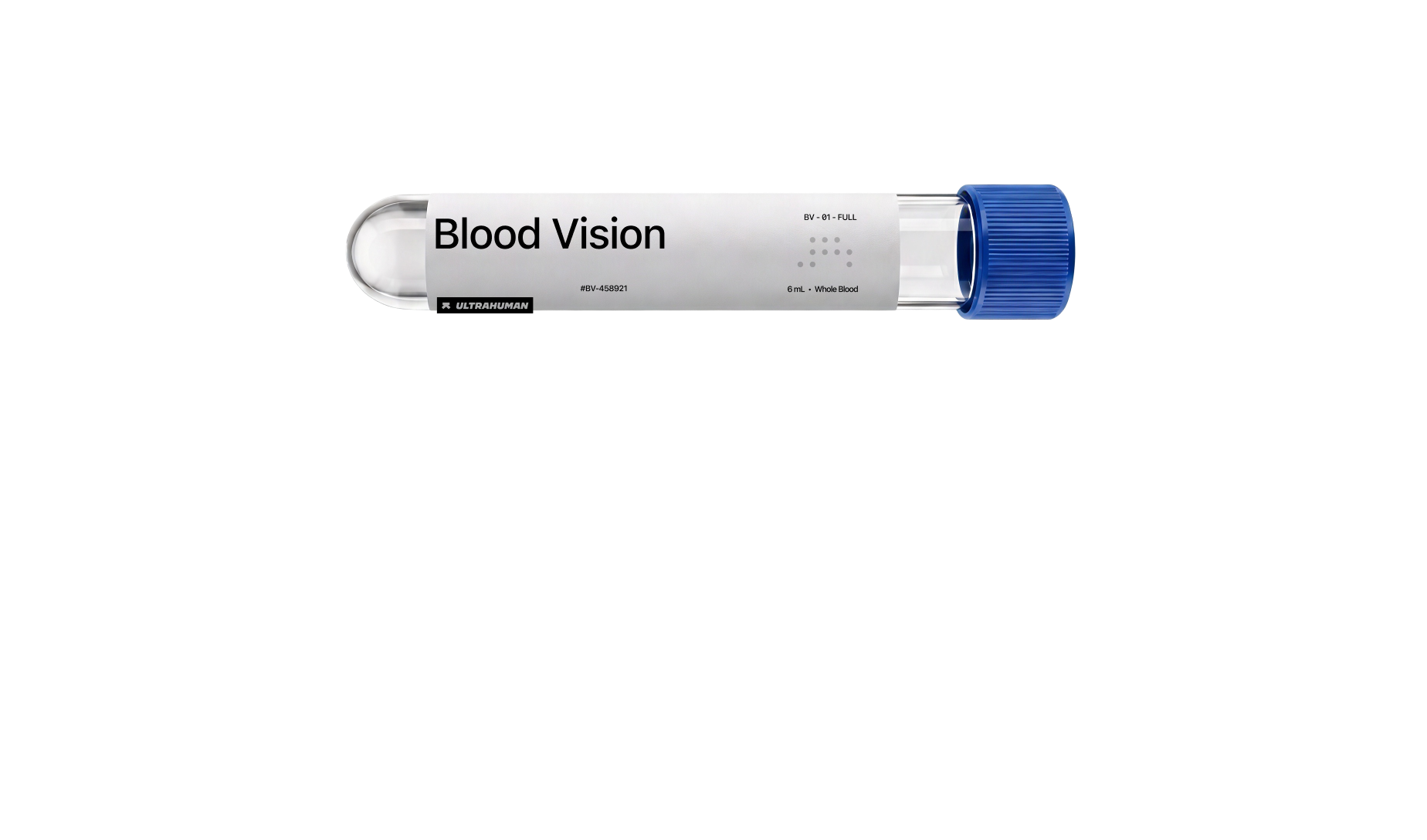





Blood Vision Heart Health Panel: ApoB vs LDL cholesterol
Medically reviewed by Mukul Mittal, MD
The Blood Vision Heart Health Panel measures your risk of heart disease, but in addition to LDL, it includes ApoB, an emerging marker for cholesterol that standard tests miss entirely.
Apolipoprotein B (ApoB) is often assumed to be another version of your LDL cholesterol number, but the two measure different things.
In this guide, we explain the difference between ApoB and LDL cholesterol, what else the panel reports, and how often the two numbers disagree.
Key takeaways
The Heart Health Panel reports ApoB and lipoprotein(a) next to the standard cholesterol numbers.
ApoB counts the particles that build plaque. LDL cholesterol weighs the cholesterol they carry, so two people with the same LDL can be carrying very different particle counts.
A normal LDL result isn't automatically an all clear. About 1 in 4 Ultrahuman members with both markers on one panel had normal LDL cholesterol alongside elevated ApoB.
Lipoprotein(a) is set largely by the genes you inherit, so a single reading usually tells you what you need to know.
What is the difference between ApoB and LDL cholesterol?
The difference is what each number measures. Every particle that can build plaque carries exactly one ApoB protein, so an ApoB result is a headcount of those particles. LDL cholesterol is a weight: the cholesterol packed inside the LDL particles.
Think of trucks on a road. LDL cholesterol tells you how much cargo is moving. ApoB tells you how many trucks are moving it. The artery wall responds mainly to how many trucks arrive, though what each one carries matters too.
The two numbers can disagree for more than one reason. The most common is particle size. Small particles carry less cholesterol each, so someone with many small particles can post an ordinary LDL result while running a high particle count. They also part ways when triglyceride-rich particles are high, because those add to the ApoB count without adding much to LDL cholesterol. The reverse pattern, high LDL with low ApoB, exists too and is much rarer.
The Heart Health Panel markers
The panel brings the particle count, the familiar lipids and one inherited marker into a single result.
- ApoB: The total number of plaque-forming particles in circulation.
- LDL cholesterol: The cholesterol carried inside LDL particles.
- Non-HDL cholesterol: All the cholesterol outside HDL, which captures the broader plaque-forming pool. A standard panel gives it for free.
- Lipoprotein(a), or Lp(a): An inherited, ApoB-carrying particle that adds risk of its own. It's reported separately because your level is set by your genes rather than built up day to day.
- Triglycerides: Fat carried in the blood, mostly in particles that also carry ApoB.
- HDL cholesterol: Cholesterol in particles that carry no ApoB.
Why the panel adds ApoB and Lp(a)
A standard cholesterol test can read normal while the particle count doesn't. ApoB is on the panel because, in most studies, it tracks heart risk more closely than LDL cholesterol does, and risk follows ApoB whichever lipid happens to move. The picture is less clear-cut in people already taking statins, where non-HDL cholesterol outperformed ApoB, and ApoB and LDL cholesterol tracked risk too closely to tell apart.
Lp(a) is there for a different reason. It's largely inherited, so it stays flat through the changes that move the other numbers, and diet and exercise barely touch it. That makes it a one-time reading, and it's invisible on a standard cholesterol test.
What the research says about ApoB vs LDL cholesterol
The two markers have been compared head to head, and ApoB holds up as the most revealing number, even though it's missing from most cholesterol tests.
A meta-analysis of 12 studies covering 233,455 people ranked all three markers against heart attacks and strokes. ApoB predicted them best. LDL cholesterol, the number most doctors order, came last.
Across 654,783 people, those who inherited gene variants lowering their triglycerides and those who inherited variants lowering their LDL both had less heart disease. The protection came from the drop in ApoB. Lowering either lipid only helped as far as it brought the particle count down with it.
In 27,533 healthy women followed for 17 years, the two markers disagreed in one in five. In those cases ApoB tracked risk better than LDL cholesterol did, though non-HDL cholesterol tracked it slightly better still. Women whose LDL cholesterol fell below the group's midpoint while their ApoB sat above it had about two and a half times the heart risk. After adjusting for HDL cholesterol and triglycerides that gap narrowed, but it held.
Lp(a) has its own evidence. In the Copenhagen City Heart Study, the highest 5% for Lp(a) had 2.6 times the heart attack risk of the bottom fifth. Inherited gene variants showed the same pattern across 40,486 Danes, which points to Lp(a) causing the risk rather than traveling alongside it.
How often ApoB and LDL cholesterol disagree
Often enough that the pair is worth reading together.
Ultrahuman looked at 3,087 members whose Blood Vision panel carried both markers between August 2025 and April 2026, using simplified wellness thresholds of LDL cholesterol below 130 mg/dL as normal and ApoB at 90 mg/dL or above as elevated. On those, 799 members (26%, or about 1 in 4) had normal LDL cholesterol with elevated ApoB. Clinical guidelines set risk-based targets that can run lower for people with added risk factors.
The disagreement was lopsided. Of the 858 panels where the two markers disagreed, 799 were the hidden ApoB pattern and 59 ran the other way. When these two numbers part company, it's usually LDL cholesterol reading low while the particle count reads high. That's the case the panel exists to catch.
This is a snapshot of members who chose to test rather than a population survey, and it doesn't say what any one result means for you.
How to read your results in the app
Blood Vision presents the panel as one heart health card. ApoB and Lp(a) appear next to LDL cholesterol, triglycerides and HDL cholesterol, each with its reference range and trend across repeat panels.
The trend is the part worth watching, because a single lipid result moves with recent meals, illness and the lab that ran it.
Two sibling panels answer questions this one doesn't. The Blood Vision metabolic panel covers blood sugar, and the inflammation panel covers the low-grade inflammation markers that sit beside lipids in heart risk.
Read the original research
All Studies →This explainer is based on original research by the Ultrahuman Science team. Explore the full Studies repository.
Frequently asked questions
Do I need to fast before an ApoB test?
ApoB doesn't need a fast the way triglycerides do, because the particle count changes little after a meal. Many labs still ask for one so the whole panel is comparable. Follow your kit's instructions, and keep the conditions the same each retest.
Is a high ApoB with a normal LDL a diagnosis?
No. It's a pattern on one lab report, and it tells you the familiar number is saying less than it appears to. What it means for you depends on your age, family history and overall risk profile, which is a conversation for a clinician.
Can I lower ApoB?
Yes. Cutting saturated fat, adding soluble fiber, losing excess weight and moving more all push ApoB in the right direction, because they act on the same particles LDL does. When ApoB is high enough to need treatment, a statin is usually the most effective way to bring it down. Whether you need one is a decision for a doctor.
Why is Lp(a) only measured once?
Because it barely moves. Your level is set mostly by the LPA gene you inherit, and it stays roughly stable through adult life. It can drift a little, and conditions like kidney or thyroid disease can shift it, but for most people one measurement is enough.
Is a very low ApoB always better?
Lower is generally the direction the evidence points, but a number isn't the whole story. A very low result alongside symptoms, unexplained weight loss or an unusual pattern across the rest of the panel is worth a doctor's look.
How is this different from the cholesterol test my doctor already ran?
A standard cholesterol test reports total cholesterol, LDL cholesterol, HDL cholesterol and triglycerides. The Heart Health Panel adds ApoB and Lp(a) on top, neither of which appears on a standard test.
References
- Sniderman AD et al. A meta-analysis of low-density lipoprotein cholesterol, non-high-density lipoprotein cholesterol, and apolipoprotein B as markers of cardiovascular risk. Circ Cardiovasc Qual Outcomes 2011. PMID 21487090
- Ference BA et al. Association of triglyceride-lowering LPL variants and LDL-C-lowering LDLR variants with risk of coronary heart disease. JAMA 2019. PMID 30694319
- Mora S, Buring JE, Ridker PM. Discordance of low-density lipoprotein (LDL) cholesterol with alternative LDL-related measures and future coronary events. Circulation 2014. PMID 24345402
- Kamstrup PR et al. Genetically elevated lipoprotein(a) and increased risk of myocardial infarction. JAMA 2009. PMID 19509380
- Boekholdt SM et al. Association of LDL cholesterol, non-HDL cholesterol, and apolipoprotein B levels with risk of cardiovascular events among patients treated with statins: a meta-analysis. JAMA 2012. PMID 22453571
Blood Vision describes associations in biomarker data, not cause and effect. It is not a medical diagnosis. If a result sits well outside its usual range or surprises you, bring it to your physician.